
Advances in technology have allowed medical professionals and researchers to do more to combat disease than ever before. In some cases that is reactive, as treatments have been honed to maximum efficiency. More and more, though, experts are using the technology to identify diseases before they even start.
In either case, data is an important factor. Here’s a look at some of the work researchers are doing when it comes to this type of early detection, and the role data plays in helping them zero in on symptoms or the people who might need the extra attention.
Can technology help identify diseases before they start?
Using data to identify those susceptible to certain diseases is nothing new. Family history and environmental factors have always factored in to medical care and the kinds of records doctors and other healthcare professionals depend upon. New technology, though, has presented those healthcare workers with more tools and better information. Artificial intelligence plays a big role in terms of how much information can be processed, but in order for the AI to do its job, the right data needs to be gathered and used.
What data are experts using to identify dementia?
One example is the work researchers are doing around Alzheimer’s. They are trying to predict patients’ likelihood of developing dementia and track shifts in their brain health long before they show symptoms of cognitive decline. To do this they test more than 100 variables related to speech, such as muscle movements, and then that information is compared with known biological risk factors for Alzheimer’s. The researchers at Mass General Brigham University of Health Professions in Boston report that in preliminary results, speech-related data was better than cognitive testing in identifying Alzheimer’s risk in cognitively unimpaired older people.
Factors such as how fast people talk, how often they pause, and how complex and varied their vocabulary is can all be collected and tracked, and researchers have their eye on this information being collected and tracked throughout someone’s life to predict dementia risk. Researchers are also doing experiments tracking speech in multiple languages from different parts of the world.
What does an analytics solution do?
None of this work is possible without data, but that information by itself is only worth so much. The right analytics solution can help make sense of the immense amount of data healthcare facilities are dealing with in order to produce results. In this particular case, tools are used to compare and contrast the speech data points with markers indicating possible signs of Alzheimer’s. An analytics tool can be used for more, including identifying which patients are candidates for this type of analysis.
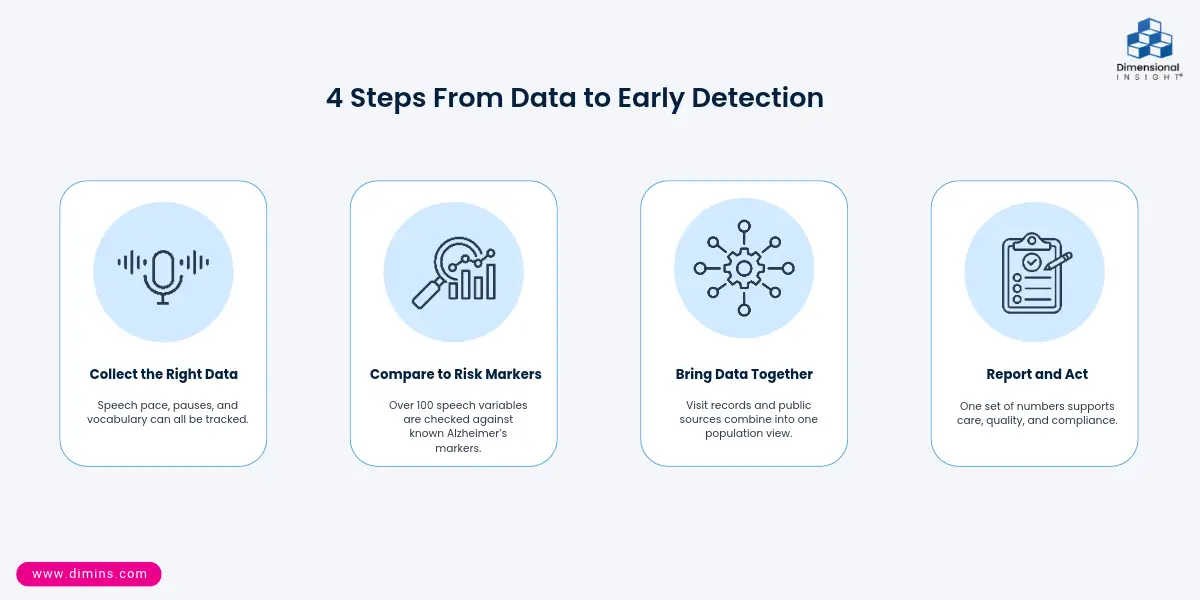
That kind of population health data is constantly being gathered in the healthcare industry, whether it is through patient visits or through newer information-gathering techniques such as sifting through social media posts to determine if there is an outbreak of some kind in a particular area. An analytics solution can help a health organization bring all of this information together to produce reports that can help decision-makers figure out a course of action to ensure patients are receiving the best possible care.
The right analytics solution is flexible, able to use that information to standardize reporting across an organization, even if it is spread out in different parts of a city, state, or the country. The same information can also be used for multiple purposes. The data that informs the best care can also be used for quality and compliance reporting, both inside and outside the organization.
For healthcare organizations looking to provide their patients with the best care, an analytics solution can not only help administrators make the best possible decisions, it can also make certain processes more efficient, helping to ease the burden on doctors and nurses. Used the right way, analytics can help identify the patients who might be susceptible to certain diseases later on. At the very least, analytics can save a healthcare organization time. In many ways, though, it can also save lives.

- Using Analytics to Predict Diseases - November 24, 2026
- How Data Helps with the Smallest Supply Chain Adjustments - November 19, 2026
- How Data Drives Automotive Manufacturing - November 5, 2026