
The first thing many people think of when it comes to healthcare is something like a visit to a doctor. While that is certainly an important part of healthcare, the industry covers so much more than that. Important work is being done in everything from finding new medications to making healthcare more affordable.
Data is at the center of all aspects of the healthcare industry, including the decisions that lead to those types of major changes. Here are a couple of recent instances where data has played a role in changes meant to improve people’s lives. Let’s take a look at the decisions themselves, and how analytics factors in.
Changes to long-term care insurance
Washington has unveiled a state-operated program for long-term care insurance, the first in the country to do so. The WA Cares Fund provides coverage for all workers in the state through a surcharge on the state payroll tax. Nearly 4 million workers participated last year, and those who contribute for 10 years qualify for a lifetime benefit of $36,500. Participants who move out of state can still get the benefits.
Other states are watching the Washington program with interest. Long-term care is expensive, and the growing price of stand-alone insurance policies has resulted in fewer Americans buying them. Healthcare organizations rely on insurance data for a variety of reasons – a major change could result in changes to the way they analyze that data.
Increasing population health by decreasing mosquito presence
One of the effects of climate change is that it has created conditions in Brazil in which mosquitoes thrive. The type of mosquito that carries dengue is one such mosquito, and in 2024 dengue infected more than 10 million people in Brazil, killing more than 6,000. That was about 4 times any previous death toll, and in the city of Belém, it was seven times higher.
Belém used data to identify the most vulnerable areas, mapping down to the street level the areas hit hardest by dengue. Researchers also looked at data from the city’s entomology lab on mosquito larvae and egg traps to gauge the size of the mosquito population. They used this information to understand where to employ mitigation efforts, including the placement of larvicide dispensing buckets aimed at controlling the mosquito population.
A flexible solution
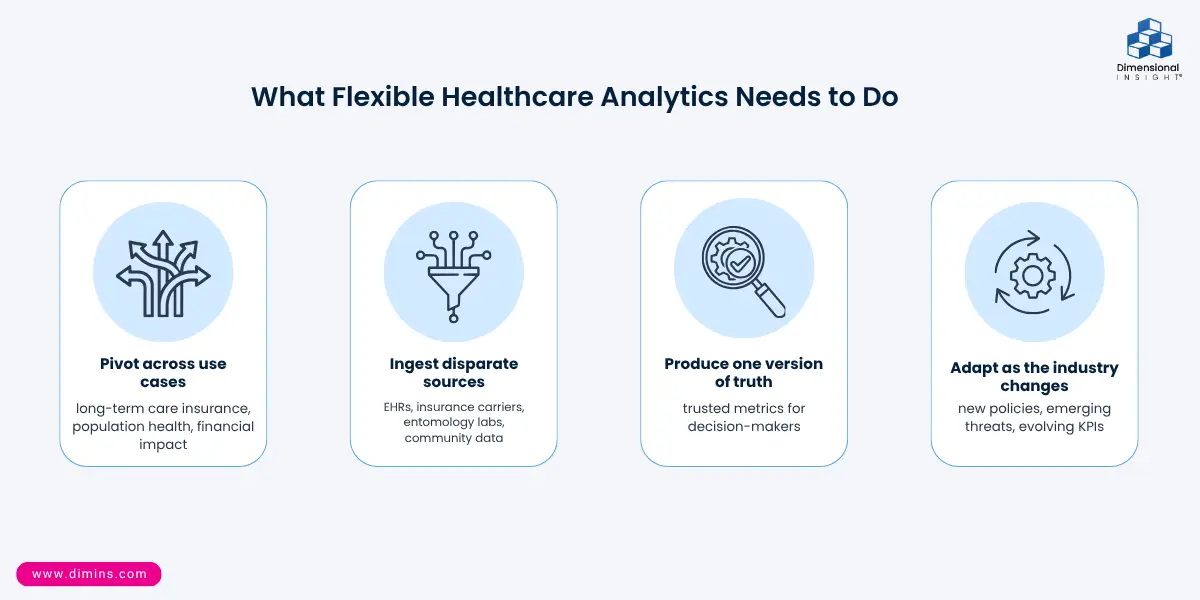
There are always going to be advancements in healthcare that can change your approach to data. The way health officials are treating dengue in Belém is similar to how health organizations around the world approach any threat to community health. When enough progress is made against one threat, they need to be able to move on to the next one. Similarly, if the WA Cares model does indeed catch on in other states, it will change the way healthcare organizations approach long-term care insurance.
In order to be able to keep up with such advancements, healthcare organizations need a flexible analytics solution. The solution has to be able to pivot from one aim to the next, and it can’t stop working just because insurance information is coming from a different source. The best solutions can work with data from all kinds of sources, whether that’s different insurance policies or being able to pivot from one population health metric to another.
These are just two examples of any number of situations where data can make a difference in healthcare. Organizations can use analytics to compare performance across a network, track key performance indicators, or monitor the financial impact of care decisions in real time. To do all of that, though, they need reliable data. The right analytics solution is one that can bring together data from disparate systems – whether that is from different buildings within an organization or from outside sources – and produce one single version of truth that decision-makers can trust.
Data can help improve health outcomes, but only if it is used correctly. A reliable analytics solution can pinpoint where conditions increase the likelihood of a certain disease, or it can be flexible if insurance coverage changes force modifications to certain data points. The best analytics solutions can do both, while still allowing for the use of data to address many other needs. Those needs are constantly changing as the healthcare industry continues to make advancements to help keep people healthy.

- Proper Data Governance Prevents Data Slop - October 8, 2026
- Tracking Shipping Price Changes with Analytics - October 1, 2026
- AI: The Good, The Bad (and Scary), and the Analytics - September 24, 2026