
Healthcare organizations have invested millions in electronic health record platforms such as Epic, Oracle Health, and MEDITECH. These systems have evolved far beyond clinical documentation, offering reporting tools, analytics applications, data warehouses, and increasingly sophisticated AI capabilities.
As a result, many healthcare leaders assume that implementing an EHR will also solve their analytics challenges. Yet organizations continue to struggle with familiar questions.
- Why does Finance report one length-of-stay number while Operations reports another?
- Why do quality measures change depending on which dashboard someone opens?
- Why do report requests require weeks of validation before leaders trust the results?
At Dimensional Insight, we’ve spent years working with healthcare organizations facing these challenges. What we’ve found is that the problem is rarely a lack of data or reporting tools. More often, organizations are missing the governance needed to create a consistent analytical foundation across the enterprise.
The EHR is designed to manage healthcare operations. Enterprise analytics requires something more.
Many healthcare organizations evaluating healthcare analytics platforms encounter solutions from not only the EHR vendors but also healthcare analytics vendors such as Health Catalyst, Innovaccer, Arcadia, Dimensional Insight, and others. While these solutions differ in their capabilities, organizations often discover that technology alone does not eliminate disagreements about metrics, definitions, and business logic.
The EHR Knows the Transaction. It Doesn’t Always Know the Business Question.
Electronic health records excel at capturing clinical activity. They manage encounters, orders, medications, documentation, scheduling, admissions, and countless other workflows that keep healthcare organizations running. However, executives rarely make decisions based solely on EHR transactions.
They ask questions such as:
- What is our true cost per case?
- Which service lines are improving financial performance?
- Where are denials increasing?
- How do staffing levels affect patient outcomes?
- Which populations are driving the greatest utilization?
Answering those questions often requires information from multiple systems, including financial applications, ERP platforms, claims systems, workforce management tools, patient satisfaction surveys, and external benchmarks.
This is where many organizations discover that EHR analytics and enterprise analytics platforms are not the same thing. The EHR provides critical data, but enterprise decision-making requires consistent business logic that extends across all data sources.
The Real Analytics Problem Isn’t Access. It’s Trust.
Healthcare organizations have never had more data available to them. Modern EHRs, cloud data platforms, and visualization tools have made information more accessible than ever before. Yet access alone does not create trust.
Trust comes from knowing that a metric is calculated consistently, that definitions are understood across departments, and that leaders can make decisions without wondering whether a different report would produce a different answer.
This challenge has become increasingly important as organizations invest in cloud platforms such as Snowflake and Databricks, visualization tools such as Power BI and Tableau, and modern healthcare analytics solutions designed to support enterprise-wide decision-making. These technologies are powerful, but they do not automatically establish shared definitions, reusable business rules, or governed metrics.
As a result, many organizations find themselves with more reports, more dashboards, and more data—but not necessarily more confidence.
Five Analytics Challenges Healthcare Organizations Still Face After Implementing an EHR
Healthcare organizations frequently assume that analytics challenges will disappear once an EHR analytics platform is implemented. In reality, several common obstacles tend to persist regardless of the technology stack.
- Too Much Depends on Technical Resources
One of the primary goals of modern analytics is self-service access to information. Yet many organizations still rely heavily on technical teams to answer new questions, modify calculations, integrate new data sources, or create custom reporting.
Business users may have access to dashboards, but adapting analytics to changing business needs often requires specialized expertise. As reporting demands grow, analytics teams can become bottlenecks rather than enablers.
Organizations that successfully scale analytics typically establish governed business logic that can be reused across the enterprise, reducing dependence on individual report developers and technical resources.
- Data Outside the EHR Is Harder Than Expected
Most strategic decisions require data beyond the EHR. Clinical outcomes must be connected to financial performance. Workforce information must be analyzed alongside operational metrics. Claims data often needs to be reconciled with clinical activity.
While healthcare organizations have become increasingly effective at moving data into centralized repositories, creating a consistent analytical view across these sources remains a significant challenge.
This is one reason many organizations continue to invest in healthcare analytics platforms even after implementing robust EHR reporting environments.
- Definitions Drift Across Departments
Length of stay. Readmissions. Patient volumes. Cost per case. Emergency department throughput. These metrics seem straightforward until multiple departments begin calculating them independently.
Without governance, analytical definitions naturally drift over time. Different teams make different assumptions, apply different exclusions, and develop different reporting methodologies.
Eventually, leadership is presented with multiple versions of the same metric and must determine which one is correct. Organizations often discover that their biggest analytics challenge is not producing reports. It is maintaining consistent definitions across the enterprise.
- Validation Consumes More Time Than Analysis
Many analytics teams spend a surprising amount of time validating reports rather than generating insights. Analysts reconcile numbers. Managers question methodology. Departments compare results from competing dashboards. This validation work is necessary, but it is also expensive.
Organizations move faster when governance is embedded into the analytical process itself. When measures are standardized and business rules are documented, teams spend less time defending numbers and more time improving outcomes.
- AI Exposes Existing Analytics Weaknesses
Artificial intelligence is creating new opportunities for healthcare analytics, but it is also exposing weaknesses that have existed for years.
- If multiple dashboards report different values for the same metric, which one should an AI assistant use?
- If departments disagree about how a measure is calculated, which definition should be considered authoritative?
AI does not eliminate governance challenges. It magnifies them. Organizations pursuing AI initiatives are increasingly discovering that trusted analytics depends on trusted definitions. The quality of AI-generated insights is ultimately limited by the quality and consistency of the underlying business logic.
Why Healthcare Analytics Platforms Still Matter
These challenges help explain why many healthcare organizations continue to invest in healthcare analytics platforms even when they already have extensive EHR analytics capabilities.
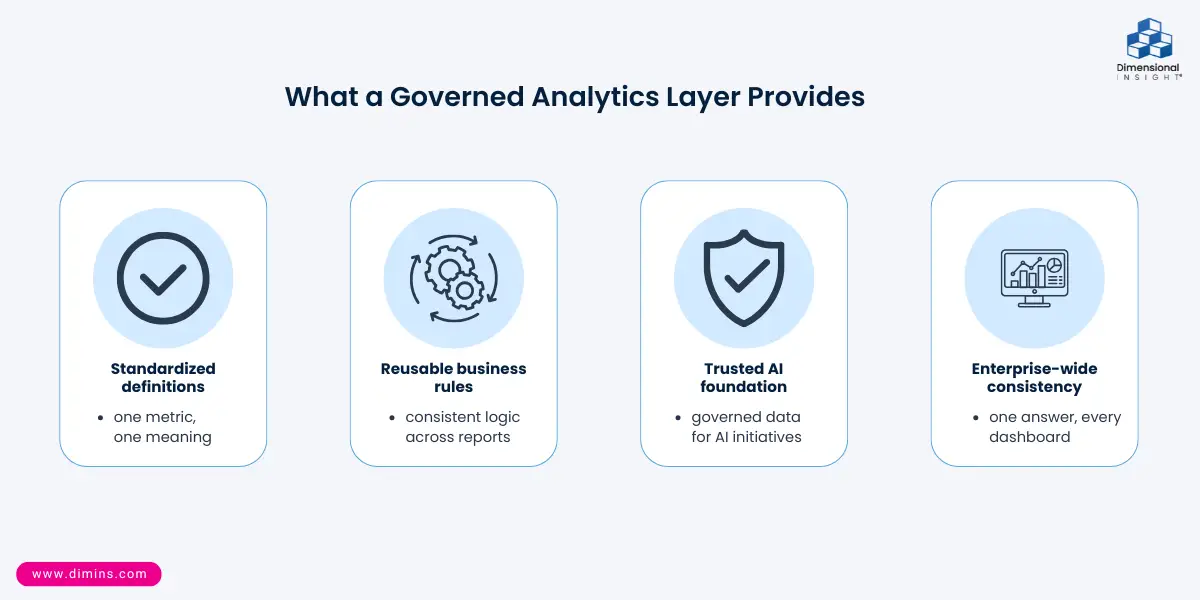
A governed analytics layer sits between source systems and end-user tools, providing:
- Standardized definitions
- Reusable business rules
- Curated analytical datasets
- Consistent measures across departments
- Trusted foundations for AI and advanced analytics
Many healthcare analytics platforms use this approach to establish a trusted foundation for reporting, self-service analytics, performance management, and AI initiatives. This approach has long been central to Dimensional Insight’s philosophy. Rather than treating governance as something that happens after reports are created, governed analytics embeds shared definitions and validated business logic into the analytical foundation itself. The goal is not to replace EHR analytics. It is to extend and strengthen it.
The Question Isn’t Whether Your EHR Has Analytics
Epic, Oracle Health, and MEDITECH all provide valuable analytics capabilities. They are essential components of the modern healthcare technology ecosystem. The more important question is whether your organization can consistently answer critical business questions across every department, every dashboard, and every decision-maker.
- Can leaders trust that a metric means the same thing everywhere it appears?
- Can analysts spend more time generating insights and less time validating reports?
- Can AI initiatives be built on a foundation of governed, trusted information?
These are the questions that increasingly define analytics success. As healthcare organizations evaluate healthcare analytics platforms, the ability to create trusted, governed information across multiple systems is becoming just as important as reporting capabilities, dashboards, and AI features. This philosophy has guided Dimensional Insight’s approach to healthcare analytics for decades: establish trusted definitions first, then build reporting, self-service analytics, and AI on top of that foundation.
For many healthcare organizations, the answer is not more dashboards or more data. It is a governed analytics layer that transforms information into something leaders can consistently trust. And as healthcare organizations continue to expand their use of cloud platforms, self-service analytics, and AI, that foundation may be more important than ever.
Frequently Asked Questions
Does Epic replace a healthcare analytics platform?
Not necessarily. Epic provides powerful reporting and analytics capabilities, but many organizations require enterprise-wide governance, cross-system analytics, and standardized business logic that extend beyond the EHR.
Why do departments report different numbers from the same data?
Differences in metric definitions, business rules, and reporting methodologies often create inconsistencies across departments.
Do hospitals still need analytics platforms if they have Epic or Oracle Health?
Many organizations continue to invest in analytics platforms to integrate data from multiple systems, standardize metrics, and support enterprise-wide decision-making.
What is a governed analytics layer?
A governed analytics layer provides standardized definitions, reusable business rules, curated analytical datasets, and trusted metrics that can be used consistently across the organization.
How does AI affect healthcare analytics governance?
AI increases the importance of governance because AI-generated insights depend on consistent definitions and trusted underlying data.

- How Hospitals Get to a Single Version of the Truth - October 20, 2026
- 10 Questions Every Healthcare Analytics RFP Should Ask - July 28, 2026
- We Have Epic. Why Are We Still Arguing About Our Numbers? - June 23, 2026