
At some point, every healthcare organization runs into the same problem: two reports, same metric, different answers.
Finance has one number. Operations has another. IT gets pulled in to figure out which one is “right.” Meetings stall. Decisions get delayed. And instead of acting on data, teams end up debating it.
When this happens, it’s easy to assume there’s a reporting issue. But there usually isn’t.
When reports don’t match, it’s not a reporting problem. It’s a definition problem.
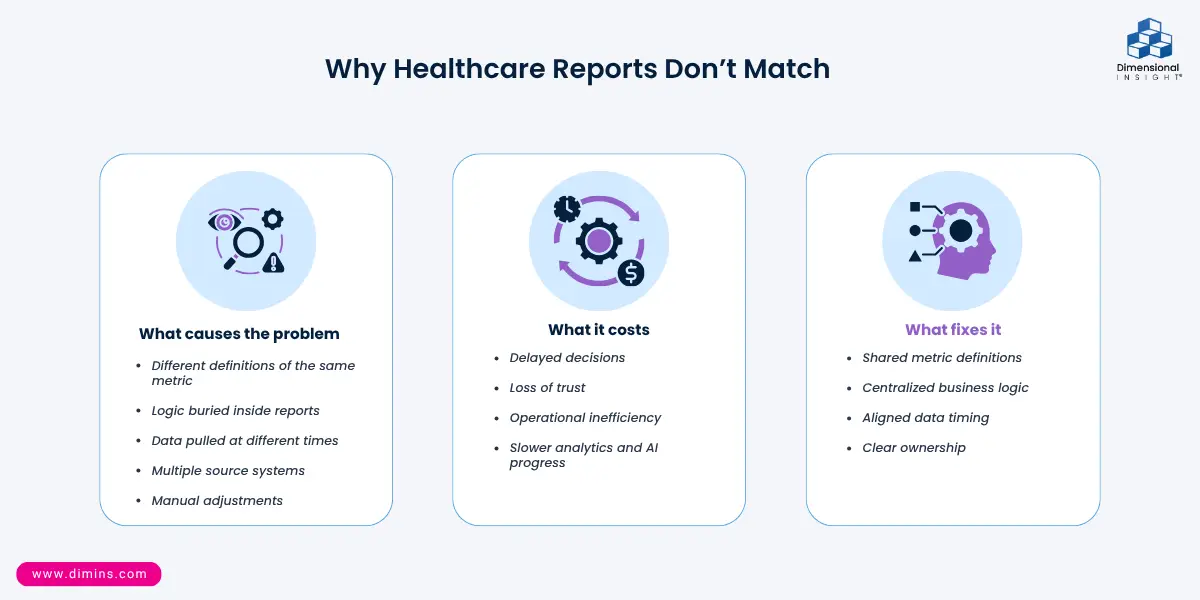
Why healthcare reports don’t match
This issue doesn’t come from one big failure. It builds over time through small, reasonable decisions that don’t stay aligned.
Here’s what’s typically going on behind the scenes:
- Different definitions of the same metric: Even something as common as “length of stay” can vary depending on how it’s calculated. Does it include observation time? Transfers? Partial days? Different teams answer those questions differently—and end up with different numbers.
- Logic buried inside reports: In many organizations, calculations live inside dashboards, reports, or spreadsheets. That means each version of a report may be applying slightly different logic, even if it’s labeled the same way.
- Data pulled at different times: Two teams can run the “same” report against slightly different data snapshots. If extracts aren’t aligned, neither are the results.
- Multiple source systems: Healthcare data doesn’t live in one place. It spans EHRs, claims systems, financial systems, and more. Without a consistent way to reconcile that data, inconsistencies are inevitable.
- Manual adjustments: Spreadsheets and one-off fixes fill the gaps. But those changes are rarely documented or reused, which makes consistency even harder over time.
None of this is unusual. In fact, it’s how most organizations operate. But it creates a problem that compounds quickly.
Why this problem is worse in healthcare
Every industry deals with data inconsistencies. Healthcare just feels it more.
That’s because:
- The stakes are higher: Decisions affect patient care, staffing, and financial performance.
- There are multiple perspectives on the same data: Clinical, operational, and financial teams all look at metrics differently.
- Regulatory reporting adds pressure: Numbers don’t just need to be accurate—they need to be defensible.
- The data environment is complex: More systems, more integration points, more room for misalignment.
In this environment, inconsistency isn’t just frustrating. It’s risky.
The real cost of mismatched reports
Most organizations recognize the annoyance. Fewer recognize the cost.
When reports don’t match, it leads to:
- Delayed decisions: Meetings turn into data reconciliation sessions instead of decision-making conversations.
- Loss of trust: Teams stop relying on reports altogether—or only trust “their” version of the data.
- Operational inefficiency: Analysts spend their time validating numbers instead of analyzing them.
- Slower progress on analytics and AI: If you can’t trust your baseline metrics, it’s nearly impossible to move forward with more advanced initiatives.
This last point is becoming more important. A lot of healthcare organizations are investing in artificial intelligence. But AI doesn’t fix inconsistent data—it amplifies it.
What actually fixes the problem
Organizations that solve this don’t just improve their reports. They change how their data is defined and managed.
That usually includes:
- Shared, clearly defined metrics: One definition for each key measure, used consistently across teams
- Centralized business logic: Calculations are created once and reused, not rebuilt in every report
- Aligned data timing: Reports are based on consistent, trusted data snapshots
- Clear ownership: Someone is responsible for defining and maintaining each metric
Taken together, this creates something most organizations don’t have today: a trusted analytics layer.
Not just data that’s available—but data that’s consistent, understood, and trusted across the organization.
5 signs your healthcare data isn’t trustworthy
If you’re not sure whether this applies to your organization, here are a few quick indicators:
- Teams regularly ask, “Which report is right?”
- The same metric shows different values in different places
- Analysts spend more time validating data than analyzing it
- Reports require explanation every time they’re presented
- IT is frequently pulled into data disputes
If even a couple of these feel familiar, the issue likely isn’t reporting—it’s alignment.
Why this matters now
Before investing in more dashboards, more tools, or more AI, healthcare organizations need to answer a simpler question: Do we trust our numbers?
If the answer is no, adding more technology won’t solve the problem. The real work is in defining, aligning, and governing the data behind those numbers—so that when a report is shared, the conversation can finally move forward.
FAQs
Why do reports show different numbers in healthcare?
Healthcare reports often show different numbers because teams use different definitions, data sources, or timing when calculating metrics. When business logic isn’t standardized, even small differences in how data is handled can lead to conflicting results.
How do you fix inconsistent reporting in healthcare?
The most effective way to fix inconsistent reporting is to standardize metric definitions, centralize business logic, and ensure all reports use the same data sources and timing. This creates consistency across teams and reduces the need for ongoing validation.
What is a trusted analytics layer?
A trusted analytics layer is a foundation where data definitions, calculations, and logic are standardized and shared across an organization. It ensures that everyone is working from the same numbers, enabling faster decisions and reducing confusion.
Why is data consistency important for healthcare analytics?
Data consistency is critical because healthcare decisions often impact patient care, operations, and financial outcomes. Inconsistent data can delay decisions, reduce trust, and create risk—especially in regulated environments.
Can AI fix inconsistent healthcare data?
No—AI cannot fix inconsistent data. In fact, it often makes the problem worse by scaling flawed logic and unreliable inputs. For AI to be effective, organizations need consistent, well-defined data first.
What causes a lack of trust in healthcare data?
A lack of trust typically comes from mismatched reports, unclear metric definitions, manual data adjustments, and inconsistent data sources. When users repeatedly see conflicting numbers, confidence in all reporting declines.


- 10 Questions Every Healthcare Analytics RFP Should Ask - July 28, 2026
- We Have Epic. Why Are We Still Arguing About Our Numbers? - June 23, 2026
- Is Your Data AI-Ready? A Beverage Alcohol Assessment Guide - June 16, 2026