DIMENSIONAL INSIGHT AI

AI governed by your source of truth.

Narrow, responsible help in the workflows your teams already trust.

Dimensional Insight brings AI into Diver Platform through Nora — the Navigation, Orientation, and Reporting Assistant — and through predictive analytics that surface what’s worth your attention. Both work inside your existing governance, access rules, and business definitions. You decide where AI helps. You decide what it sees.

OUR APPROACH

Four principles for AI where truth matters.

In healthcare, beverage analytics, and other industries where decisions carry consequences and data carries rules, AI has to answer to your data — not the other way around. These four principles shape how AI behaves inside Diver Platform.

1

Your data is the source of truth

AI reasons on your Diver data, your definitions, and your business logic — not on whatever the model absorbed from the open internet.

2

The AI sees only what the user is allowed to see

Existing access controls apply at query time. Every user gets answers from inside their own governed view — no exceptions, no leaks across permissions.

3

The AI knows what it’s looking at

KPI definitions, calculations, filters, and on-screen context travel with every question. Arithmetic runs on the Diver calculation engine, not the language model — so quantitative answers come from your data, not the model’s best guess.

4

You choose the model. You can change it tomorrow.

Bring your preferred LLM — cloud, BAA-backed, or on-prem. Switch providers if pricing, terms, or compliance needs change. No lock-in, no re-architecture.

Three questions we ask before any AI feature ships:

  • 1How does this benefit the customer?
  • 2How do we know we’re getting good answers?
  • 3How do we know where the data is going?
  • THE ASSISTANT

    Meet Nora.

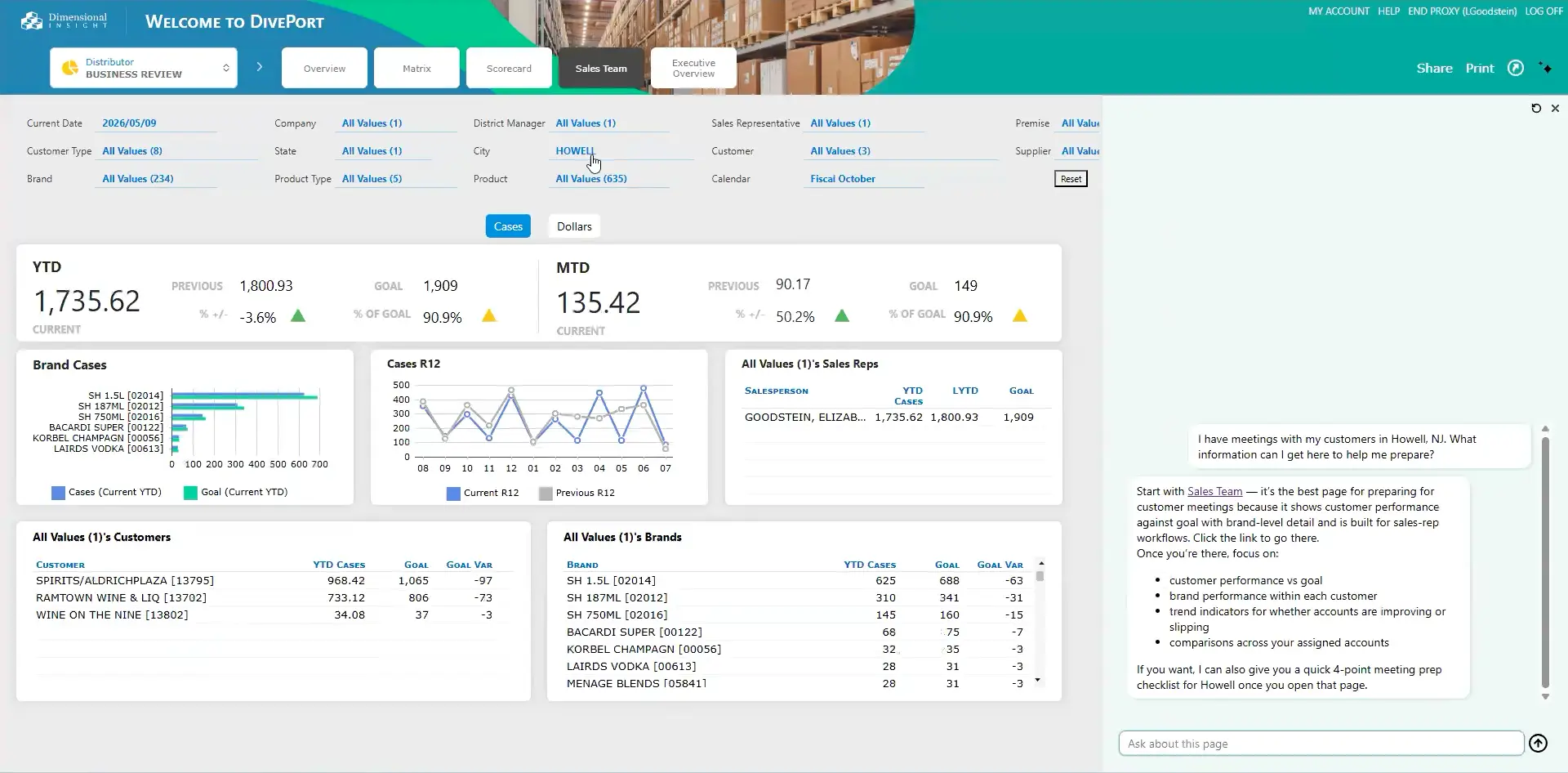
    Nora — the Navigation, Orientation, and Reporting Assistant in DivePort, the analytics portal where your team accesses dashboards, reports, and KPIs every day. Working from the same governed data and page context your team already sees, Nora keeps answers grounded in your business semantics — not in generic AI output. It draws on both structured analytics data and approved unstructured sources — bringing the numbers and the context behind them together in one place.

    WHERE NORA HELPS

    Speed onboarding

    New users, occasional users, and frontline people don’t always have time to learn the analytics. Nora explains what a KPI means and how it’s calculated, points users to the right report or page, and answers the practical questions that come up in the moment — Where’s this data coming from? What can I do with this report? Where do I go to see more? How do I share it?

    Nora also helps keep people from going to four different places for answers. Users have data questions, product questions, documentation questions, and process questions, and too often they have to bounce between systems for each one. Nora brings those answers closer together, in one governed place.

    Drive better analysis

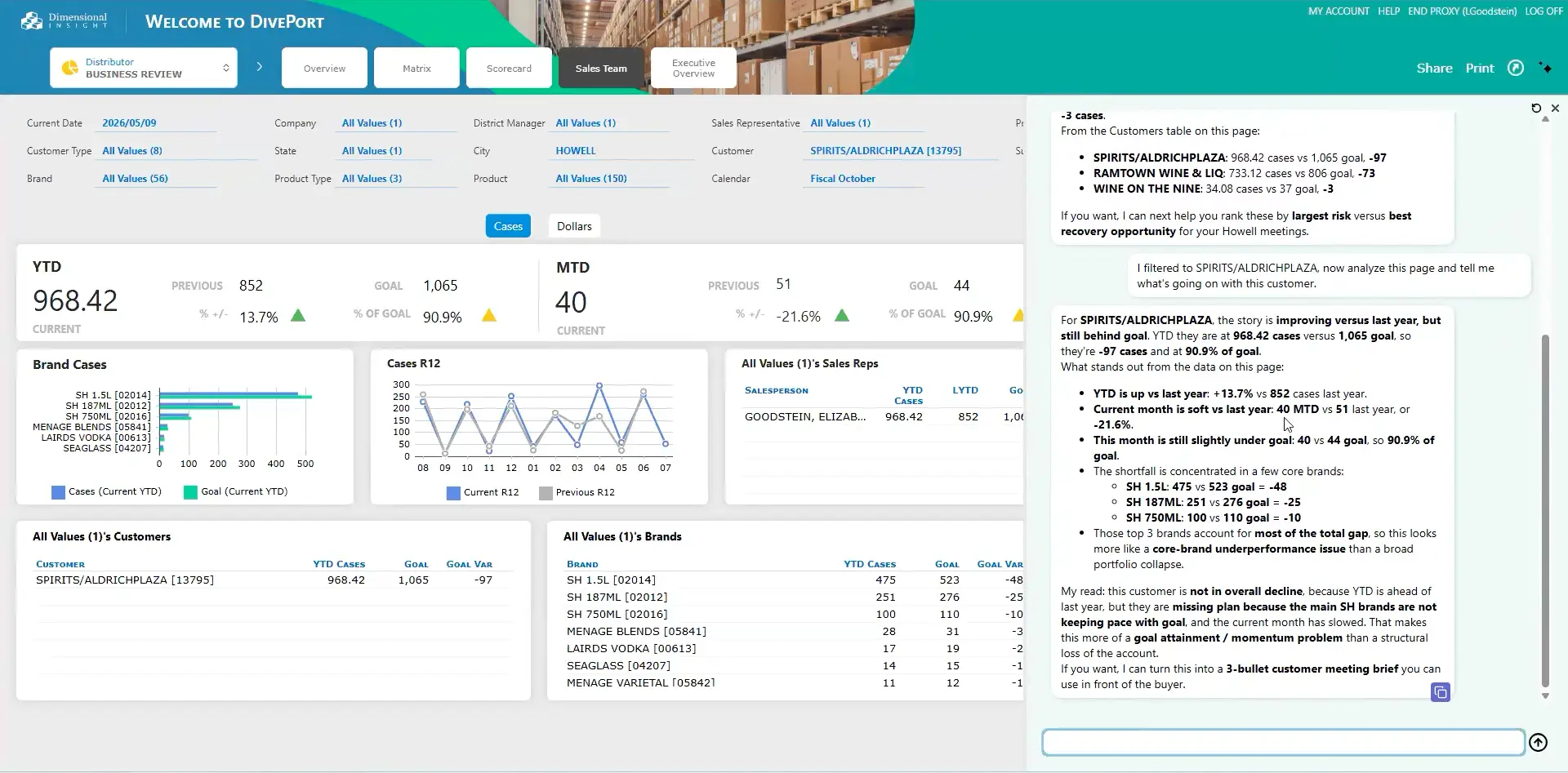
    Help your team get more out of what’s already on the page. Nora summarizes what the analysis is showing, suggests where to look next, and helps users walk into the meeting better prepared — past the table and into what matters. Which customers should I be worried about? What changed? What am I going to get asked about this?

    Nora also helps make the handoff easier. A lot of people are still taking an analysis table, putting it into a PDF, writing up notes about what the data says, and sending it out. Nora can help summarize the findings and make that work less manual.

    Deliver trusted knowledge

    The number alone is often not enough. People also need the policy, the training material, the product information, or the planning context behind it. Nora can use approved business knowledge alongside the data — policies, training materials, strategic plans, meeting notes, product information — and approved external sources where they help.

    Answers reflect how your organization actually works, not generic best-practice text pulled from the open web.

    When an answer isn’t enough, Nora can also take the next step — running an approved action inside Diver and reporting back on the result.

    ALSO USEFUL FOR

    Cutting down on exports to Excel and outside AI tools

    When people can’t get answers where the data already lives, they start exporting to Excel or pasting things into outside AI tools. Nora gives them a better path inside the governed environment, where the data, controls, and context are already in place.

    Making the portal more useful for suppliers, reps, and occasional users

    Not everyone lives in analytics all day. Suppliers, sales reps, new hires, and occasional users still need answers, a better sense of what they’re looking at, and help getting to the next step. Nora makes the portal friendlier for them without requiring them to become analysts first.

    PREDICTIVE ANALYTICS

    See what deserves your attention before you go looking.

    Predictive analytics is the longer-running side of Dimensional Insight’s AI work — proven techniques applied inside your existing Diver environment to surface what’s worth a closer look: outliers, forecasts, patterns. Same four principles, same governance posture, no special AI infrastructure required.

    Spot the outliers

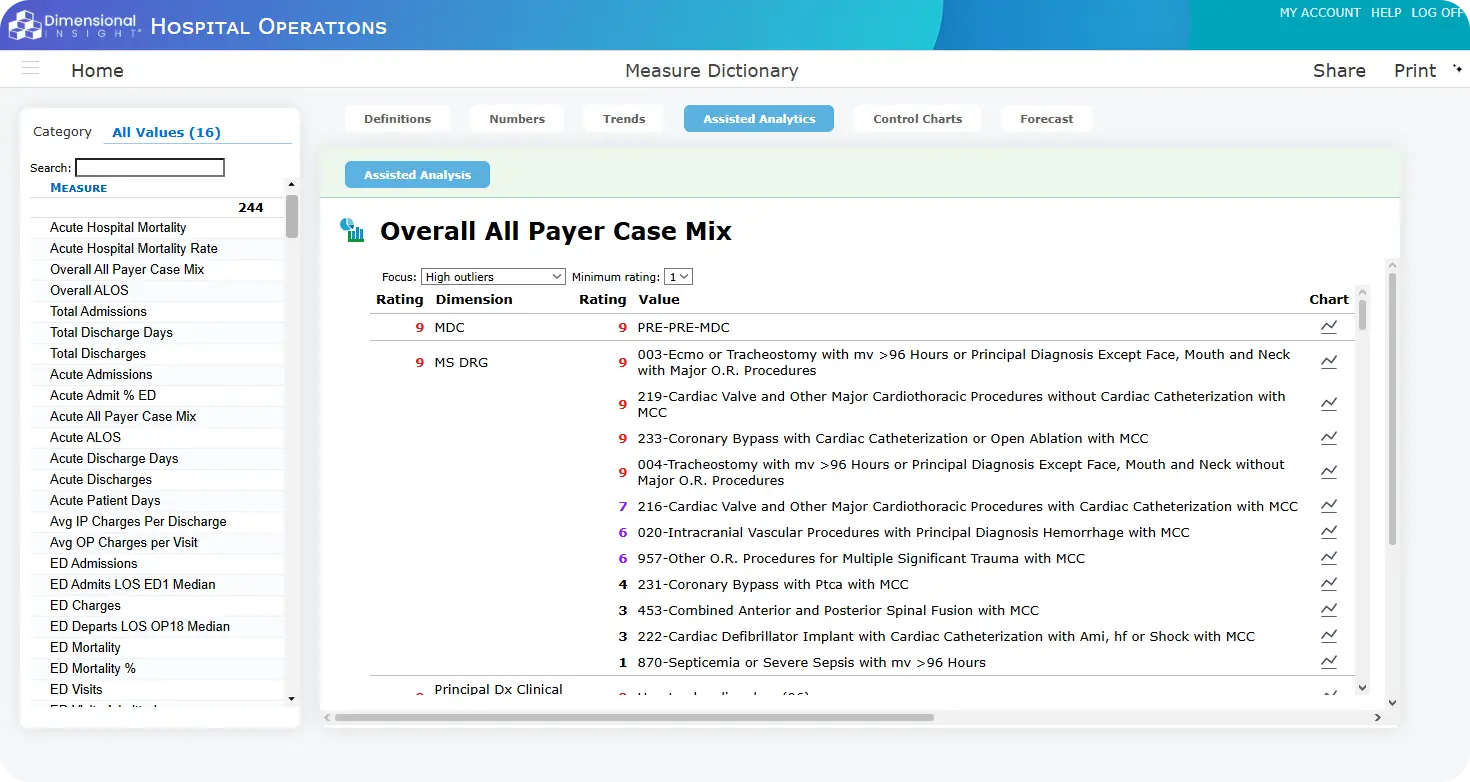
    Find values that don’t fit the pattern — at volumes a person can’t reasonably scan. The system flags them as the data changes, so teams see what’s worth investigating without combing through every row.

    See what’s coming

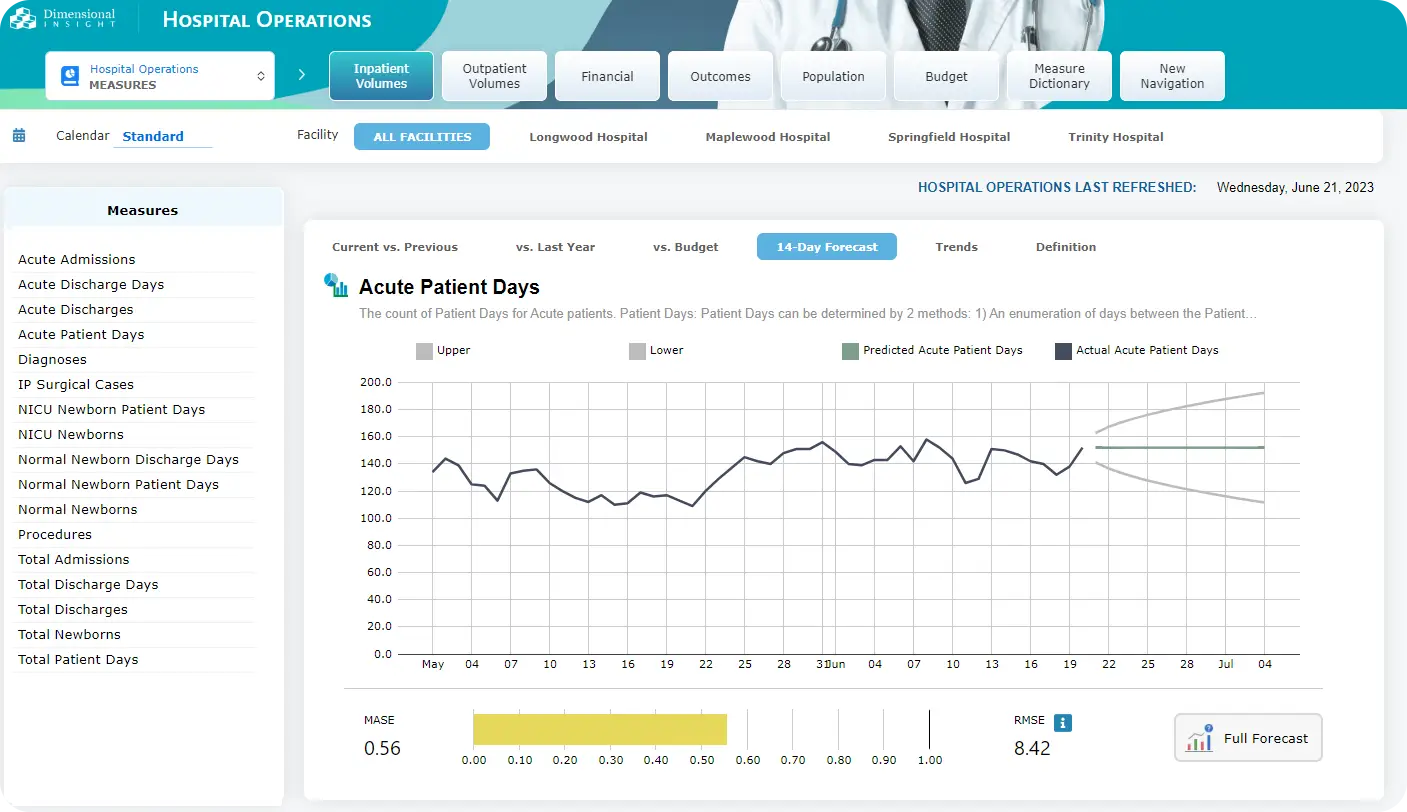
    Forecast demand, volume, attrition risk, or other forward-looking measures, so teams can act before the change shows up after the fact.

    Find the patterns that matter

    Classification and segmentation models flag accounts, employees, transactions, or other entities that share a profile worth attention — for retention planning, risk scoring, or targeted follow-up.

    From thousands of values to the few that matter. The system rates each value against its peers, so the right exceptions surface without a manual scan.

    Forward-looking numbers, with a confidence range. Forecasts show projected values, the band of likely outcomes, and how the model is performing — so users know what kind of decision the forecast supports.

    Predictive analytics runs on your existing Diver infrastructure. No GPUs, no external cloud ML service, no special AI hardware — and the data stays where it already lives.

    Machine learning works best when it’s iterative and paired with stakeholder expertise. Engagements treat your domain experts as collaborators, not as consumers of a finished model.
    INDUSTRY FIT

    Built for the way your industry already works.

    Dimensional Insight’s AI is shaped by the industries we know best — where the data is complex, the rules are real, and the cost of a wrong answer is high.

    Healthcare

    Hospital operations, clinical and quality analytics, supply and pharmacy planning, workforce and capacity questions. Diver has been the system of record for healthcare analytics at major health systems for years, and Nora and predictive analytics extend that footing into the daily work of the people who run those operations. Deployment options include BAA-backed cloud and self-hosted models for organizations that need to keep data inside their own boundaries.

    Beverage alcohol

    Distributor, supplier, and wholesaler workflows — inventory and demand planning, depletion and shipment analysis, territory and program performance, supplier collaboration. The same governed analytics and AI patterns, applied to the vocabulary and rhythms of the beverage alcohol trade.

    Other complex industries

    Manufacturing, public sector, retail, and other data-heavy operations are typically a custom fit on the same foundation. The four principles, the governance posture, and the deployment options don’t change. The use cases are shaped to what your teams already do.

    CONTROL & PRIVACY

    Your environment. Your rules. Your model.

    Organizations are not all in the same place on AI. Some want a straightforward cloud connection. Others need a Business Associate Agreement with the model provider, or a fully self-hosted model that keeps every prompt and response inside their own network. Dimensional Insight supports the range.

    Nora always runs on top of an LLM that you choose — OpenAI, Anthropic, or any compatible option. You keep direct control of the provider relationship, credentials, and billing. The assistant doesn’t change. Only the deployment behind it does.

    If pricing, terms, or compliance needs change, you change a setting. Not an architecture.

    Customer-selected LLMsBAA-backed cloud optionsSelf-hosted model optionsRole-based visibilityGoverned access controls
    GETTING STARTED

    Talk with our AI team.

    Most engagements start the same way: a short conversation to understand what your teams are doing today, where AI would meaningfully help across analytics, predictions, and trusted knowledge — and what the right first step looks like for your environment.

    01

    Identify the right use cases

    Where AI will earn its keep — and where it shouldn’t be used at all.

    02

    Prioritize likely ROI

    Sequence the work by where value shows up first.

    03

    Prove the value

    Run a focused proof of concept on a real use case in your environment.

    04

    Implement where it matters most

    Roll out in the workflows your teams already trust.

    Frequently asked questions

    What is Nora?
    Nora — the Navigation, Orientation, and Reporting Assistant — is the front-end AI experience inside Diver Platform. Users access it through the configurable web portal they already use for dashboards, reports, and analytics, then ask questions in plain English about what they are seeing. It can work from page context, approved metrics and metadata, supporting knowledge sources, and user-specific access rules.
    What can Nora do today?
    Current capabilities include the in-product chatbot, structured and metadata retrieval, unstructured knowledge bases, AI-enhanced documentation, customer choice of LLMs, and implementation support. In practical terms: explaining KPIs, finding reports and documentation, improving analysis, retrieving trusted knowledge, and supporting next-step actions.
    What predictive analytics capabilities are available?
    Forecasting, outlier detection, classification, regression, and clustering — applied to demand, capacity, attrition, supply, and other forward-looking measures. Models run on standard Diver infrastructure, with the data staying inside your environment.
    How is privacy and security handled?
    Nora operates within existing access boundaries. It only sees what the current user is allowed to see. Administrators can configure prompts and context at the portal, environment, and page levels, giving organizations tighter control over how AI behaves across different parts of the application.
    Does this support HIPAA and BAA requirements?
    Yes. Deployment options include cloud-provider approaches backed by a Business Associate Agreement, as well as fully self-hosted LLM options for organizations that want maximum control over where data is processed and stored.
    Can customers choose the AI model?
    Yes. Customers can connect OpenAI, Anthropic, and OpenAI-compatible endpoints. They maintain direct control over the provider relationship, credentials, and billing.
    Can Nora work with more than dashboard data?
    Yes. Nora can use both structured analytics data and approved organizational knowledge, including policies, training materials, strategic plans, meeting notes, product information, and documentation.
    Can Nora take action, or does it only answer questions?
    Both. With AI Actions enabled, Nora can execute scripts, trigger workflows, update records, and report back on the result.
    What version of Diver Platform is required?
    The in-product experience on customer data requires Diver Platform 8.0. Version 7.2 supports AI-enhanced documentation, which can serve as an earlier entry point, but it does not provide the full in-product AI experience available in 8.0.
    What orchestration tooling supports the knowledge-base capability?
    For knowledge-base and advanced workflow scenarios, Dimensional Insight supports an orchestration layer and has recommended an open-source option called Dify.ai. Customers are not locked into a single tooling choice.
    What vector database options are used for retrieval?
    For retrieval-augmented generation and knowledge-base workflows, examples include Weaviate and Elasticsearch.
    What does self-hosted architecture mean here?
    Organizations can connect Diver Platform to a self-hosted LLM, and the knowledge-base orchestration layer can also be hosted within the customer’s own environment. This gives customers a path to keep data processing inside their own boundaries when privacy or regulatory requirements demand it.
    Do we need extra infrastructure?
    Nora itself adds minimal overhead to the portal environment because the heavy lifting is handled by the LLM layer. Predictive analytics runs on the standard Diver servers you already have. If an organization chooses the knowledge-base capability, the orchestration platform requires dedicated infrastructure rather than sharing production workloads.
    What VM sizing is suggested for the knowledge-base server?
    Suggested sizing is 4 cores / 8 GB RAM for up to 100 users; 4–8 cores / 16 GB RAM for up to 200 users; 8 cores / 16–32 GB RAM for up to 500 users. Final sizing should be confirmed during implementation based on the environment and usage profile.
    What is available now, and what is on the roadmap?
    Available now: Nora, structured and metadata retrieval, unstructured knowledge bases, predictive analytics, AI-enhanced documentation, customer choice of LLMs, privacy options, and implementation support. Roadmap items include AI updates for beverage applications and a possible Dimensional Insight Cloud-hosted private LLM.
    How does an engagement typically begin?
    A short discovery conversation to identify useful opportunities, low-hanging fruit, and likely ROI — then a focused proof of concept before any broader rollout.

    See what targeted, governed AI looks like inside Diver Platform.

    If you are evaluating how AI can support decision-making without compromising governance, privacy, or control, we would be glad to show you what that looks like in practice.