
Election Day brings with it a focus on all kinds of data. There’s the fact that data centers are a hot-button topic this November, both as a ballot question and in terms of candidates who either do or don’t support the facilities in a number of states across the country.
But there’s also the idea that numbers will come fast and furious between now and Election Day. Which ones should you believe and which ones aren’t trustworthy? Let’s take a look at some data history and the lessons your organization might be able to take away from election predictions.
Election Day and data
Data has always been a part of Election Day coverage. There is, of course, the constant gathering of data by politicians and political parties as they try to gauge what matters to voters and where they need to focus their efforts during campaigns. But there is also polling throughout the electoral calendar as pundits make their predictions and media outlets look to boost their coverage.
Some of the polling is for fun. At the Iowa State Fair leading up to a presidential election, people can put a corn kernel in a jar next to their chosen presidential candidate and that can offer some fun data on who might be worth watching in the upcoming primary election. Any kind of straw poll is not very scientific, though. Whether it’s conducting a poll at the voting booth, going door to door, or interviewing people at a 4th of July parade, as one of the earliest recorded straw polls published in a newspaper did, the results often do not match what actually happens on Election Day. In one famous example, The Literary Digest conducted a poll by including a postcard that readers could mail back with their presidential choice in the 1936 election, leading to a prediction that Alf Landon would defeat Franklin D. Roosevelt.
Polling data can be misleading
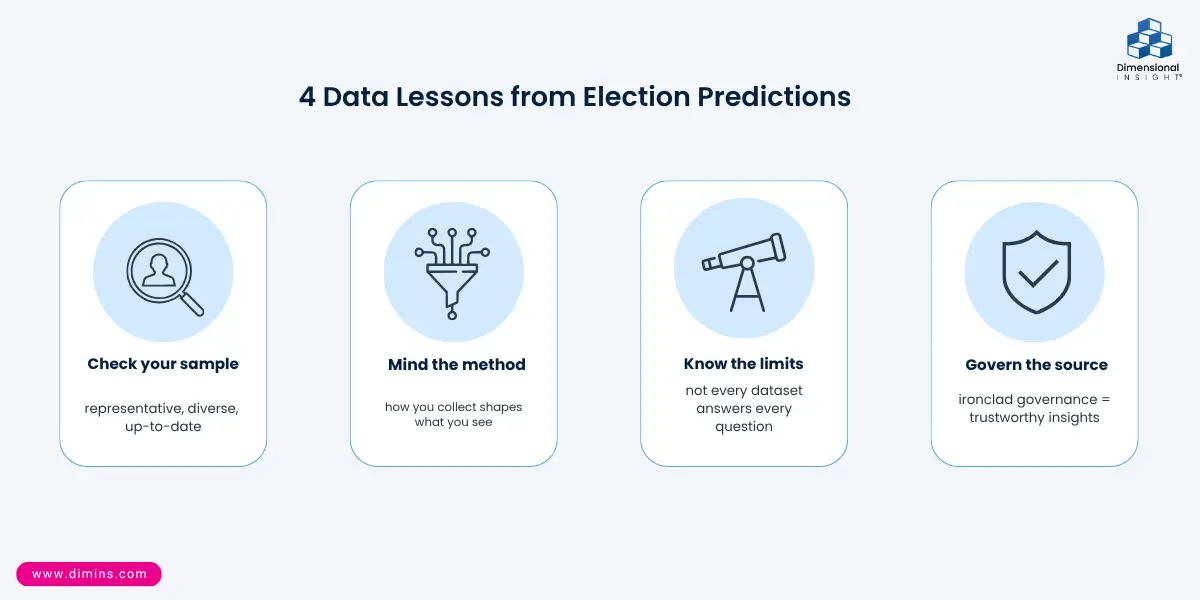
Data doesn’t always tell the whole story. The Literary Digest, for example, successfully gathered millions of ballots from across the country both through its postcards and from calling readers, but it did not get a true sampling of the American population. The types of people who owned telephones in 1936 were not representative of most Americans. The magazine’s polling did not include the less wealthy people who were looking for the kind of social programs a vote for FDR might bring about, and the actual election reflected that.
Putting too much faith into the data from early voting is still not very reliable, even though the technology has gotten much more advanced since 1936. One of the most common ways to figure out which way voters are leaning is by the political party of early voters, but a number of states do not record party registration, and in those that do, often people have not updated their party registration even though they may have changed their ideologies. Early voters are also not always representative of the people who wait until Election Day to vote. Finally, when it comes to using past information to inform the future, the process of early voting is still evolving and the rules are changing, so it is difficult to use that information to identify trends.
The right data can make a difference
When it comes to analyzing data in the business setting, you have to fully understand the data that is being used, and that data needs to be ironclad. You can’t expect accurate results if there isn’t care put into the way data is collected in the first place. The Literary Digest didn’t consider the fact that there was no diversity in the people it was polling. This is why data governance is so important. By thinking about the results you are expecting from analytics, you can help guide the information you are gathering in the first place. Whether it is industry-wide information or data from within your organization, it is important to select the specific data points you want to consider to produce reports that can help you make decisions.
It is sometimes useful to understand and acknowledge the limitations of your data. While the early voting data, for example, might not be useful in making predictions about what is to come, it is good information as far as who is turning out early to vote as opposed to waiting for Election Day. Similarly, your data may be better suited to one conclusion than another.
Whatever the case, the right analytics solution can help your organization use data to make the kinds of decisions that can make a difference. Whether it’s figuring out how to boost sales, increase efficiencies, or make sense of the data through better reporting, a flexible solution such as Dimensional Insight’s Diver Platform can bring together data from all sources to produce a single version of truth. The best solutions can then grow with your organization, building on your work together rather than starting from scratch when a new challenge pops up.
People are unpredictable. Just because someone voted for one candidate in a previous election doesn’t mean they’ll make the same choice this time around. The same is true in business. Past performance can help inform future decisions, but it doesn’t guarantee future results. The key is knowing what your data can tell you, understanding its limitations, and using those insights to make better decisions for your organization.

- What Election Predictions Can Teach Us About Data Analytics - October 22, 2026
- Data can Lead the Way for Tuition Decisions - October 15, 2026
- Proper Data Governance Prevents Data Slop - October 8, 2026