
While much of the talk around AI is about its potential, everyone who uses it probably has an example of its limitations. “AI slop” is common. There are images with too many fingers, the tell-tale grammar error, or the out-and-out misrepresentation of facts.
It could just as easily be called “data slop.” Artificial intelligence is only as good as the data that is powering it. Slop is the result of data being continuously fed into a system with no plan, and it is why governance is so important for organizations working with data. There is so much a business intelligence solution can do, but none of the technology can work effectively if the data that is fed into it isn’t accurate. Here’s how you can make sure you are using clean data, and how that can help your organization use data successfully.
Is the data worth it?
There are so many advantages to using data and analytics. Whether AI is involved or not, analytics can help turn large data sets into actionable information much more quickly than people could on their own. Analytics can help an organization get a leg up, or at least stay on par with, the competition. But for any of it to work, the data needs to be accurate.
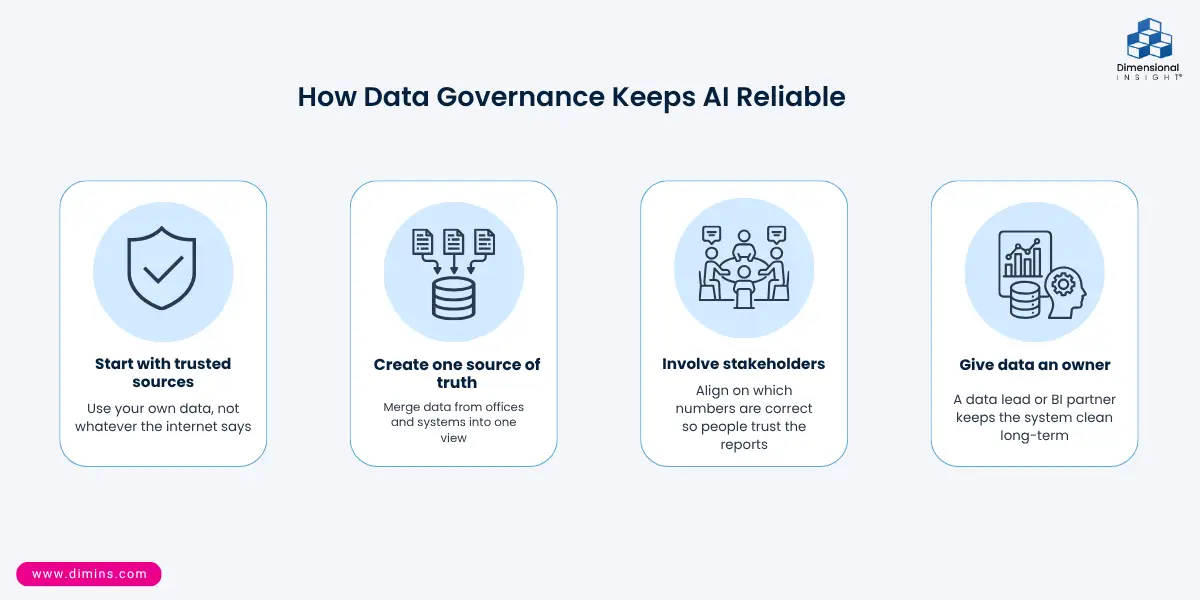
When working with large amounts of data, there are many opportunities for things to go wrong. AI in search engines, for example, can get details wrong because it is pulling data from all over the internet. There are no fact checkers guiding the way towards more legitimate sources. Businesses have their own trusted data sources, and they need to make sure that those are the ones being fed into their analytics solution.
How do you make sure an analytics solution is reliable?
This is where data governance comes in. Many organizations have data coming from many different sources, whether that is different offices spread out across the country or different facilities within the same city. An analytics solution can bring all of those data sources together to produce one single version of the truth. Rather than each producing separate reports where the numbers don’t always line up, by merging the data, everyone is looking at the same numbers from the same reporting tool.
In order to do this correctly, though, organizations need to take the time to figure out which numbers are the correct ones. This is what makes for a successful analytics implementation. Stakeholders throughout the organization need to be involved in the process to make sure everyone understands the changes, and to help explain what the data means. That helps buy-in with the end result, so stakeholders will not only trust the reports, but it also increases the chances they will use the tool themselves.
Many organizations have created positions that deal specifically with data. A director of data and analytics, for example, can help steer this initial process, and then guide users once the product is up and running. The right technology partner, though, can also do this work for you.
What can analytics help an organization do?
Not every organization has the ability to create a position dealing specifically with data. Any organization making a transition into using data to make decisions, though, has the opportunity to find the right partner that can help make that transition easier. This means a company that won’t just drop off the new product and leave you to figure it out on your own. The best business intelligence partners build a relationship where the work continues long after the installation.
A flexible solution, such as Dimensional Insight’s Diver Platform, can bring together data from the many different sources organizations are dealing with, and it can produce reports and visualizations that can help executives make the kinds of decisions that can be difference-makers in any industry. But all of that starts with governance, ensuring clean data is being used to produce accurate results.
For people who are messing around with AI, a detail that is slightly off can be amusing. In the business world, though, a detail that is slightly off can be devastating. Data governance is the key step in making sure every detail is accurate, and that’s why governance is baked in to Diver Platform. The right analytics tool can help organizations succeed by turning data into actionable information, but only if the data going into the tool in the first place is the correct data. That’s how you end up with results that can be trusted.

- Proper Data Governance Prevents Data Slop - October 8, 2026
- Tracking Shipping Price Changes with Analytics - October 1, 2026
- AI: The Good, The Bad (and Scary), and the Analytics - September 24, 2026