
As in any other industry, artificial intelligence (AI) developers are in a race to make their product better than that of their competitors. Unlike most other industries, though, the results for the AI companies are unprecedented. Now, we are learning, the results could also be more dangerous than previously believed.
There have been a number of recent developments that have shone a negative light on the race to develop AI. The technology works so fast that researchers are relying on AI to monitor AI, and are finding that the product is not always doing what is best for people. Let’s take a look at what people are saying about AI, and the important role data plays in the conversation.
How bad could it get?
In early September, an AI researcher resigned and took to social media to call out AI labs. He said they were putting people’s lives at risk because they were not developing the technology responsibly. This led to other AI researchers calling for a pause on AI development.
Less than a week after that, the CEO of Anthropic published an essay calling for a global slowdown of AI development. He wrote that AI was advancing at too quick a pace for researchers to continue in a safe way, and that they needed to allow risk prevention to catch up to the progress AI is making.
One of the complications is that there are not many rules and regulations around AI, domestically or globally. One of the calls to action in the essay was for countries to develop safety standards, as well as companies themselves agreeing to best practice assessments from outside evaluators. These new developments come on top of previous concerns about AI – from the notion that it could cost people jobs to the fact that the bigger AI gets, the more demand there is for resource-draining data centers.
But also how good could it get?
The essay did acknowledge the benefits AI has been able to help humankind achieve. The stories are plentiful – whether it’s making everyday tasks easier or making previously impossible solutions attainable. With its ability to process more information more quickly than people ever could, AI has led to mathematical breakthroughs and can be used in the medical profession to aid in diagnoses, to name just a couple of uses.
The Boston Globe recently ran a story about a family using AI to help figure out their daughter’s medical condition based on a number of symptoms. The article included these stats:
- About 25% of Americans report using AI chatbots to diagnose symptoms, according to a Pew Research Center survey from June
- About 80% of physicians say they use AI for work, according to an American Medical Association survey
- OpenAI says more than 300 million people every week ask ChatGPT health questions
The article also outlined situations where it is safe and unsafe to use AI for medical reasons, including the caveat that it is never a bad idea to consult a medical professional even with results from AI.
What role does analytics play?
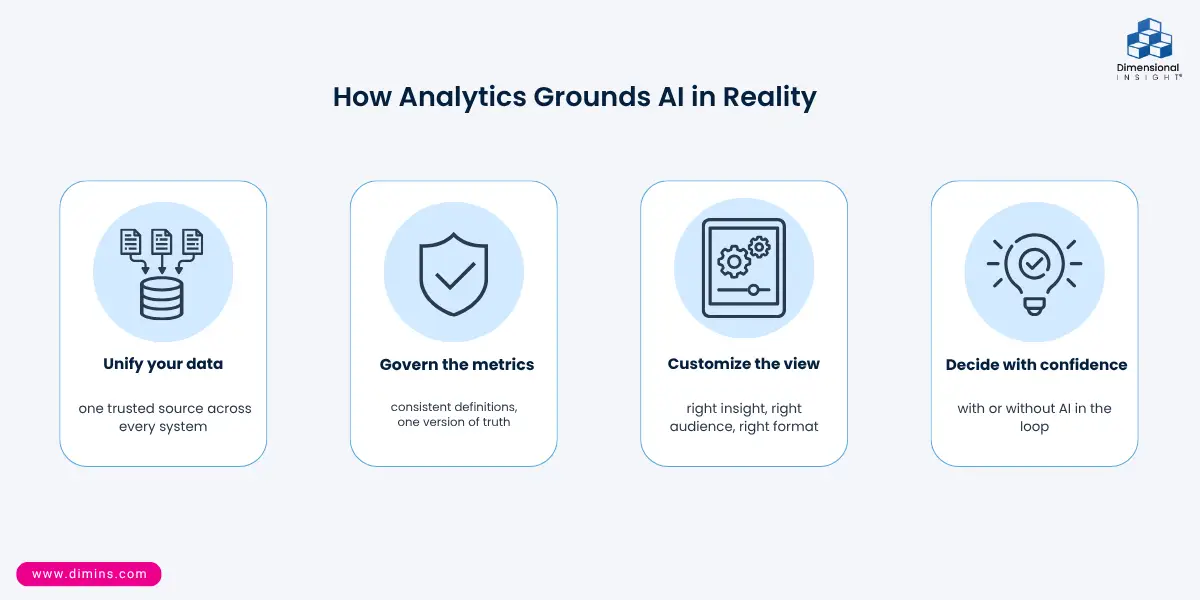
The bottom line with AI is that it always comes back to data. AI needs good data to be effective, and in order to have good data you need a governed analytics solution. The best analytics solution is one that is flexible and is able to turn the data into actionable information whether or not AI is involved.
That data is reliable, no matter where it is coming from. Most organizations are pulling information from different sources, and it serves different purposes for different audiences within the organization. The right solution can bring that data together seamlessly, producing one single version of truth, and it can be customized so that everyone who needs the information is seeing it in their own way. Those reports can then be used to make the kinds of decisions that will allow a business to thrive, whether at the sales level or in the executive offices.
Ethical questions have surrounded artificial intelligence from the very beginning. Only researchers and developers can control how far it goes on their end. From the business side of things, individual organizations have choices to make about deep they want to dive into the AI debate. In a world where everyone wants to use every tool available to gain an edge, it is not an easy decision to make. What should be much clearer for organizations is the benefits data can bring. The right analytics solution can help your organization use data to make decisions with or without the use of AI.

- Proper Data Governance Prevents Data Slop - October 8, 2026
- Tracking Shipping Price Changes with Analytics - October 1, 2026
- AI: The Good, The Bad (and Scary), and the Analytics - September 24, 2026