
For some runners, the only data they need before they head out the door is whether or not their ear buds are fully charged. Other runners, though, spend a lot of time thinking about data and how it can improve their performance.
There are all sorts of data points that runners can collect based on their time, heart rate, speed, or revolving around their nutrition and hydration. Making tweaks to any of these details can result in improved times. Some runners adjust after every race, some even after every training run. There are lessons that can be learned by businesses from the world of running about how to use data – let’s take a look.
What similarities exist between running data and the data my business uses?
At first glance it might not seem like there’s a lot in common between a runner with a watch or a heart rate monitor and an organization that may have data coming in from all over the world. However, the ways they both use data are comparable. Here are some of the ways advice for one can work for the other:
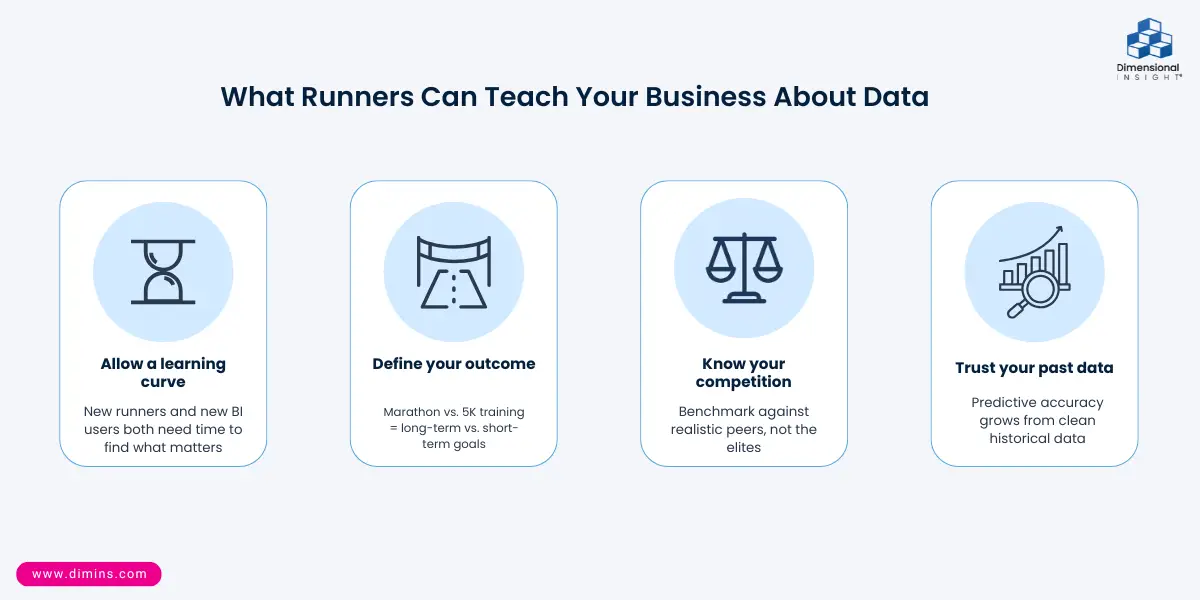
- Allow for a learning curve: New runners – or newly serious runners – are probably unsure about what data should matter and what metrics they should be looking for. That can be the same for a business undergoing a technological transition, shifting to a more data-driven culture. Runners only have to worry about their own information – a business might have many stakeholders who can offer input into which data points matter. In either case, allow for some time for everyone to learn so that they can get the most out of the data. Also, know that it’s OK to change your mind if you decide one focus is more important than what you were originally going to pursue.
- Know what you want your outcome to be: An important part of the process of using data is knowing what you want as an end result. For runners that may be improving endurance for a longer race, such as a marathon, or improving speed for a shorter race, such as a 5K. Those are very different types of running that call for different training approaches. For your organization, that could translate to changes over a long period of time, or quick fixes. Different time frames might call for organizations to focus on different pieces of data – it is often important to think about the end result before you get too far into the early stages of analytical work.
- Know your competition: For some runners, the data is for personal use only – improving an individual time or just trying to increase stamina to achieve greater distances. Sometimes the data is to achieve peak performance to try to win a race. In either case, it is important to consider who you are measuring yourself against. Setting a realistic distance goal should be based on how you are individually progressing, not what you are seeing others go out and do. A runner training to perform well in a local race shouldn’t necessarily measure their time against what the elites do on a world stage. The same is true for organizations – if you are comparing yourself to any other companies, find businesses that you have a realistic shot of competing against, and measure yourself against similar standards.
- Past results can indicate future performance: Most running apps can use a runner’s data points to predict how that individual might do on upcoming races. The apps can’t take into consideration elements such as weather conditions the day of the race or what happens if a runner wakes up sick, but training periods are lengthy enough to produce numbers that can give a fairly accurate preview of how a race might go. Any organization that has used data knows that so much of the predictive analytics that a business intelligence solution can provide is based on information that has already happened. It is important that information is logged correctly and understood by decision-makers as what is likely to happen, rather than 100% certain.
How can analytics help?
Runners can calculate this type of information all by themselves, or they can hire a coach to help guide them towards maximum efficiency. For businesses, that coach takes the form of a business intelligence solution that can help make sense of all of their data.
One of the most important features of an analytics tool is flexibility. All of the above scenarios are contingent on certain elements – whether that’s the metrics other businesses use that you are measuring yourself against, or outcomes that may change depending on how your organization decides to approach the data. A flexible solution can roll with those changes, allowing you to easily adjust rather than being designed to produce one outcome only.
The right solution should be customizable, not one-size-fits-all. You should be able to input the measures you are most concerned about, rather than stock measures that may not fit your needs. Customizable dashboards can allow the people who need the data to visualize it how they see fit, and customizable reports give decision-makers easy access to the information that can make a difference for the enterprise.
The data used by runners is coming from one single source – their running performance. Businesses could have information coming from many different sources within the organization. The right analytics solution can bring all of that information together to produce one single source of truth that can help improve the organization’s performance. That’s another thing runners and organizations using data have in common: Wherever the finish line is, they both want to reach it feeling strong and satisfied that they did everything they could to succeed.


- What Election Predictions Can Teach Us About Data Analytics - October 22, 2026
- Data can Lead the Way for Tuition Decisions - October 15, 2026
- Proper Data Governance Prevents Data Slop - October 8, 2026