
The most important aspect of an organization’s transition to analytics is the data itself. If the data is not reliable, nothing else matters. You need to be able to trust that the numbers you are working with are accurate in order to improve the way you do business.
There’s a very close runner-up, though, when it comes to ranking importance. Different companies might have different priorities, but the one that should come in right behind the data is the buy-in from stakeholders. Let’s take a look at why this is so important, and how you can get people on board.
Why does buy-in matter?
Organizations vary when it comes to the ways they make decisions. Some are unilateral, others are collaborative. There’s no right or wrong way to make decisions, really. A lot of it depends on the people in the organization and how they work best. That’s an important part of this kind of technological transformation – knowing the people in your company. Identifying who would want to be included in a major decision and asking for their input helps ease any transition, and in this case including people in the earliest stages can help lead to them being users of the product when the time comes. It is also worth noting that the more people that are included in decision-making in an organization, the more diverse the perspectives you are getting, and research shows that kind of diversity leads to better decision-making overall.
How can you get employee buy-in?
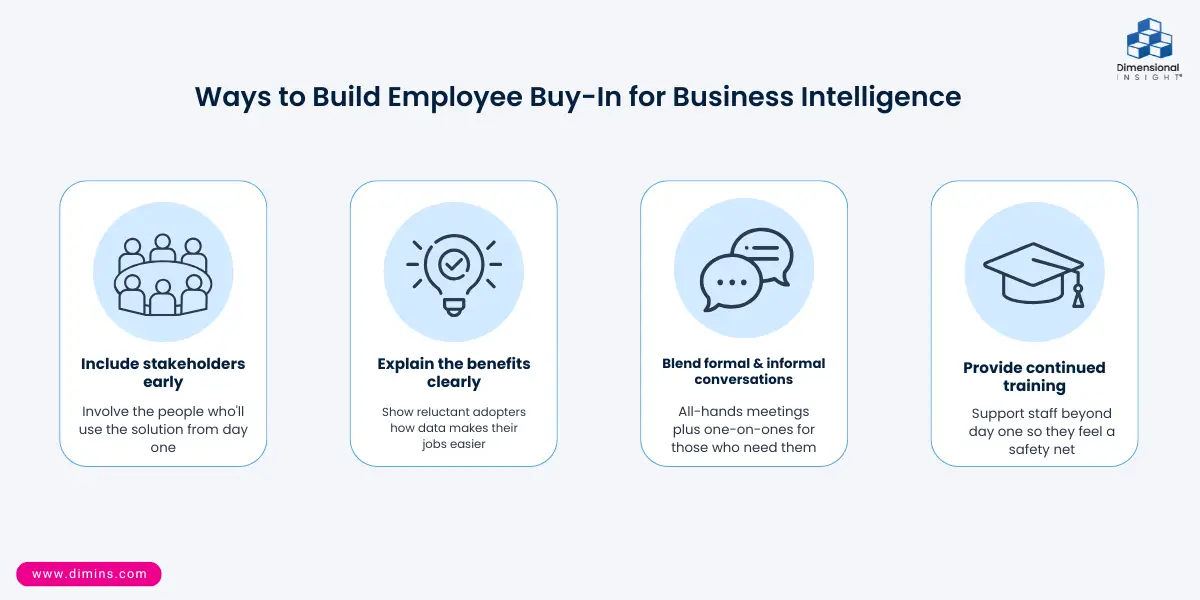
It’s more than just including stakeholders in the earliest stages of the decision-making process. Here are a couple of other ways companies can help make sure everyone is on board with using data:
- Clearly explain the benefits: People who are unfamiliar with data can be uncomfortable with data. By explaining to people who are likely to be reluctant adopters all of the ways that the end result can make their jobs easier, it can help them see the overall plan rather than just the immediate change they are facing.
- Formal and informal conversations: A company-wide meeting to explain the value of a business intelligence solution is a good way to make sure everyone understands the organization’s goals. Still, though, good leaders know how everyone responds to information. For those that need an extra conversation or a more specific connection to how it will affect them, it’s worth taking that extra time to make sure they feel heard in the process.
- Continued training: Preparing employees for the coming change is one thing, actually using the solution is another. It is important to make sure staff feels supported with using the new technology beyond day one. Knowing that they have a safety net to help catch them if they hit a snag will help them feel more comfortable with the change.
How can the right analytics solution help?
None of this has to fall solely on your organization. Partnering with the right business intelligence organization can help make the transition as seamless as possible. While you know your organization and how people are likely to respond to a major change, the organization you partner with will know the technology and has helped organizations make these kinds of transitions before.
It is important to find that right partner, though. Some companies will install the product and move on. You want a company that will help you through all parts of the transition, including that continued training, helping users figure out the earliest stages of the new adoption and then continuing the relationship as they become more comfortable with the solution and develop new, more specific questions that can help them do their job better.
Similarly, the solution should be flexible enough to meet your specific needs. None of the earlier work of soliciting buy-in will matter if the product can’t be tailored to address the issues your staff wants fixed, or where they need more information to produce results. A customizable analytics solution includes the type of off-the-shelf metrics that can work generally for many different organizations, but it can also be adjusted to include specific KPIs that your company feels is important to attain its individual goals. The flexibility will also allow the solution to grow with your organization as things change over time and new approaches to the data become necessary.
Organizations that successfully use data are quick to tout the numbers – workers are more efficient, money is being saved, operations are moving more quickly. All of that is worth shouting about. The work to get to those results, though, starts much earlier, and is much less exciting to shout about. It might begin with individual conversations over lunch months before a solution is brought in, or it might be at a work desk with a trusted analytics partner showing someone how to customize a dashboard. There is no question, though, that without that early buy-in, the exciting results don’t happen.


- What Election Predictions Can Teach Us About Data Analytics - October 22, 2026
- Data can Lead the Way for Tuition Decisions - October 15, 2026
- Proper Data Governance Prevents Data Slop - October 8, 2026