
The utilities industry is facing a period of transition. Every electrification advancement creates a new challenge for the industry. As the grid is asked to do more, organizations in the utilities industry are forced to get creative.
That ability to problem-solve makes it an exciting time for the industry. Let’s take a look at some of the challenges the industry is facing, how one company is working to make sure the grid can handle the increased demand, and the role analytics plays in making sure organizations can find those creative solutions.
What is the state of the utilities industry?
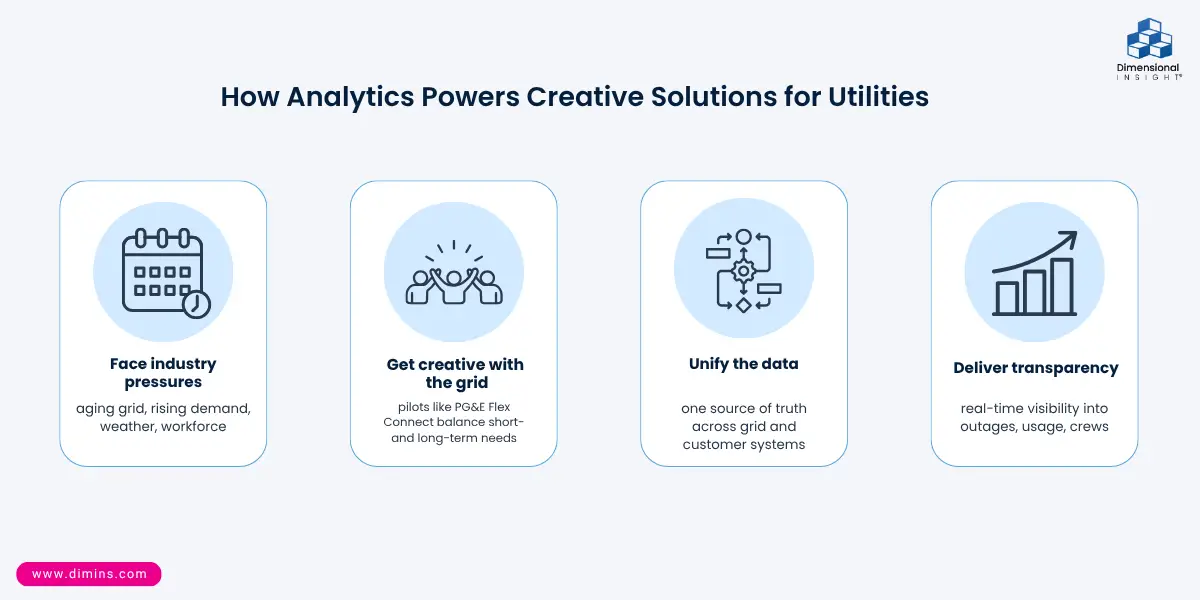
To put it simply, energy demand is increasing and the energy infrastructure is aging. The majority of the U.S. electrical grid is more than 25 years old and needs replacing in the coming years. This is exacerbated by the fact that there has never been more of a reliance on that grid. Electric vehicles and the general move towards electrification in other industries, combined with the expansion of data centers, has driven up electricity use over the past couple of years, with no sign of slowing down.
The utilities industry also faces the challenge of extreme weather. The work utilities do is complicated by outages caused by events such as flooding, droughts, wildfires, and high winds. Another challenge experts in the industry have their eye on is with the workforce. An aging workforce coupled with a higher turnover rate for younger workers has companies looking for ways to ensure there is not a large talent gap.
How are utilities companies being creative?
Pacific Gas and Electric Company (PG&E) provides natural gas and electric service to about 16 million people over a 70,000 square mile service area in northern and central California. It is one of the largest utility companies in the United States. PG&E has launched a pilot program that helps its customers meet their energy demands without overtaxing the grid.
Under normal circumstances, a new customer might be limited in how much energy they can consume until PG&E can ensure the grid can handle the new demands. It might be months or years before they can be fully connected to an updated grid. Through its Flex Connect pilot program, PG&E creates individualized solutions that meet a costumer’s short-term needs while also planning for the overall, long-term impact. PG&E’s grid management system will connect to the company’s energy management system and send an hourly power limit forecast a day in advance.
What role does an analytics solution play in this?
Organizations may not be able to address all of the challenges facing the industry at once. In order to tackle what they can, though, they need an analytics solution that can help them make the kinds of decisions PG&E is making.
PG&E’s Flex Connect is informed by both the customer’s energy management system and their own grid management system, providing scheduled or real-time capacity limits based on grid availability. That is a lot of information coming from different systems. An analytics solution can seamlessly bring all of that data together to produce one single version of truth that both the energy customer and energy provider can use to make decisions. Whether that date is about energy usage, preventative maintenance, or the workforce, a comprehensive analytics solution can produce reports that allow a utility company to find efficiencies in every aspect of their business.
Transparency is important in the utilities industry. Customers’ expectations are increasing in proportion with their energy demands. The right analytics solution can help provide real-time visibility into everything from when outages will be restored to information about their energy consumption. That visibility can also allow an organization to track teams responding to evolving conditions or unexpected events that can impact service.
The utilities industry faces its share of challenges in the coming years. Along with those challenges, though, come opportunities for innovation. It is an exciting time in the industry, and many organizations, like PG&E, are taking advantage of the opportunities to get creative. The best innovations are informed by data, and the right analytics solution can help you make those calls.

- Proper Data Governance Prevents Data Slop - October 8, 2026
- Tracking Shipping Price Changes with Analytics - October 1, 2026
- AI: The Good, The Bad (and Scary), and the Analytics - September 24, 2026