Confidence and clarity are two traits every great leader needs — and in today’s data-driven world, the two are deeply connected. Yet for many professionals, especially women, confidence with data doesn’t always come easily.
A recent study found that one in three women say they would avoid applying for a job that lists “using numbers or data” as a requirement — compared with one in five men. That simple gap in comfort can have a lasting impact on career paths, leadership readiness, and the way decisions get made in every industry.
Meanwhile, as women now hold 29% of C-suite roles — up from 17% a decade ago — the path to leadership increasingly runs through data literacy. Knowing how to interpret numbers, question assumptions, and tell a story with data has become a defining leadership skill.
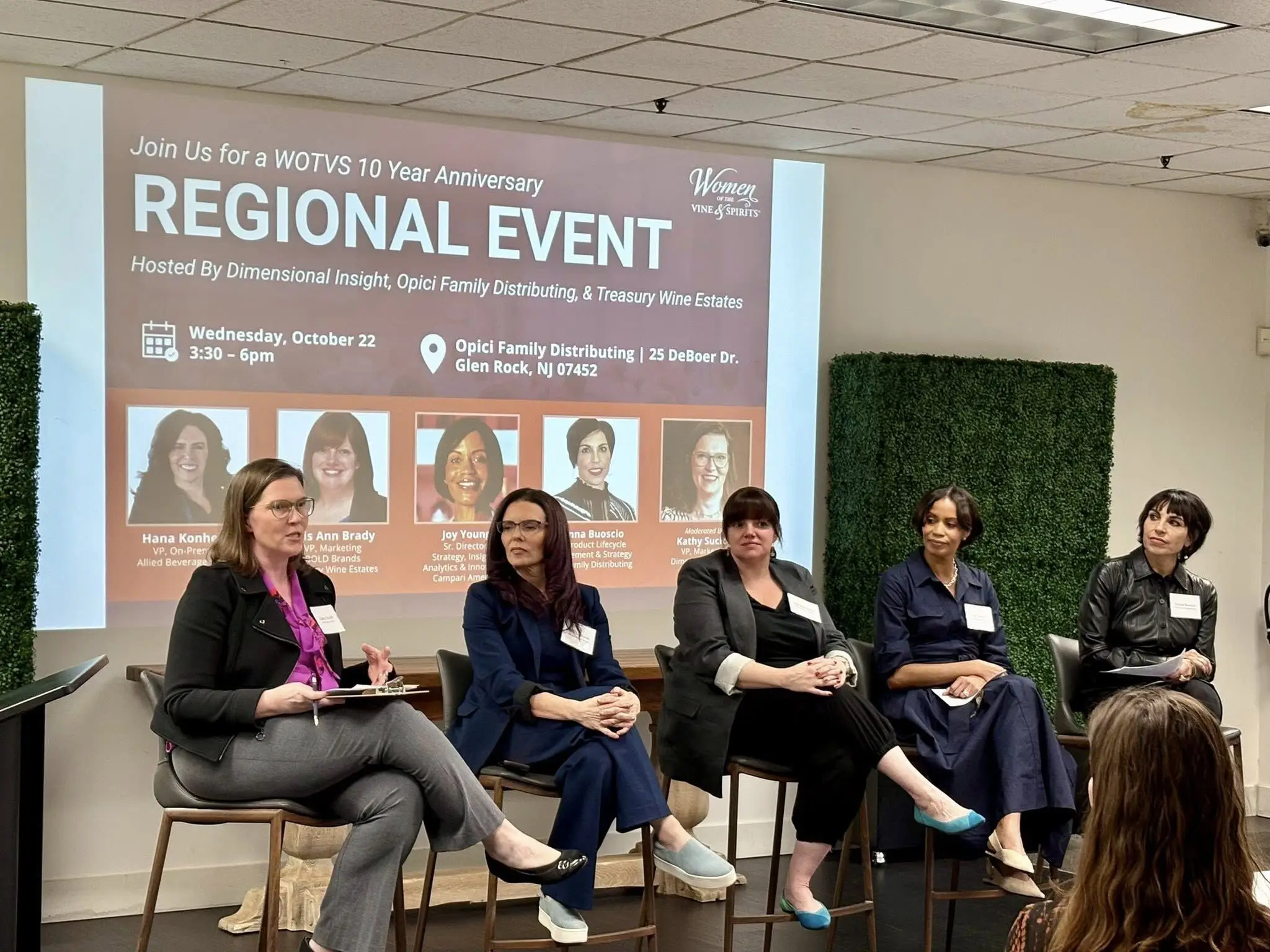
That’s the context that brought women from across the wine and spirits industry together on October 22 at Opici Family Distributing in Glen Rock, New Jersey, for a Women of the Vine & Spirits regional event: “Confidence, Clarity, and the Data Mindset.” Sponsored by Dimensional Insight, Opici Family Distributing, and Treasury Wine Estates, the discussion explored how data builds credibility, drives better decisions, and strengthens leadership across the industry.
I moderated the panel, which featured women leaders from across the industry, including Donna Buscio of Opici Family Distributing, Kris Ann Brady of Treasury Wine Estates, Joy Young of Campari America, and Hana Konheim of Allied Beverage Group. Each panelist shared practical perspectives on how data is transforming leadership in wine and spirits.

Data as Power and Confidence
One of the strongest themes to emerge from the event was that data is a source of power — not in a controlling sense, but as a foundation for confidence. When leaders use data effectively, it builds credibility in the room and shifts conversations from emotion to evidence. Data can neutralize opinions, bridge perspectives, and help everyone rally around a shared goal.
Confidence with data isn’t about knowing every metric or mastering every system. It’s about curiosity — asking the right questions, understanding what’s relevant, and using information to clarify decisions. That mindset helps transform uncertainty into influence and allows leaders to lead with both confidence and empathy.
Finding Focus in the Flood of Information
The wine and spirits industry has no shortage of numbers: depletion reports, market share data, shipment trends, and consumer insights. But too much information can create confusion instead of clarity.
The panelists discussed the need to start with purpose — knowing why you’re analyzing something before diving into the data itself. Defining the problem first helps teams avoid drowning in spreadsheets and focus instead on what will move the business forward.
When you begin with the right question, the right data tends to follow.
Listening First: The Human Side of Data
A recurring theme throughout the discussion was that effective data work starts with listening. Too often, people rush to “pull the numbers” before understanding what they’re truly trying to solve.
Listening to the challenges and context behind a request ensures that analysis serves a purpose — not just a report. It reframes data as a conversation tool rather than a compliance task. In a relationship-driven industry like wine and spirits, empathy and listening are just as important as analytics skills.
Turning Numbers Into Stories
Data doesn’t create change on its own — people do. That’s why storytelling emerged as a central theme. When data is presented as a story, it connects the dots for others and drives action.
The group emphasized simplifying complex data, eliminating unnecessary jargon, and tailoring visuals and messages for different audiences. Whether presenting to executives, marketing teams, or sales reps, the goal is the same: make the information meaningful and easy to act on.
When data is shared this way, it becomes inclusive. People who once felt intimidated by numbers begin to see how data supports their goals — and how they can use it to influence outcomes.
Balancing Data and Instinct
Despite the growing role of analytics, instinct still matters. Data may reveal patterns, but human judgment provides context. The best leaders know how to balance the two — using data to validate intuition rather than replace it.
Several examples from the discussion illustrated how trusting both the numbers and the experience behind them leads to stronger, faster decisions. Data helps frame the conversation, but the human element keeps it grounded in reality.
Learning Through Action
Another major theme was the importance of action over perfection. In an industry that moves quickly, waiting for “complete” data can mean missing opportunities. The group encouraged embracing progress over precision — acting when you have enough information to move forward, then learning and refining along the way.
This mindset encourages experimentation: pilot programs, market tests, and small-scale launches that reveal real-world insights. Failure, when viewed as feedback, becomes part of the learning process.
Building Confidence Across Teams
Confidence with data doesn’t just belong to analysts or executives — it’s a skill that benefits everyone. The conversation touched on ways to help teams feel more comfortable using data in everyday decision-making.
That means explaining the “why” behind metrics, simplifying reports, and modeling curiosity from the top. When data is framed as a shared resource instead of a judgment tool, engagement increases and collaboration improves. Confidence grows through participation — and participation comes from inclusion.
From Insights to Opportunity
Ultimately, the conversation reminded us that data is a source of opportunity. It helps us see what’s working, where we can improve, and how to lead with both confidence and clarity.
For women in the wine and spirits industry — and for anyone navigating a data-rich world — developing a data mindset isn’t about numbers. It’s about empowerment. It’s about using insight to tell stories, build credibility, and create meaningful change.
Conclusion
This conversation was part of the broader mission of Women of the Vine & Spirits: to advance empowerment, collaboration, and opportunity for all who work in the beverage industry. Events like this remind us that when we share insights, experiences, and support, we lift not just women, but everyone around us. Thank you to Women of the Vine & Spirits, our hosts at Opici Family Distributing, and everyone who joined us in New Jersey for contributing to an open and inspiring dialogue.


- How Hospitals Get to a Single Version of the Truth - October 20, 2026
- 10 Questions Every Healthcare Analytics RFP Should Ask - July 28, 2026
- We Have Epic. Why Are We Still Arguing About Our Numbers? - June 23, 2026