
The world is changing quickly around us, and it can be hard not only to keep up, but also to keep one’s head up amidst all this change. Burnout is common — as is the feeling of resignation or defeat.
But there’s one skill that can help people personally manage their reaction to change, as well as help their companies succeed: resilience.
Resilience is what allows individuals and organizations to not just withstand disruption, but to grow stronger because of it. It’s what transforms challenge into opportunity. And it’s a skill that can be cultivated. Let’s examine why resilience is essential today — and how people can strengthen this all-too-important capability. We’ll also take a look at how we at Dimensional Insight are helping our customers build their resilience.
What does resilience mean in the workplace?
Resilience is the capacity to adapt, recover, and even thrive during times of stress or uncertainty. It’s not only about “bouncing back” from challenges, but also about “bouncing forward” — learning, evolving, and emerging better equipped for what comes next.
In the workplace, resilience shows up in both people and systems. For employees, it means staying motivated, engaged, and adaptable even in tough times. For organizations, it means building structures and cultures that can pivot quickly, minimize disruption, and capture new opportunities.
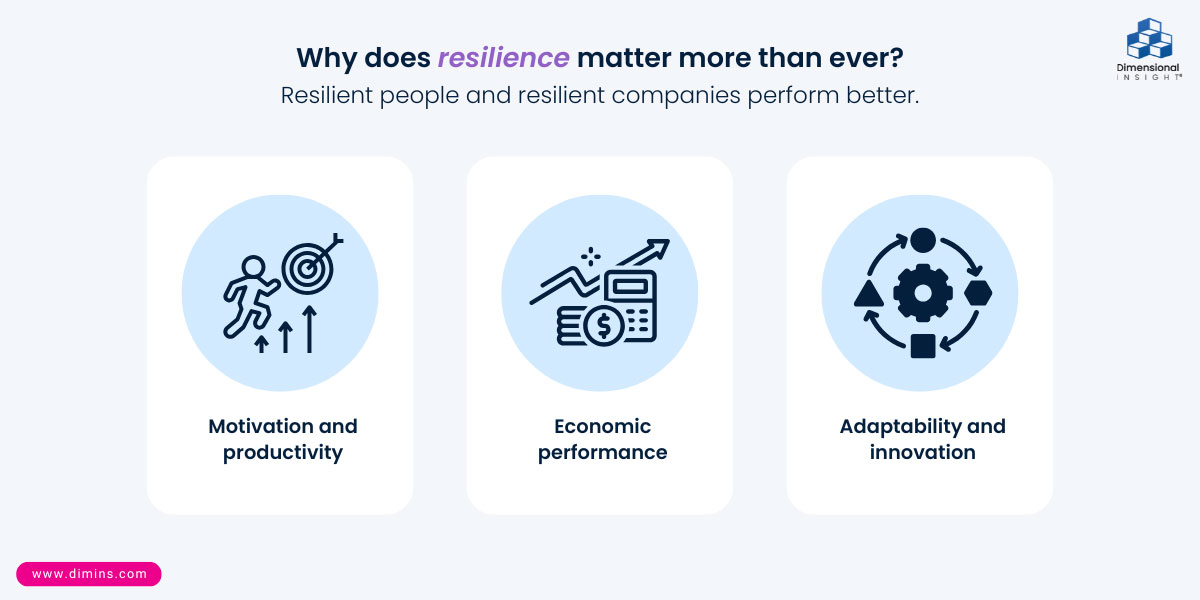
Why does resilience matter more than ever?
The numbers speak clearly: resilient people and resilient companies perform better.
- Motivation and productivity: Aon research shows that 86% of resilient employees are highly motivated, compared to only 44% of those who are not resilient. Motivation directly translates into engagement, performance, and business results.
- Economic performance: McKinsey found that “resilient” companies generated about 10% higher total shareholder returns during downturns, and a 50% performance differential during recovery periods, compared with peers.
- Adaptability and innovation: Other research from McKinsey found that organizations that cultivate resilience are more agile in responding to market shifts and emerging technologies. Yet only 16% of global employers invest in adaptability programs, even though 26% of employees say adaptability is a top skill they want to develop.
Resilience isn’t just a soft skill. It’s a measurable factor that impacts motivation, productivity, and the bottom line.
What happens when resilience is lacking?
Without resilience, organizations are more vulnerable to disruption, and individuals are more prone to burnout. Studies show that resilience acts as a protective factor — employees with higher resilience experience lower levels of stress, burnout, and absenteeism, while maintaining stronger performance under pressure.
The costs of not building resilience are real: disengagement, turnover, and missed opportunities for growth. Organizations that fail to invest in adaptability and support risk falling behind in a rapidly changing business environment.
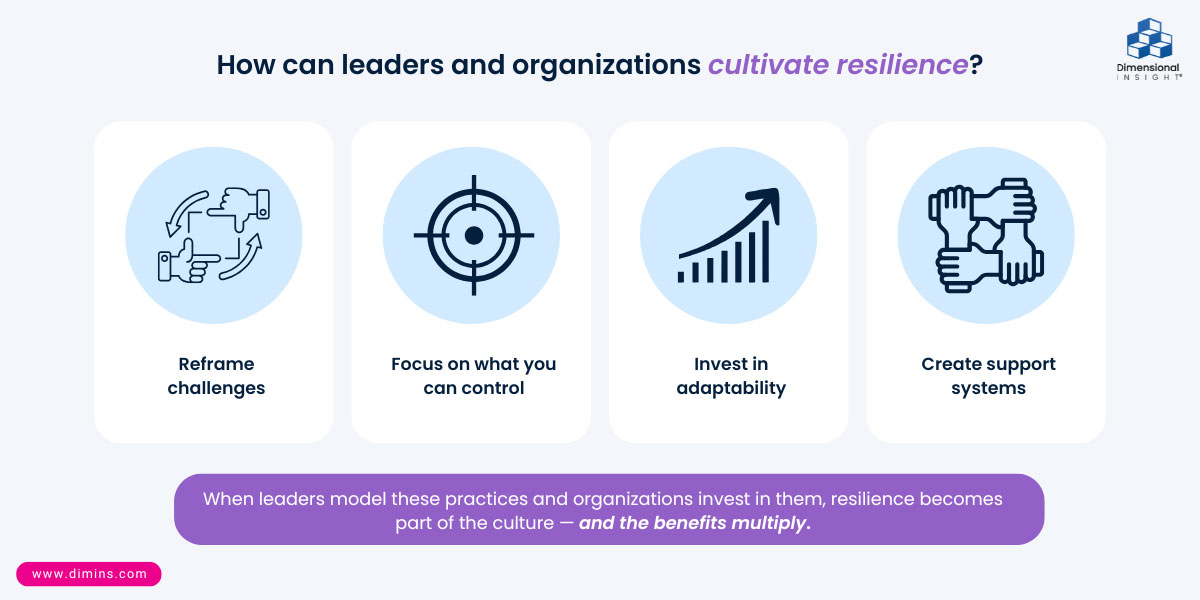
How can leaders and organizations cultivate resilience?
The good news is that resilience is not fixed — it can be built and strengthened over time. A few proven strategies include:
- Reframe challenges: View setbacks not as failures but as opportunities to learn and grow.
- Focus on what you can control: Energy spent on preparation, mindset, and response is always worthwhile.
- Invest in adaptability: Provide training and opportunities that help employees build skills for navigating change.
- Create support systems: Encourage mentorship, collaboration, and community, which strengthen collective resilience.
When leaders model these practices and organizations invest in them, resilience becomes part of the culture — and the benefits multiply.
How is Dimensional Insight supporting resilience?
At Dimensional Insight, resilience isn’t just a topic we talk about — it’s something we actively help our customers build. We know that organizations today face constant disruption, whether it’s economic uncertainty, evolving workforce needs, or rapid advances in technology. Our role is to provide clarity and confidence in decision-making, so that our customers can adapt quickly and effectively.
That means:
- Delivering analytics that help leaders see the full picture, even in complex environments.
- Supporting adaptability through tools that make it easier to respond to changing conditions.
- Building trust in data, so organizations can make confident decisions in uncertain times.
By combining technology, expertise, and partnership, we aim to be a source of resilience for our customers — helping them navigate disruption and find opportunities for growth.
The bottom line
Resilience is no longer just a personal trait. It’s a leadership imperative and an organizational advantage. Companies that cultivate resilience are better equipped to navigate uncertainty, adapt to change, and thrive in the face of disruption.
At Dimensional Insight, we believe resilience is key to sustainable success — and we’re committed to helping our customers build it through clarity, adaptability, and data-driven decision-making.
Resilience is how we move forward stronger — as individuals, as organizations, and as an industry.


- How Hospitals Get to a Single Version of the Truth - October 20, 2026
- 10 Questions Every Healthcare Analytics RFP Should Ask - July 28, 2026
- We Have Epic. Why Are We Still Arguing About Our Numbers? - June 23, 2026