
There are many factors prospective students take into consideration when looking at colleges. A college tour focuses on such aspects as academic offerings, campus life, the surrounding area, and amenities in a dorm, to name a few. For most students, though, the most important factor they consider when looking at schools is the overall cost.
Colleges and universities know this, and they spend a lot of time thinking about how to present the numbers around tuition and financial aid. Here’s what the experts say about whether that work makes a difference, and how analytics can help schools make decisions about cost.
What does it cost to go to college?
It’s not hard to find the tuition each college charges. It is much harder to figure out what an individual student might be paying if they decide to attend that college. There is financial aid to consider, of course, whether that is in the form of federal assistance or scholarships from the school itself. But there are many other ways that colleges and universities use their tuition costs to attract students.
Some schools offer incentives to get students to apply in their early decision window. The incentives can range from waiving application fees to a promise to grant 100% of a student’s financial aid needs. Some schools freeze tuition for four years once students are admitted. And more and more schools are offering free tuition to students, either due to academic or residency requirements, or for those whose annual family income falls below a certain level. But free tuition rarely means attending college is free.
How colleges talk about tuition matters
A public policy think tank released a study that showed the way colleges talk about free tuition could be different than what students actually pay. For students who fall under a certain income level, the tuition price might end up being covered by financial aid, but that doesn’t factor in expenses such as food, housing, books, and other supplies. The report says in addition to offering free tuition, institutions need to include information about all of the other expenses students will incur to make sure they are ensuring fully transparent communication. They say better communication about costs is one of the biggest benefits of the free tuition offer.
Another study focused on “tuition resets,” where instead of steadily increasing tuition year after year, some schools cut tuition by a certain amount. This study reviewed a set of schools that reduced tuition by at least 15% between 2011 and 2023 and found that the strongest results were in the areas of increased applications and new transfer enrollment. With the college landscape changing, colleges are looking to different populations than just high school graduates to make up their student body. The study points to tuition resets as a possible solution in terms of transfer students. However, experts caution the resets are only effective when accompanied by other initiatives, such as a variety of academic offerings as part of a well-rounded marketing strategy.
Data can help
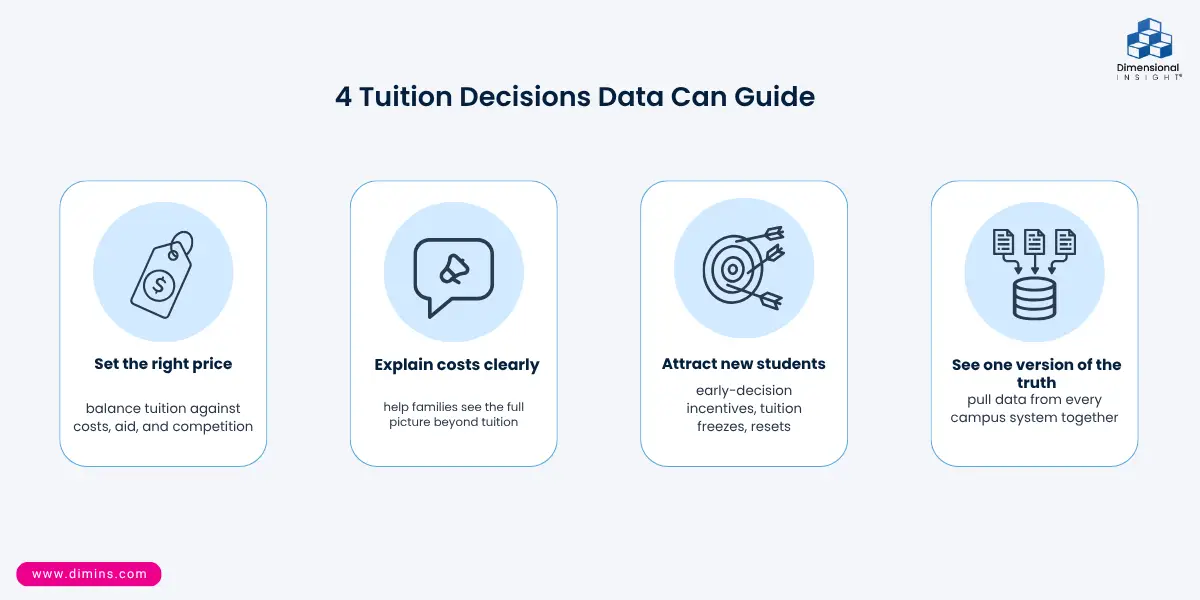
These are the types of tuition decisions where analytics can play a role. For some smaller schools, tuition is a major piece of the financial puzzle, while for larger colleges and universities there are other financial considerations that allow them to rely less on tuition. Either way, when it comes to the cost of a college education, schools need every piece of data they can get to make informed decisions about not only where to set the price, but also how to market it.
Often this data is spread out across campuses, as the system that holds the information about salaries, for example, might be completely different from the one that is used for facilities. The bigger the university, the wider the spread of information, whether that is sports teams or budgeting for different academic offerings and activities. The right analytics solution can bring all of that information together to produce one single version of truth so that when it comes time to decide about tuition increases or other adjustments involving that cost, all factors are being considered.
Analytics is not just for tuition decisions. Here are a few ways analytics solutions, such as Dimensional Insight’s Diver Platform, can be used in education:
- Schools are always trying to plan ahead, whether that is for their own internal strategic plan or for external accreditation processes. Analytics can help provide an overview of the quality initiatives that need to be tracked for these cycles.
- Analytics solutions can provide an overview of projects such as evaluations and monitor progress and collect evidence tied to strategic objectives.
- They can help with everything from improving student performance on campus to making it easier to reach out to alumni in fundraising efforts.
No two schools are alike. Just as there is no one standard tuition that works for all schools, there is no one approach to any of the efforts schools make when it comes to student life or the overall financial health of the institution. Whatever your school is targeting, the right analytics solution can help you use data to make those decisions, both now and into the future.


- Data can Lead the Way for Tuition Decisions - October 15, 2026
- Proper Data Governance Prevents Data Slop - October 8, 2026
- Tracking Shipping Price Changes with Analytics - October 1, 2026