
Artificial intelligence (AI) is no longer a future consideration; it is rapidly becoming an essential component of higher education. However, this does not mean that colleges and universities are adequately prepared to integrate AI into their programs. While many students use AI on a regular basis, they often feel as though they are not receiving enough guidance to use these tools efficiently and responsibly.
As a result, they are more likely to misuse it, which has raised many concerns within institutions on how to implement appropriate policies to ensure academic integrity. The lack of trust in these platforms, despite their widespread prominence, emphasizes the importance of sufficient AI training to guarantee productivity over dishonesty, along with developing skills that will be applicable in future professional environments as well.
How is AI being used in higher education?
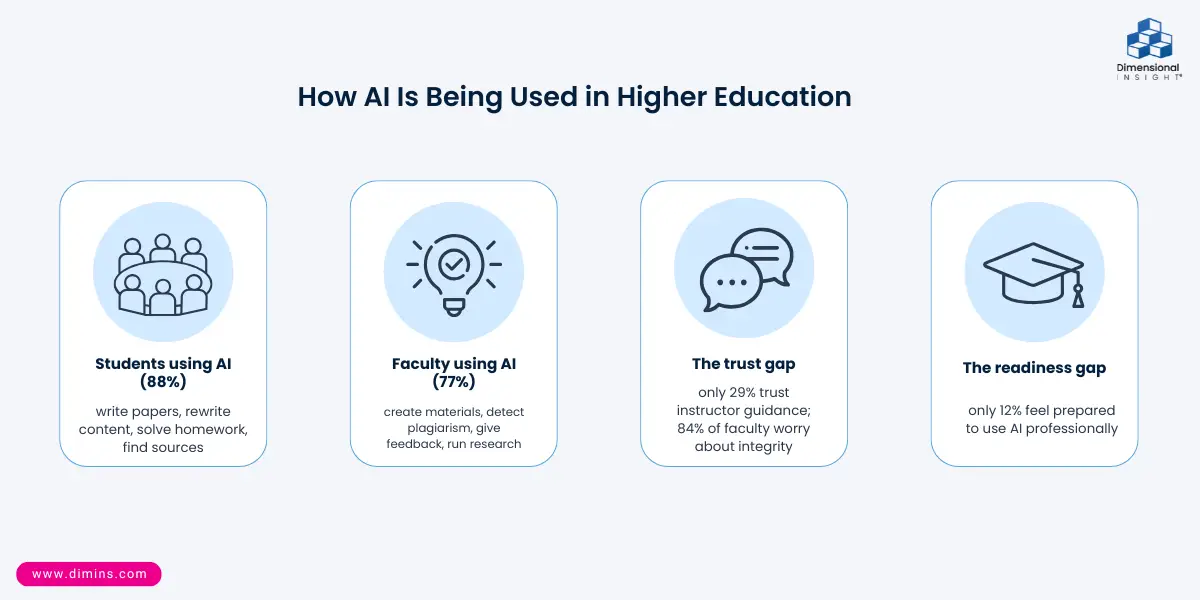
AI is being used in a widespread manner in higher ed by both students and faculty. Globally, 88% of students have used AI to support their studies, most commonly to:
- Write papers
- Rewrite content
- Solve homework problems
- Search for sources
77% of faculty have reported using AI in their curriculum to:
- Create teaching materials
- Detect plagiarism in students’ work
- Provide feedback to students
- Conduct research
The number of students and faculty regularly using AI has increased 16% since 2025. Additionally, AI use is widely promoted as many universities provide free access to ChatGPT Edu for students. While these increasingly growing applications indicate that AI has become a crucial part of academic workflow, it also means that a new set of challenges have been introduced. Students now must learn to use AI responsibly, and educators must consider how to integrate appropriate policies into their teaching.
What are the negative effects of AI in education?
However, a survey by the Digital Education Council states that only 29% of students feel as though their instructors are well equipped to guide them on AI, and a College Board survey found that 84% of faculty report concerns surrounding academic integrity with AI. Additionally, students worry about their peers using AI, as they are concerned that it may create unfair advantages. While institutions are eager to continue implementing AI-related skills and uses, this lack of guidance and trust could face severe consequences. Unclear expectations about appropriate AI use may lead to overreliance, preventing students from thinking independently, and inconsistency across curriculums.
For example, at Brown University, an economics professor allowed his students to take home their midterm exams. The exam had an average score of 96%, which varied drastically from past years. He ran the questions through ChatGPT and realized that his students had most likely used AI to complete the exam. He then required the final exam to be taken in-person, which resulted in 18 students dropping the class, and the class ended up with an average score of 48.6%.
Despite AI’s potential to enhance learning, this case emphasizes the importance of promoting AI literacy, not dependence. It is important to implement policies to condone academic integrity, however; it is just as important to introduce policies that ensure that AI is used as a tool and not a replacement.
How does this translate beyond education?
Of course, AI isn’t just being used in higher ed – it is being used widespread in the workplace as well. However, only 12% of students feel as though their studies are preparing them to use AI professionally. There is also concern surrounding AI taking over future job opportunities. This further exemplifies the need for adequate AI training in higher education. Students need to learn to work with AI instead of against it, setting them up for success throughout their careers.


- How Gen Z is Reshaping the Beverage Alcohol Industry - August 25, 2026
- How AI is Impacting Higher Education - August 20, 2026