
Your CFO asks what average length of stay was last month. Finance says 4.7 days. Operations says 5.1. Who’s right?
Both of them. And that’s exactly what makes this so hard to fix.
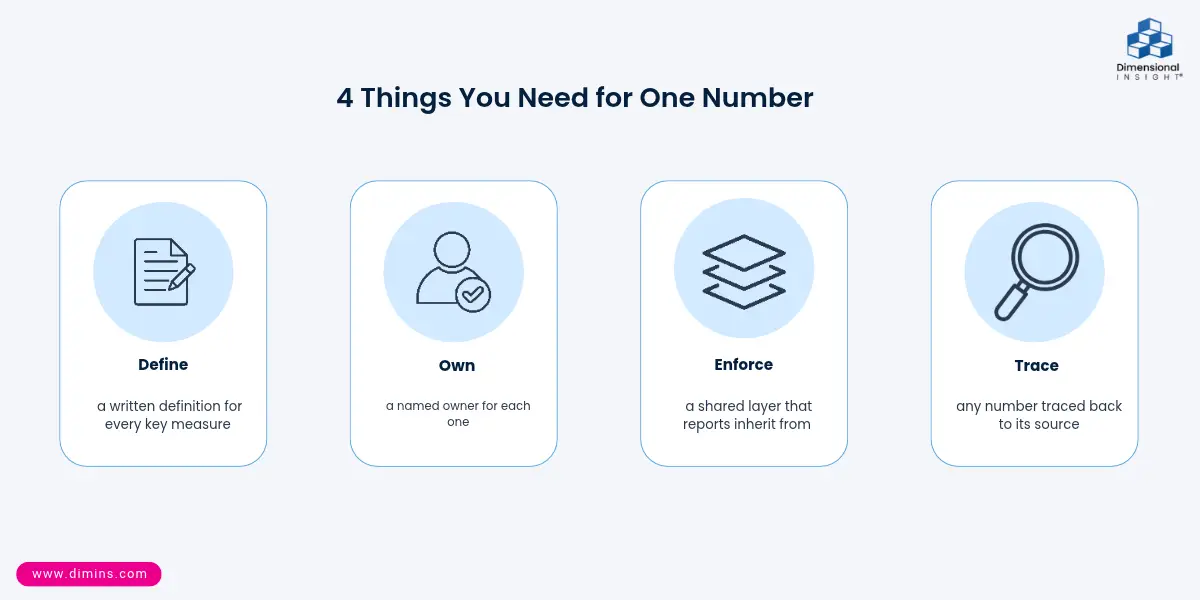
Getting to a single version of the truth takes four things:
- A written definition for every measure that matters
- An owner for each one
- Enforcement in a shared layer your reports inherit from
- The ability to trace any number back to where it came from
Platforms built around that requirement – Dimensional Insight’s Diver Platform among them — keep definitions in one place instead of letting every report rebuild them.
Most hospitals don’t have any of the four. Here’s what that looks like in practice.
Why your departments report different numbers
Finance counts calendar days. Operations divides hours by 24. And it keeps going from there. Do observation patients count? Is the patient attributed to the admitting service or the discharging one? Is a transfer between units one stay or two? What about a leave of absence day?
Every one of those is a defensible choice. Somebody made it years ago, built it into a report, and nobody wrote it down where the other team could see it.
Now multiply that by readmission rate, net revenue, case mix index, denials, and productive hours. You probably recognize what happens next. Meetings turn into debates about whose report is right. Your analysts spend their days reconciling instead of analyzing. And your executives hesitate to act, because they’re not sure which number to believe.
A data warehouse won’t fix this
When organizations recognize this problem, the usual response is to consolidate. Build a warehouse, move everything into it, connect a BI tool. Months later, the numbers still don’t match.
Here’s why. A warehouse governs where your data lives. It doesn’t govern what your data means. You can land every table from every system into one beautifully designed environment, and if finance writes its own length of stay calculation in SQL while operations writes a different one in the BI tool, you’ve consolidated your storage and changed nothing about your answer.
The same is true of visualization tools. Power BI, Tableau, and Qlik render whatever logic you give them. They’re capable products and plenty of hospitals use them well. But logic that gets rebuilt in every report will drift apart no matter how good the report looks.
So the capability that matters isn’t storage and it isn’t visualization. It’s a governed layer where each measure gets defined once and everything downstream inherits it.
What to look for in a platform
If you’re evaluating healthcare analytics platforms, whether that’s Epic, Health Catalyst, Innovaccer, Arcadia, Dimensional Insight, or something else, here are the four capabilities that matter for this particular problem.
- Define each measure once, with the rules attached. A definition isn’t a description in a document somewhere. It’s a specification: inclusions, exclusions, date logic, attribution rules. And it needs to apply everywhere the measure shows up. In Diver Platform, business rules and KPIs live centrally, and your dashboards, reports, and exports inherit them.
- Show how the number was calculated. When somebody disputes a figure, can they click into it and see the math? Most arguments end right there. Diver Platform lets users drill from a summary measure down to the records behind it, within whatever permissions they have.
- Hold definitions across systems, not just inside one. A definition that only works inside your EHR isn’t an enterprise definition. Your CFO looking at margin isn’t working from clinical data alone. Your COO looking at staffing needs workforce data. Diver Platform connects to your general ledger, cost accounting, workforce, supply chain, patient experience, and revenue cycle systems alongside clinical data, so a measure means the same thing no matter which system it came from.
- Change it once, change it everywhere. Definitions change. Regulations shift, you add a service line, you acquire a practice. When a definition gets revised, every report using it should update too. Otherwise you’ve just created a second generation of inconsistency alongside the first.
You don’t have to settle every definition first
Most organizations assume they need to run a long governance process before analytics can be useful. That gets the order backwards.
Dimensional Insight’s healthcare applications come with hundreds of measures already defined. Where CMS specifies a measure, we use the CMS definition, so you’re starting from a published national standard rather than an internal argument.
And these are real definitions, not labels. Take Normal Newborn ALOS. It’s the sum of normal newborn discharge days divided by total normal newborns discharged. But that requires defining a normal newborn — a baby not in a NICU or special care nursery— which in turn requires defining what counts as a NICU and what counts as a special care nursery. Those nested decisions are exactly the ones that sit unresolved in hospitals for years, and they’re the reason two reports disagree.
If your organization needs a measure calculated differently, you change it in one place and everything downstream follows.
So the conversation still happens. It just happens over the handful of measures where your organization genuinely differs, instead of all of them.
What technology still can’t decide for you
Pre-built definitions shorten the list. They don’t eliminate it, because governance is an organizational problem before it’s a technical one.
Somebody at your hospital still has to decide the things CMS doesn’t define for you, and which departments get measured on what. The organizations that handle this well put together a small group with real authority, work through the measures people argue about most, and publish the answers. The shorter that list, the faster you get through it.
AI makes this more urgent
Every health system is being asked what it’s doing about artificial intelligence (AI), and most are piloting something.
Here’s the problem. AI doesn’t solve governance problems. It exposes them.
Ask an assistant what your readmission rate is. If it’s querying your tables directly, you’ll get a fluent, confident, nicely formatted answer. It won’t know you have four definitions of readmission. It won’t tell you which one it used.
Analytics that disagree give you an argument in a meeting. AI that disagrees gives you an answer nobody questions, delivered fast, to people who weren’t in the room when the measure was defined.
That’s why governed definitions have become a prerequisite for useful AI rather than a separate project. An assistant working from governed measures can show its work. One querying raw tables is just generating plausible numbers. Diver Platform applies the same governed measures to its AI capabilities as to every dashboard, so what you get in a conversation matches what you’d get in a report.
Frequently asked questions
What analytics platforms give hospitals a single version of the truth?
Look for a platform that enforces measure definitions in a shared layer instead of in individual reports, lets users trace a number back to its source, and connects to systems beyond the EHR. Hospitals commonly evaluate Epic, Health Catalyst, Innovaccer, Arcadia, and Dimensional Insight for this. Dimensional Insight’s Diver Platform keeps business rules and KPIs centrally, so dashboards, reports, and exports all inherit the same definitions.
Why do different departments at our hospital report different numbers for the same thing?
Usually it’s differing definitions, not bad data. Finance, quality, and operations often calculate measures like length of stay, encounters, and net revenue with different inclusion rules, date logic, and attribution rules. Each one is internally consistent. They just don’t match each other. Platforms like Diver Platform address this by defining each measure once and applying it everywhere.
Do we need a data warehouse first?
No. A warehouse governs where your data lives, not what it means, and hospitals with mature warehouses often still have four definitions of net revenue. The definition layer is a separate problem and you can tackle it on its own.
Can we do this with Power BI or Tableau?
Those tools render whatever logic you give them, and plenty of hospitals use them effectively. But unless the measure logic lives in a shared layer underneath, each report rebuilds it and the definitions drift. Diver Platform provides that layer along with the analytics on top of it.
Who should own a metric definition?
Usually a business owner rather than an IT owner, backed by a governance group that can settle disagreements between departments. The owner needs the knowledge to make the call and the standing to make it stick.
What is a governed metrics layer?
It’s where your business rules and measure definitions live centrally and everything downstream inherits them. It sits between your source data and the reports, dashboards, and AI tools that use it, so a measure gets calculated the same way wherever it appears.
Is our data ready for AI?
If you have more than one definition of a key measure, an AI assistant querying your data will hand you confident answers without saying which definition it used. Governed definitions are a prerequisite, not an upgrade. Diver Platform applies the same governed measures to its AI capabilities as to its dashboards.


- How Hospitals Get to a Single Version of the Truth - October 20, 2026
- 10 Questions Every Healthcare Analytics RFP Should Ask - July 28, 2026
- We Have Epic. Why Are We Still Arguing About Our Numbers? - June 23, 2026