
Over the past few years Major League Baseball has introduced a number of new rules. For a sport notoriously slow – or even resistant – to making changes, it has been jarring for some fans. Most of the adjustments have been well-received, though, because they have improved the quality of play on the field.
The first major change was the introduction of instant replay challenges. Then, in 2023, Major League Baseball instituted a package of big rule changes: a pitch clock, the infield shift was banned, pitchers were limited in how many times they could disengage from the rubber to keep baserunners in check, and the size of the bases increased. Those rules were aimed at making games quicker and more exciting, encouraging more hits and stolen bases.
For the 2026 season, Major League Baseball has brought in the Automated Ball-Strike (ABS) system. The game is played the same way as always, with an umpire behind the plate calling balls and strikes. The difference is, if a hitter, pitcher, or catcher wants to challenge one of those calls, they can instantly tap their head, and the automated system will be employed to check the umpire’s work.
Each team starts with two challenges, and if they get a challenge right, they keep it. If the player is wrong, the team loses a challenge. The change has been well-received so far by fans and players alike, and it can help illustrate exactly why analytics can bring about positive change for your organization:
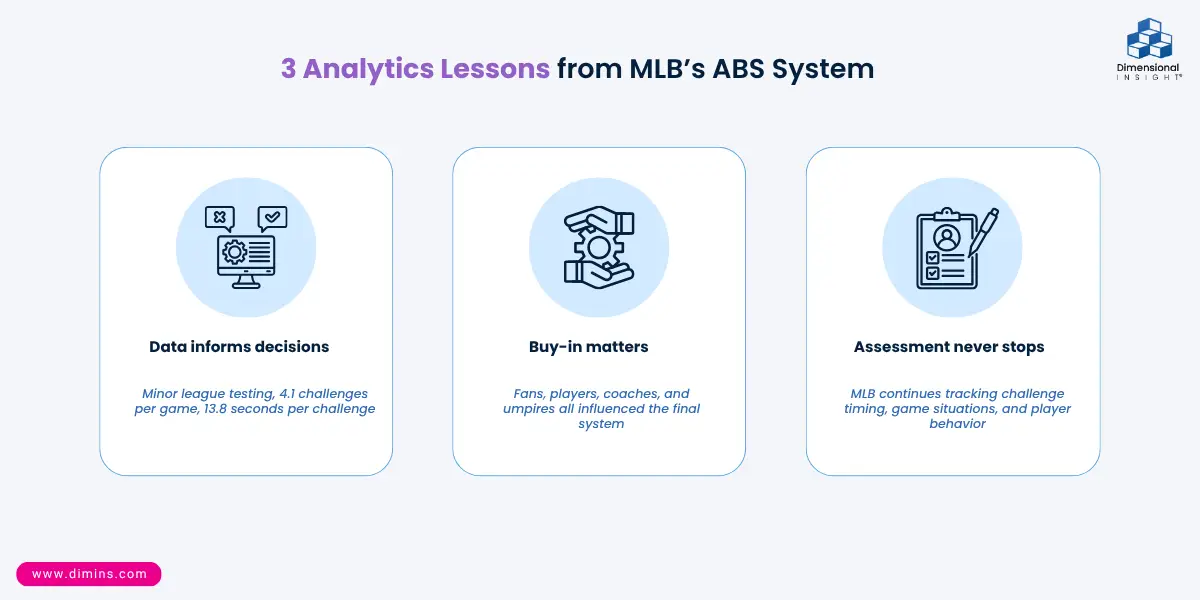
- Data helps inform decisions. Officials in Major League Baseball didn’t just wake up the day before spring training began and decide to start using the ABS system. The change was the result of careful planning and the use of data. All of the changes baseball has made in recent years were tested in the minor leagues to gather data, and in this case, ABS was also used during 2025’s Spring Training games. For ABS, officials considered whether the reviews would make games longer. They found that in the 288 2025 spring training games in which ABS was used, there were an average of 4.1 challenges per game, which took an average of 13.8 seconds each. The challenge system also did not add more pitches per plate appearance in those games.
When using data to institute change in your organization, it is important to figure out exactly what data points would help you make the best decisions. For Major League Baseball, one of the keys was the length of games. After the pitch clock made games significantly shorter, they likely had a cutoff of how much extra time they were willing to give back for the ABS challenges. With the average game seeing only about 57 seconds of added time, that was a small enough impact that they felt they could go ahead and make the change.
- It is important to get buy-in from all constituents. Another data point Major League Baseball considered was opinions from those involved. The league surveyed fans, players, and coaches and the results were that people liked the system. At one point the league was deciding between using full ABS, but there was a preference for keeping a human element in the game and using the challenge system over only automated balls and strikes. Baseball also asked fans what their preferred number of challenges would be and used that information to help land on two challenges per team.
When instituting any kind of change, organizations see better results when they don’t act unilaterally. It is important for people to feel their voices are being heard, even if they are not fully on board with the proposed changes. In baseball’s case, it was important to also get buy-in from the umpires. The fact that the league chose the challenge system over full ABS was a compromise. Although umpires are now being put on the spot multiple times a game, fans are also appreciating just how good many of them are at their jobs, with fractions of an inch often being the deciding factor in whether they got a call wrong or right. Taking care of all stakeholders in a major decision is an important part of the analytics process.
- Assessment is continuous. Just because the season has started and ABS is in use doesn’t mean the work is done. Major League Baseball is continuously assessing the impact of ABS on the product on the field. The entire ABS system is built on data – from accurately measuring every player in order to create their strike zone for the automated system to breaking down the ball-strike counts in which the system is used. For teams, the data being collected revolves around which game situations are the best times to use a challenge, and which players are most successful at recognizing when a call is wrong.
The same is true of business intelligence in your organization. Just because you might have made a decision based on the data you were able to use doesn’t mean your work is done. The right analytics solution is one that is flexible, able to adjust with your organization when you decide you might need to shift gears and address an issue that may not have been the original aim of your work with data. A comprehensive analytics solution can bring together data from a variety of sources to produce reports that can help you make decisions that have a positive impact on all aspects of the organization.
Data is everywhere in baseball. It can often dictate which players are in the lineup on a given day, but it can also inform decisions like which days attendance can be boosted by a gate giveaway. Fans are not exactly showing up at the park to watch an ABS challenge happen. But there’s no doubt it can be exciting when a walk turns into a strikeout for the home team’s pitcher after the catcher challenges an umpire’s call. The roar of the crowd can be a form of data as well. What are you trying to do to please your audience? Analytics can help your business make the decisions that send your fans home happy.


- What Election Predictions Can Teach Us About Data Analytics - October 22, 2026
- Data can Lead the Way for Tuition Decisions - October 15, 2026
- Proper Data Governance Prevents Data Slop - October 8, 2026