
Decision-makers in higher education have an immense amount of data they use in their work. Depending on the issues they are trying to address, they can pull financial, campus building, current student, former student, or prospective student data, to name a few. Those are just the data points the college can generate on its own. There is also data that comes from outside sources.
One such source is the United States census. Every ten years, in years ending with a 0, what’s known as the decennial census is taken. Those results can help many different industries make decisions about areas that are growing – or decreasing – in population. In between the decennial counts is the American Community Survey (ACS), which can provide more fresh datasets related to the U.S. population. The 2024 5-year estimates were released recently. Here’s how that data can influence the work of colleges and universities.
Workforce needs
Dubuque County in Iowa offers an example of how schools and cities can work together to achieve goals. The 2020-2024 ACS results for the area show population growth, a rise in median income, and a drop in poverty rate. The Greater Dubuque Development Corp. (GDDC) gives some of that credit to Opportunity Dubuque, a program offered through Northeast Iowa Community College that provides training in a number of disciplines to fill high-demand and high-paying jobs.
GDDC sets goals that the organization measures using the ACS results. They are not sure they will meet a goal of 105,000 residents by 2027, but they believe their work with the university there is moving them in the right direction. The University of Dubuque is planning a medical school downtown and has future plans for an engineering program, both of which match the area’s workforce needs. The GDDC’s director of workforce programming says, “We’re trying to ensure that higher ed decision-makers understand the needs of employers in the area and vice versa.”
Domestic outmigration
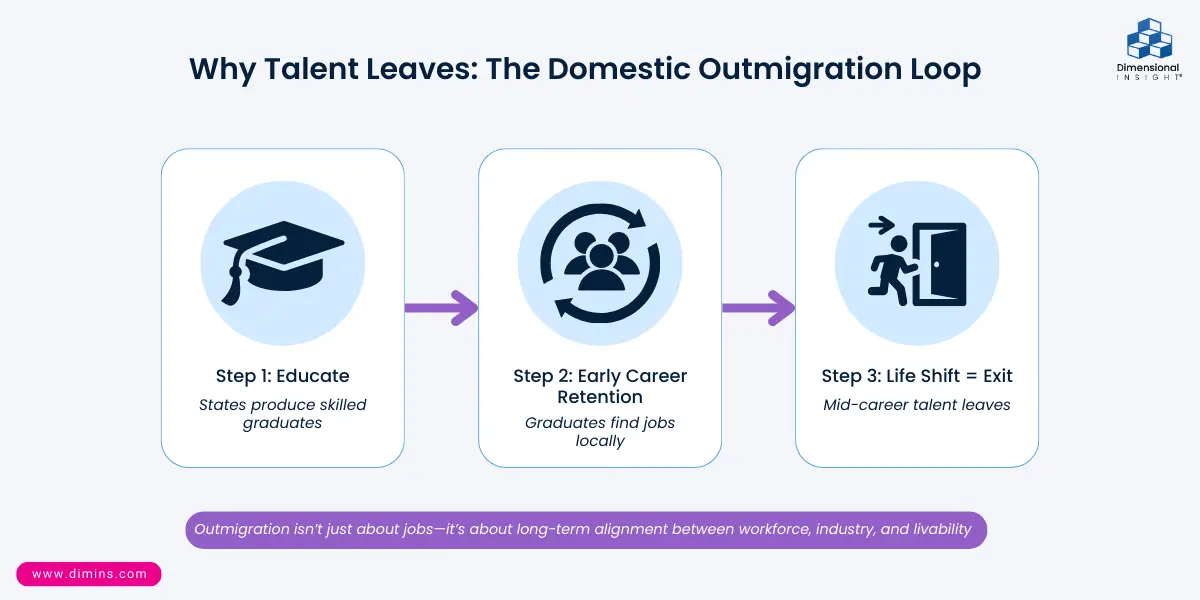
One of the statistics that comes out of the ACS that states pay a lot of attention to is domestic outmigration. Not unlike the situation described above in Iowa, there is a connection between this number, industry, and education. Not every case of someone leaving a state is related to what they studied in school – there are many elements to consider such as tax rates or age range and affordability. Virginia, for example, has seen increasing numbers of college graduates leaving the state 5-to-10 years after graduation. This could be because young college graduates are able to find work and housing in the state, but as they get older and look for a house with a yard, for example, they might move to where those things are more affordable.
States can’t rely on colleges and universities to address those exact situations, but they can use the numbers to address what they can. It could be that they use the ACS results to more closely align industry offerings in their state to the kinds of workers their schools are good at creating. They can offer incentives to attract those types of businesses to their state. Similar to Iowa, they can also look to add college offerings that align with the industries that are already located there.
What is data’s role?
What is certain is that when the outmigration numbers trend upwards, state officials look to take action, and higher education is one area that can help. Using data to dictate class offerings is not new to the world of higher education. Colleges and universities use a lot of data from prospective students to help them understand whether they are lacking in certain classes or disciplines, or if they employ the personnel to increase their class variety or need to make more hires.
Whether the data is being used for college programs or in collaboration with the larger community in connection with the type of information that comes from the ACS, it is important to have a reliable analytics solution. The right solution can produce reports that lead to effective decision-making, bringing together information from across the organization, for either small colleges housed in a few buildings or a university spread across a big city.
Having the data is just one part of the equation. Business intelligence can turn that data into the type of actionable information that can help solve problems, both for the school itself and possibly for the surrounding community. The census might provide new details whenever those datasets are released, but colleges and universities are gathering data every day. An analytics solution gets decision-makers the information they need to use that data to make improvements for the school and its students.


- Using Public Data with Your Analytics - April 9, 2026
- An Election Year Puts the Spotlight on the Energy Industry - April 2, 2026
- How Data Helps Improve Accessibility - March 26, 2026