For some patients, healthcare is as simple as an annual physical, or issues connected to their family history. For others, though, there are other factors at play, like Income level, or housing, or access to healthcare. These are the social determinants of health, and understanding their impact is essential to the healthcare industry.
Data is playing a major role in that understanding. Here’s how a team of researchers has had an impact on the industry with their data around social determinants of health, and how organizations can use data to make a difference of their own.
What are social determinants of health?
Social determinants of health are the environmental factors that have an impact on a person’s health. The World Health Organization (WHO) gives a broad definition as “the conditions in which people are born, grow, live, work, and age, and people’s access to power, money, and resources.” The organization goes on to call the differences in health status within and between countries “unfair and avoidable.”
People who have limited access to quality housing, education, social protection, and job opportunities have a higher risk of illness and death, according to WHO. There is a lot of work being done in healthcare to study and take action with regard to the social determinants of health in order to address health issues in some populations before they happen.
How can data make a difference?
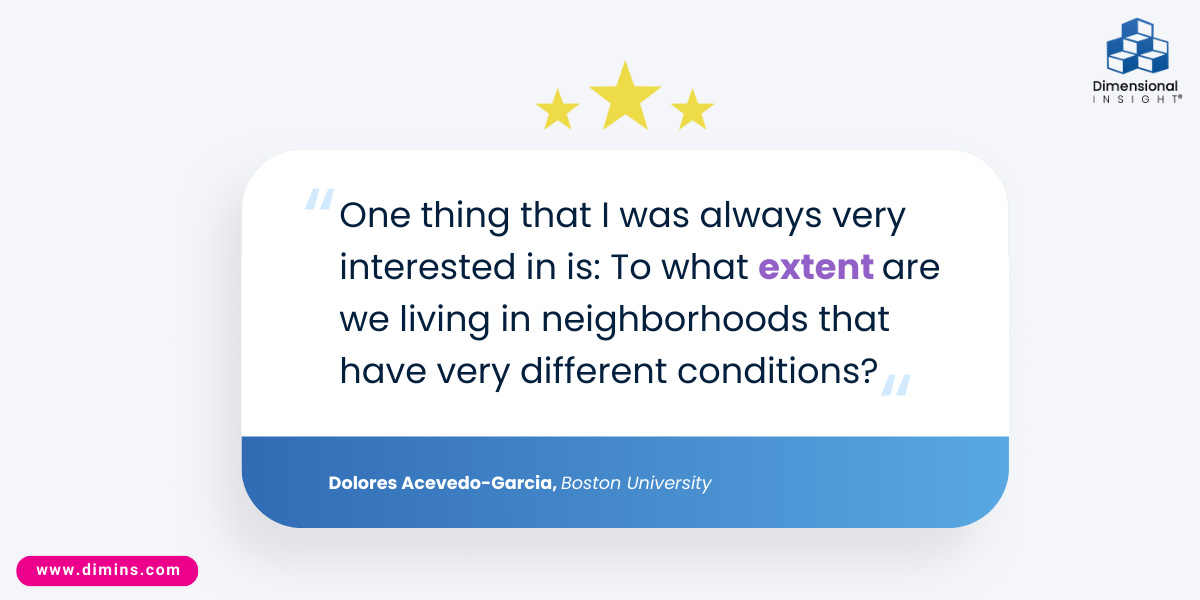
Some of that work is being done by a team of researchers at Boston University led by Dolores Acevedo-Garcia. They publish the Child Opportunity Index (COI), which tracks data in areas such as education, health, environment, and economics. “One thing that I was always very interested in is: To what extent are we living in neighborhoods that have very different conditions?” Acevedo-Garcia told Boston University’s Bostonia magazine. “Do we see patterns that Latino kids or Black kids, for example, are largely living in neighborhoods with much harder conditions for them to grow in a healthy way? Much to my surprise, we did not have a national data system to look at that.”
The information Acevedo-Garcia’s team has made public has led to a number of actions being taken. In New York, COI data led the state to consider equitably reducing school suspensions and expulsions. Michigan has used the data to target services toward children in low-opportunity neighborhoods, and in California a professor used the COI data alongside emergency room data to show that children in low-opportunity areas are far more likely to visit the ER for a medical issue that could be treated more appropriately and cost effectively by a primary care provider.
How can an analytics solution help organizations make a positive impact?
The COI uses a larger data set than was previously used to assess these conditions. In the past, the poverty index was the main source of information about health and socio-economic conditions. The COI included more specific data from different areas, like access to parks or open spaces, or when it comes to health who actually had health insurance, and different factors within education such as schools. In order to take information from different sources like these you need an analytics solution that can integrate data from a diverse group of systems to produce reliable results. If the information is not reliable, it cannot bring about the kind of change that the COI has helped to spur.
It is also important to know what kind of results you are looking for, and to have a solution that is flexible enough to meet your needs. Partnering with a company that understands what you are looking for is paramount, and it takes cooperation within your organization as well. Every stakeholder who would benefit from the results should be involved in the process so that all necessary data is included to get the best results.
There are many ways to bring about positive change in the healthcare industry. Some healthcare is reactive, and data can be used to help address health challenges when it comes to treatment. But with social determinants of health, a lot of the work data can do is proactive. By using all of the information available to the industry, healthcare workers can step in to improve health outcomes before anyone even steps foot in a medical office. But in order for the data to make that kind of an impact, you need to use an analytics solution that can help you make the best decisions possible.

- “Where’s the Beef?” How Data Turns AI From Gimmick to Growth - January 27, 2026
- How Analytics Can Help with 2026 Supply Chain Challenges - January 22, 2026
- Analytics Can Guide Higher Ed through Challenging Times - January 15, 2026