
Healthcare organizations spend a tremendous amount of time evaluating analytics platforms. RFPs often stretch for dozens of pages and include hundreds of requirements covering everything from security and architecture to visualization tools and artificial intelligence capabilities.
There is nothing wrong with evaluating technology. The problem is that many healthcare analytics RFPs focus heavily on features while overlooking the factors that ultimately determine whether an analytics initiative succeeds.
Two departments are looking at the same metric and getting different answers. A report that was supposed to support a strategic decision turns into a discussion about methodology. Analysts spend days reconciling numbers while leaders wait for answers. Most healthcare organizations have experienced some version of this scenario. Yet many analytics RFPs devote far more attention to dashboards, databases, and AI features than to the questions that help prevent these problems in the first place.
Healthcare organizations evaluating analytics platforms may encounter solutions from Epic, Oracle Health, MEDITECH, Health Catalyst, Innovaccer, Arcadia, Dimensional Insight, and others. While these solutions differ in their approach, the most successful analytics initiatives tend to address the same fundamental challenges.
Before issuing a healthcare analytics RFP, consider whether you’re asking the questions that matter most.
1. How Are Metrics Defined and Governed?
This should probably be the first question in every healthcare analytics RFP. Unfortunately, it often isn’t.
Many organizations assume that analytics challenges stem from a lack of data or insufficient reporting tools. In reality, one of the most common obstacles is disagreement about how key metrics should be calculated. Length of stay, readmissions, patient volumes, cost per case, emergency department throughput, and countless other measures can be calculated differently depending on who owns the report, which data source is being used, or what assumptions have been applied.
The result is a situation that many healthcare leaders know all too well. Meetings become less about performance improvement and more about determining which report is correct. Analysts spend valuable time validating numbers. Executives hesitate to make decisions because they are unsure which version of a metric should be trusted.
The challenge isn’t necessarily access to data. It’s creating a consistent framework for defining and managing information across the organization.
When evaluating healthcare analytics vendors, ask how business rules are created, maintained, and shared. Ask what happens when a metric definition changes. Ask how departments ensure they are using the same logic. A platform may be able to produce an impressive dashboard, but if every report calculates a metric differently, confidence in the analytics will erode over time.
Questions to ask vendors:
- Who owns metric definitions?
- How are business rules documented and managed?
- What happens when a metric definition changes?
- How do you ensure consistency across reports and dashboards?
2. What Outcomes Have Your Customers Achieved?
Many healthcare analytics RFPs spend pages evaluating technology and only a few lines evaluating results.
Hospitals do not purchase analytics platforms because they want more dashboards. They invest because they want to improve financial performance, reduce denials, increase revenue capture, improve throughput, optimize staffing, reduce readmissions, or improve quality measures. The technology is important because it supports those goals, not because it is the goal itself.
This is why one of the most valuable questions in an RFP is also one of the simplest: What measurable outcomes have your customers achieved?
A vendor should be able to point to specific examples of operational, financial, or clinical improvement. More importantly, they should be able to explain how those outcomes were achieved and whether they were sustained over time. A feature list tells you what a platform can do. Customer outcomes often provide a better indication of what an organization is likely to accomplish with it.
Questions to ask vendors:
- What measurable outcomes have customers achieved?
- Can you provide healthcare-specific examples?
- How were improvements measured?
- How long did it take customers to realize value?
3. How Do You Support Data Beyond the EHR?
One of the most common misconceptions in healthcare analytics is that implementing an EHR automatically solves analytics challenges.
Modern EHR platforms such as Epic, Oracle Health, and MEDITECH provide powerful reporting and analytics capabilities. They contain enormous amounts of valuable information and are essential components of the healthcare technology ecosystem. However, most strategic decisions require information that extends beyond the EHR.
A chief financial officer evaluating margin performance is unlikely to rely exclusively on clinical data. A chief operating officer assessing staffing efficiency may need workforce management information. Population health initiatives may require claims data. Patient experience programs often rely on survey information. Quality initiatives may incorporate external benchmarks.
This is why many organizations continue to invest in healthcare analytics platforms even after implementing sophisticated EHR reporting environments. Enterprise decision-making requires organizations to combine information from multiple sources and apply consistent business logic across all of them.
When evaluating vendors, look beyond EHR integration. Ask how the platform supports financial systems, ERP applications, workforce management solutions, claims data, patient satisfaction information, and other critical data sources. The ability to create a unified view of performance is often more valuable than any individual report.
Questions to ask vendors:
- How do you integrate data beyond the EHR?
- How easily can new sources be added?
- How is consistency maintained across systems?
- What experience do you have integrating financial, operational, and clinical data?
4. How Much Technical Expertise Is Required?
Most healthcare organizations begin their analytics journey with the goal of making information more accessible. Yet many eventually discover that they have simply moved the bottleneck from one place to another.
Business users may have access to dashboards, but answering a new question often requires submitting a request to an analyst. Adding a new metric requires technical resources. Integrating a new data source requires technical resources. Modifying a calculation requires technical resources. Over time, analytics teams become overwhelmed by report requests and maintenance work, leaving less time for higher-value analysis.
This is one reason healthcare organizations should carefully evaluate who can use the platform and how much expertise is required to maintain it. An analytics environment that depends heavily on a small group of technical experts may struggle to scale as reporting demands grow.
The goal is not to eliminate governance or oversight. The goal is to enable business users to answer more questions on their own while ensuring that everyone is working from trusted information.
Questions to ask vendors:
- Who can create reports and analyses?
- How much technical training is required?
- Can business users answer their own questions?
- What tasks require IT or analyst involvement?
5. How Do You Support Self-Service Analytics?
Self-service analytics has been a goal of healthcare organizations for years, but it remains one of the most misunderstood concepts in analytics.
Many organizations interpret self-service to mean giving users access to large amounts of data and hoping they can figure it out. The result is often hundreds of reports, inconsistent calculations, and users drawing different conclusions from the same information.
Effective self-service analytics requires more than flexibility. It requires structure. Users should be able to explore information, ask new questions, and investigate trends without having to rebuild business logic every time they open a report.
The best self-service environments strike a balance between freedom and governance. They allow users to investigate data independently while ensuring that everyone is working from the same definitions and assumptions.
Questions to ask vendors:
- How do users explore data on their own?
- What guardrails exist to maintain consistency?
- How are shared definitions enforced?
- How do you balance flexibility with governance?
6. How Does AI Access Trusted Information?
No healthcare analytics RFP would be complete today without questions about AI.
Vendors are rapidly introducing conversational analytics, natural language search, automated insight generation, and predictive capabilities. These technologies have tremendous potential. They can make analytics more accessible and help users find answers more quickly.
At the same time, AI introduces a challenge that many organizations underestimate. AI does not eliminate governance problems. It exposes them.
If multiple reports produce different values for the same metric, which number should an AI assistant use? If departments disagree about how a KPI is calculated, which definition should be considered authoritative? If the underlying business logic is inconsistent, AI may simply generate incorrect answers more efficiently.
This is why healthcare organizations should evaluate AI capabilities within the broader context of data governance. The quality of AI-generated insights is ultimately limited by the quality and consistency of the information behind them.
Questions to ask vendors:
- How does AI interact with governed metrics?
- How are conflicting definitions handled?
- What safeguards exist to prevent misleading insights?
- How does AI leverage trusted business logic?
7. How Are New Data Sources Added and Maintained?
Healthcare technology environments rarely remain static for long. Organizations implement new applications, acquire physician practices, add service lines, adopt new regulatory requirements, and pursue new strategic initiatives. Each change creates additional reporting and integration needs.
A platform may perform well during the initial implementation, but healthcare organizations should also consider how easily it can adapt to future requirements. Adding a new data source should not require a major redevelopment effort. Likewise, maintaining existing integrations should not consume an excessive amount of time and resources.
This becomes particularly important as organizations expand their use of cloud platforms, operational systems, and external data sources. Scalability is not simply about handling larger volumes of data. It is about supporting organizational growth without creating unsustainable maintenance requirements.
Questions to ask vendors:
- How difficult is it to add new data sources?
- How are integrations maintained over time?
- What resources are required to support growth?
- How does the platform adapt to changing business needs?
8. How Much Validation Is Required Before Users Trust the Data?
One of the most overlooked costs in healthcare analytics is not software. It’s the time people spend trying to determine which number is correct.
In some organizations, analysts spend a significant portion of their time validating reports, reconciling metrics, and investigating discrepancies. Leadership meetings begin with discussions about methodology rather than performance. New dashboards require weeks of validation before users feel comfortable relying on them.
Some level of validation will always be necessary. Healthcare data is complex, and organizations should expect to verify important metrics. The question is whether validation becomes an occasional activity or a permanent way of life.
Healthcare organizations should understand how vendors help establish trust in the information from the beginning. How are definitions standardized? How are discrepancies identified and resolved? What processes reduce the need for repeated reconciliation?
The more time an organization spends debating the numbers, the less time it spends improving them.
Questions to ask vendors:
- How do customers validate new metrics?
- How much ongoing validation is typically required?
- How are discrepancies identified and resolved?
- What processes help establish trust in the data?
9. What Does Customer Support Look Like?
Analytics is not a one-time project. It is an ongoing capability.
Business priorities change. New questions emerge. Data sources evolve. Regulatory requirements shift. As a result, the relationship between a healthcare organization and its analytics vendor often extends far beyond the initial implementation.
This is why customer support deserves more attention in the RFP process than it often receives. Organizations should understand not only how support requests are handled, but also how customers are engaged over time. Does the vendor provide strategic guidance? Are customers involved in product direction? Is training available as needs evolve?
Technology is important, but long-term success is often influenced by the quality of the partnership behind it.
Questions to ask vendors:
- How is support delivered?
- What training resources are available?
- How are customers engaged after implementation?
- How are product enhancements prioritized?
10. What Is Customer Retention?
This may be the most revealing question in the entire RFP. Most healthcare analytics evaluations focus on what happens before a contract is signed. Customer retention provides insight into what happens afterward.
A vendor’s ability to retain customers over long periods of time often reflects factors that are difficult to evaluate in a demonstration. Product value. Customer satisfaction. Support quality. Adaptability. Partnership. The ability to continue meeting customer needs as organizations evolve.
No single metric tells the entire story, but retention can provide a useful perspective when comparing healthcare analytics vendors. Organizations should not hesitate to ask how long customers typically remain with the platform and what percentage renew year after year.
Questions to ask vendors:
- What is your customer retention rate?
- How long do customers typically remain with the platform?
- What percentage of customers renew?
- Can you provide examples of long-term customer relationships?
Common Mistakes Healthcare Organizations Make When Writing Analytics RFPs
After reviewing hundreds of analytics requirements, it’s easy to understand why many healthcare organizations struggle to differentiate between vendors. RFPs often become lengthy inventories of features, technical specifications, and architectural preferences. While these details are important, they don’t always help organizations determine whether a platform will actually succeed after implementation. Here are some of the most common mistakes organizations make in the RFP process:
- Placing too much emphasis on dashboards and visualizations: Dashboards are important, but they are only as valuable as the data and business logic behind them. Organizations can spend months evaluating visualization tools while overlooking the governance processes that determine whether users trust the information being presented.
- Treating AI as a separate evaluation category rather than an extension of analytics: AI can help users find answers faster, but it cannot compensate for inconsistent definitions, poor governance, or a lack of trust in the underlying data. Organizations that focus exclusively on AI features may overlook the foundation required to make those features useful.
- Underestimating the importance of adoption: The most sophisticated analytics platform will not deliver value if business users cannot answer questions independently or if every new request requires technical resources. Successful analytics initiatives depend as much on usability and organizational adoption as they do on technology.
The Best Healthcare Analytics RFPs Focus on Outcomes
At the end of the day, healthcare organizations are not purchasing analytics platforms because they want a new reporting environment. They are investing because they want to improve performance.
That performance may take different forms. One organization may be focused on reducing denials and improving revenue capture. Another may be working to improve throughput, reduce readmissions, or strengthen quality performance. Regardless of the objective, the platform itself is only valuable if it helps the organization achieve measurable results.
This is why outcomes deserve a larger role in the RFP process. Healthcare organizations should spend as much time evaluating customer success stories, measurable improvements, adoption rates, and long-term customer relationships as they spend evaluating technical capabilities.
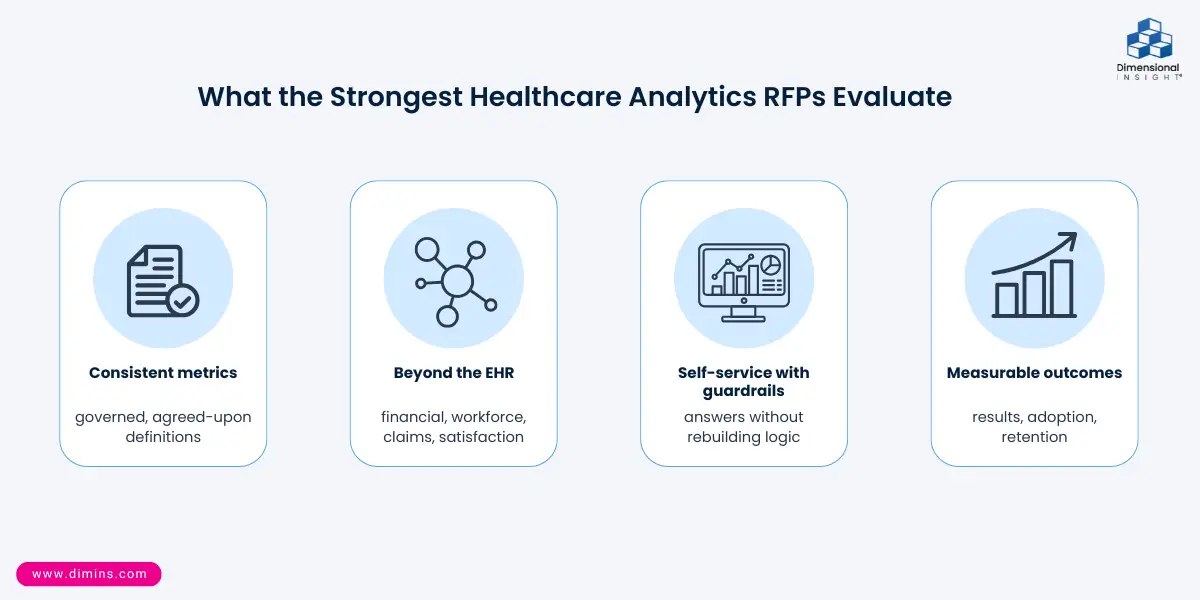
The most successful analytics initiatives tend to share several characteristics. They are built on trusted definitions. They provide consistency across departments. They support self-service access to information without sacrificing governance. And they help organizations move beyond reporting to meaningful operational improvement.
Features matter. Dashboards matter. AI matters. But healthcare organizations rarely struggle because they lack technology. More often, they struggle because they lack trust, consistency, adoption, or alignment around what the data actually means. The strongest healthcare analytics RFPs recognize that reality.
Conclusion
At Dimensional Insight, we’ve found that the most successful analytics initiatives share several characteristics. They establish trusted definitions. They create consistency across departments. They enable users to answer questions without sacrificing governance. And they focus on measurable outcomes rather than simply producing more reports.
The strongest healthcare analytics RFPs recognize that technology alone does not determine success. They evaluate not only what a platform can do, but also whether it can help an organization trust its data, adopt analytics more broadly, and create lasting value from its information.
The goal of a healthcare analytics platform is not simply to generate reports. It is to help healthcare organizations make better decisions. The questions included in an RFP should reflect that objective.
Frequently Asked Questions
What should be included in a healthcare analytics RFP?
A healthcare analytics RFP should evaluate more than dashboards, reports, and technical architecture. Organizations should assess how vendors define and govern metrics, support data beyond the EHR, enable self-service analytics, incorporate AI, establish trust in the data, and demonstrate measurable customer outcomes. The strongest RFPs focus not only on functionality but also on long-term adoption, governance, customer support, and business value.
How should healthcare organizations evaluate healthcare analytics vendors?
Healthcare organizations should evaluate vendors based on their ability to deliver trusted information, measurable outcomes, and sustainable adoption. Important considerations include governance, integration capabilities, AI readiness, customer retention, support quality, and the ability to provide a consistent analytical foundation across the enterprise. Organizations should also ask vendors to provide examples of operational, financial, and clinical improvements achieved by customers.
Does an EHR replace a healthcare analytics platform?
Not necessarily. EHR platforms such as Epic, Oracle Health, and MEDITECH provide valuable reporting and analytics capabilities, but most healthcare organizations require information from multiple systems. Financial, operational, workforce, claims, patient satisfaction, and benchmark data often need to be combined to support enterprise decision-making. Many organizations continue to invest in healthcare analytics platforms to create a unified view of performance across all data sources.
Why do healthcare organizations struggle with inconsistent metrics?
Inconsistent metrics often result from departments using different definitions, business rules, data sources, or reporting methodologies. Over time, these differences can create multiple versions of the same measure, reducing trust in the data. Effective governance helps organizations standardize definitions, manage changes, and ensure that metrics are calculated consistently across reports and dashboards.
What is healthcare analytics governance?
Healthcare analytics governance is the process of establishing standardized definitions, business rules, ownership, and controls for analytical information. Governance helps ensure that metrics are calculated consistently, data is trusted across departments, and reporting supports informed decision-making. Strong governance reduces confusion, improves adoption, and creates a foundation for advanced analytics and AI.
Why is data validation important in healthcare analytics?
Data validation helps healthcare organizations confirm that metrics, reports, and dashboards accurately reflect underlying business and clinical activity. Without validation, organizations risk making decisions based on inaccurate or inconsistent information. However, excessive validation can become a burden. The most effective analytics environments reduce the need for ongoing reconciliation by establishing trusted definitions and governance from the outset.
How should AI be evaluated in a healthcare analytics RFP?
Healthcare organizations should evaluate AI capabilities within the broader context of data quality and governance. AI-generated insights are only as reliable as the information behind them. Important questions include how AI accesses governed metrics, how conflicting definitions are handled, and what safeguards exist to prevent misleading results. Organizations should view AI as an extension of their analytics strategy rather than a standalone feature.
What are the most common mistakes healthcare organizations make when writing analytics RFPs?
Common mistakes include focusing too heavily on dashboards and visualization tools, treating AI as a separate evaluation category, underestimating the importance of governance, and overlooking user adoption. Organizations also frequently prioritize technical features while spending too little time evaluating outcomes, customer success, and long-term value.
What makes a healthcare analytics implementation successful?
Successful healthcare analytics initiatives are built on trusted definitions, consistent business logic, strong governance, and broad organizational adoption. They enable users to answer questions independently while maintaining confidence in the information. Most importantly, successful implementations produce measurable improvements in operational, financial, or clinical performance.
How can healthcare organizations measure the value of an analytics platform?
Organizations can measure value through improvements in operational efficiency, revenue capture, quality performance, throughput, staffing optimization, patient outcomes, and user adoption. The most effective analytics platforms help organizations move beyond reporting and use information to drive measurable business and clinical improvements.


- 10 Questions Every Healthcare Analytics RFP Should Ask - July 28, 2026
- We Have Epic. Why Are We Still Arguing About Our Numbers? - June 23, 2026
- Is Your Data AI-Ready? A Beverage Alcohol Assessment Guide - June 16, 2026