
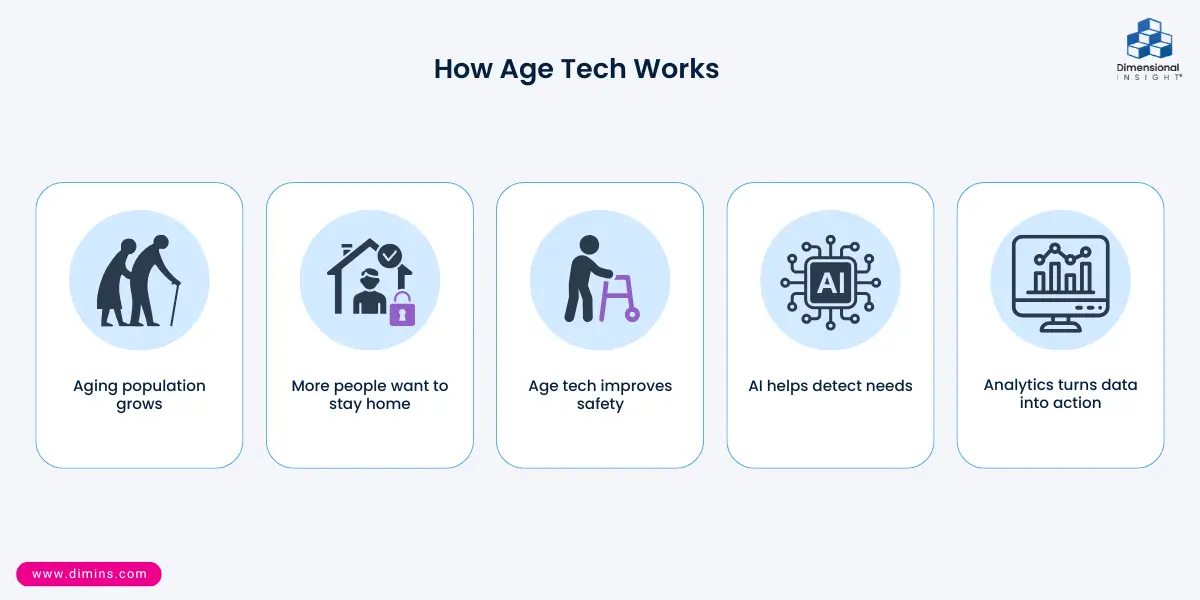
Baby boomers caused the largest-ever 10-year gain among the 65+ population from 2010 to 2020. The increase of 15.5 million people was the fastest growth rate and also the largest-ever percentage-point increase for the demographic, from 13.0% to 16.8% of the total population. Baby boomers began turning 65 in 2011, and by 2030, the entire generation will be 65 and over.
75% of Americans age 50+ would like to live in their current home for as long as possible, according to AARP’s Home & Community Preferences national survey. The survey reports that among adults age 50 and over who are unsure their community will be suited for them as they age, 41% say they will never leave their current home, regardless of their uncertainty or lack of confidence.
For caregivers concerned about older adults who they might think need assisted-living or other care facilities, remaining in the home is becoming a more appealing accommodation thanks to age tech. Let’s take a look at what this growing field can offer, and the role data can play in all of it.
What kind of technology falls under the category of “age tech”?
Age tech is any innovation that helps meet the needs of the world’s aging population. A big part of the technology is to help make homes (and other areas) safer for older adults while easing the burden on caregivers. It can include smart devices such as pill boxes or walkers, aids for the hearing impaired such as glasses that have lenses providing real-time captions, and services that connect older people with deliveries or drivers. (There is some overlap between the kind of tech that is considered “age tech” and what is considered “accessible.”)
Some devices allow caregivers to operate them remotely. People caring for their elderly parents, for example, can use smart devices while they are at work to help control such household operations as thermostat settings, television channels, or speakers. In some cases, they can set up cameras to communicate or monitor what is happening inside the home.
How does age tech use AI?
More and more, artificial intelligence is playing a role in helping people age safely at home. Items like the smart walkers, for instance, can learn from their surroundings, knowing to brake going downhill or provide a slight boost uphill. They can navigate tight spaces or help users quickly fold the walker to fit under the table in a restaurant or in an overhead bin on a plane.
Non-wearable devices can detect falls or track vital signs, alerting caregivers if intervention is needed. More innovations are on the way. The Age Tech Collaborative from AARP is bringing together startups and investors “to create modern solutions to empower people to choose how they want to live as they age.”
What role does data play in this technology?
Much of age tech involves predicting what the user needs, whether that is an immediate alert for help or a reminder about what time they need to take a medication. In order to accurately predict those needs, you need to be able to make sense of the data you are collecting. And to do that, you need a reliable analytics solution.
Artificial intelligence is only as good as the data that feeds it – and often that data is coming from a variety of sources. The right analytics solution can bring together all of that data to produce one single version of truth that creates trust for everyone using the product. Some of this age tech is sending data straight to healthcare facilities. This is another source that needs to be integrated into the work an analytics solution is doing.
Organizations don’t want one device that provides good reports while another updates the data in real time and another is producing an entirely different report. A business intelligence solution should be flexible enough to handle all of it, and be able to adjust as your organization grows or changes direction.
When the data is taken care of, the important work being done to help this growing population can move forward. For those who would like to age at home, technological innovation is a key factor. Making sure you have a solution that can manage your data is an important step in making those innovations happen.


- Relying on Data in the Supply Chain When AI Doesn’t Deliver - August 13, 2026
- Utilities Can Use Data to Take Advantage of EV Popularity - July 23, 2026
- What Businesses Can Learn From Runners Using Data To Achieve Peak Performance - July 17, 2026