
The United States Postal Service delivers 127 billion pieces of mail each year. Like any other organization, though, it faces competition from other companies that promise to get packages delivered safer or faster or with less hassle for the customer. In order to keep itself relevant and stay ahead of competitors, the USPS is relying heavily on data.
The USPS processes more than 110 petabytes of data per year. It is working to make better use of all of that data to better serve customers and continually evolve. Here’s a look at how the organization is using analytics, and the lessons other organizations in the supply chain can apply to their own work with data.
Prioritizing data
The Postal Service is in the middle of a 10-year strategic plan, part of which involves modernizing its approach to technology. The organization set up an internal group that monitors its data use. The group set up a governance policy for the agency, and it evaluates any new applications the agency is considering using.
Under the leadership of the data group, the USPS is stressing the organization and management of data in a way that makes it immediately accessible. The work is ongoing for the organization, USPS CIO Pritha Mehra said at a recent conference. “You have to relentlessly prioritize, because there’s so much technology out there.”
How is USPS using its data?
The USPS is leveraging its data to make use of AI. Some of the ways it is using or hopes to use AI is through tools for logistics optimization, customer care, customer sentiment analysis, maintenance assistance, fraud detection, and training courses.
The organization also uses data in its business shipping platform, which brings together all participants in the supply chain. They hope the platform allows them to be more transparent by sharing shipping data, and they also hope to increase their responsiveness to shippers. If a business suggests something that would help improve the platform, the postal service will look at it the same way it is looking at all technology upgrades.
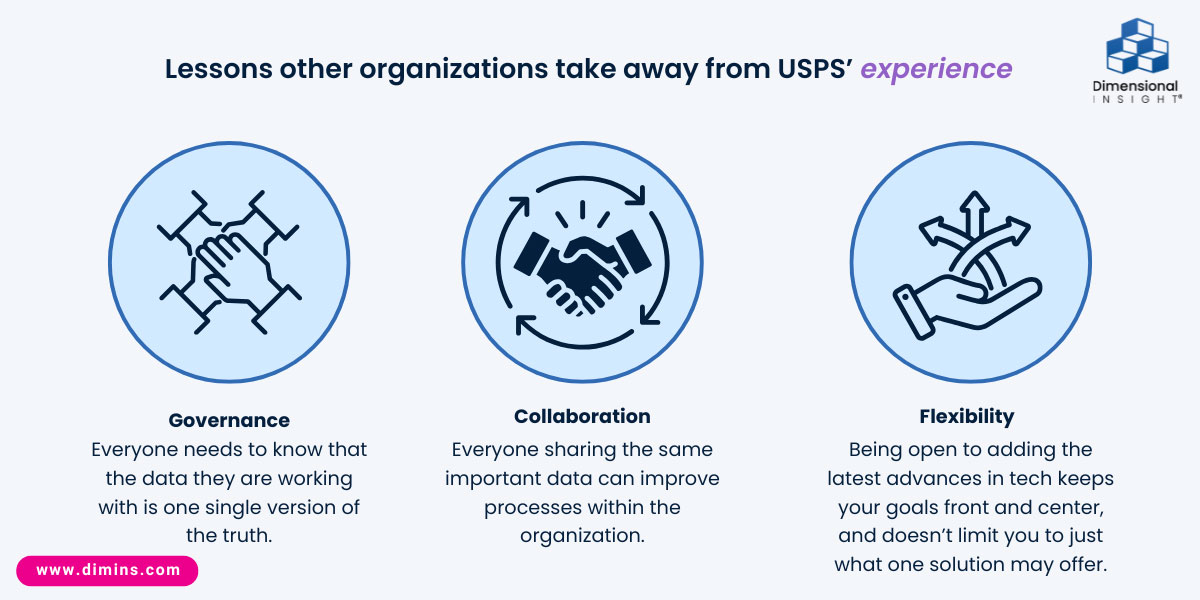
What lessons can other organizations take away from USPS’ experience?
While the USPS may have taken a longer journey than others towards using its data more effectively, the way it has gone about its data transition could set a path for other organizations looking to make the same kind of transformation. Here are three key takeaways:
- Governance: The Postal Service began with the organization of its data, creating a data governance policy and making sure the same definitions were in place for everyone. Without this important first step, the rest of the work is meaningless. Everyone needs to know that the data they are working with is one single version of the truth. From there, everyone working with the data can know that they are all working with consistent information.
- Collaboration: With its shipping platform, the USPS is sharing important data with key stakeholders. Organizations in the supply chain can do the same thing to make sure everyone is on the same page when it comes to certain information. Whether that means everyone is looking at the same dashboard or at least has access to the same metrics, it means everyone is sharing the same important data that can improve processes within the organization.
- Flexibility: The USPS is open to adding applications when the situation calls for it. Some organizations find a business intelligence solution that they’ll cater to, adjusting their expectations so that the solution can fit their needs. But being open to adding the latest advances in technology, like AI for example, keeps your goals front and center, and doesn’t limit you to just what one solution may offer.
The best analytics solutions, though, can provide all of this and more. A flexible solution can integrate data from many different sources, allowing scalability when an organization decides it may need to add something – or possibly change its analytics focus. The integration can also be done without sacrificing the important data governance work that was done at the beginning of the process. It can continue to offer a single, unified view to everyone who needs it at any time.
For the Postal Service to live up to its mission and be “always on,” it needs to stay on top of its data. It’s a model that any other company can follow, with the right business intelligence solution. Organizations that can track real-time supply chain data and get it to the people who need it can always be on and always be able to stay ahead of the competition.


- AI is Available to the Masses. What Does That Mean for Business Intelligence? - February 10, 2026
- How Data Helps Utilities Limit the Damage from Winter Storms - February 5, 2026
- “Where’s the Beef?” How Data Turns AI From Gimmick to Growth - January 27, 2026