
ChatGPT helped introduce people to how they could use artificial intelligence (AI) for everyday tasks. In case people didn’t hear the buzz when it was released, the company has also aired a series of well-crafted advertisements that display how the technology can be used for recipes, to create workout programs, or plan trips.
People with no technology background are getting a sense of how much more AI can do. They can now use AI to code, helping them accomplish tasks that would have been impossible for them to do on their own. It can also be used for any number of tasks within e-mail. Here’s how AI is making its way even more into day-to-day life, and what that could mean for businesses and how they use analytics and business intelligence tools.
How has Gmail incorporated AI?
If you’re a Gmail user, perhaps you’ve noticed new AI features in your email powered by Google’s AI assistant Gemini. In addition to the pop-up predictive text appearing as you type that it has provided for years, Google has expanded its offerings to allow you to type a prompt such as “an email to a friend,” resulting in a draft of an email. It also offers summaries of incoming emails, providing a brief recap of a message in your inbox, and suggested replies.
Google has been rolling out the AI features in the new year, including AI Inbox, which can help users who get a lot of e-mails in a day prioritize tasks. AI Inbox can create a To-Do List suggesting which e-mails to respond to first or which ones have information that needs to be acted upon. There are other AI features that include services such as editing that people can pay for.
How can I make AI work for me?
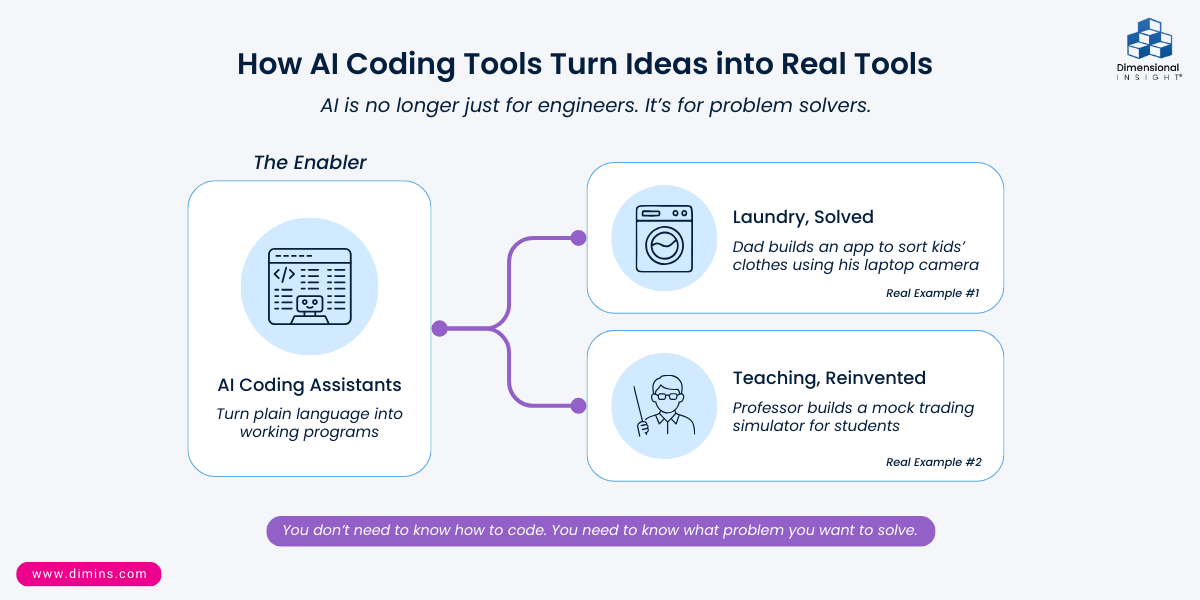
AI coding tools have allowed people with no coding experience to build their own programs and apps. The New York Times recently detailed how some users are using one such tool, called Claude Code, which was introduced last year. Among the projects is a program developed by a father in Australia who uses the camera on his laptop to identify which shirt belongs to which of his children as he sorts laundry, and an assistant professor of finance at the University of Delaware who developed a demo of a trading simulator that her students could use as a mock market.
What does this mean for the future of business intelligence?
With complicated technology at everyone’s fingertips, it might seem like a waste of time and money for organizations using analytics and business intelligence platforms. But not so fast. First of all, the work for which many organizations rely on these types of solutions can be much more complicated than what they would get from a simple AI fix. There are layers to the analytics work being done and what might seem like a great solution on the surface with a tool like Claude Code could lead to more work down the road when another issue pops up that wasn’t anticipated in the first query. The best analytics solutions are flexible and able to adjust as your company grows.
Another characteristic of a business intelligence solution that could become more and more valuable as time goes on are the people. The best companies are the ones that build relationships with the organizations using their technology. They don’t look at the users as clients so much as partners, working together to understand the decisions that need to be made and how they can use the data to figure out what works best for the organization. An AI tool might provide a quick momentary fix. But the best analytics solutions are more than just the tool – they are the people, experts in their fields, who know how the technology works best and can guide you through the process to get the most out of the tool.
In some ways, these new uses of AI are a positive sign of what the technology was meant to do: it is making people’s lives easier, and it’s accessible to many – most of the Gmail additions are free, and users of Claude Code pay a subscription fee of $20 to $200 a month. Still, the technology has a long way to go before it forces companies to give up on the best business intelligence tools. Chatbots can be helpful, but they’re not the same as people. It’s those relationships that companies build with the actual experienced people providing analytics tools that will never be replaced.

Frequently Asked Questions About AI and Analytics
In this context, analytics refers to the systems organizations rely on for shared metrics and decision-making—not ad-hoc analysis or one-off experimentation.
Can ChatGPT replace analytics platforms?
No. Tools like ChatGPT are useful for generating ideas, answering questions, or speeding up individual tasks. But analytics platforms are designed to support consistent decision-making across teams by working from shared data, common definitions, and reusable logic. Organizations still need analytics systems to ensure insights are accurate, trusted, and sustainable as the business evolves.
What’s the difference between generative AI and analytics?
Generative AI responds to prompts by producing outputs based on patterns it has learned. Analytics focuses on analyzing an organization’s own data within its business context—using defined metrics, consistent calculations, and established data relationships. AI excels at speed and flexibility; analytics provides reliability and continuity when decisions need to be repeated, explained, or validated over time.
How can organizations use AI without replacing analytics?
The most effective organizations treat AI as a complement to analytics, not a replacement. AI can help accelerate exploration or reduce manual effort, while analytics platforms provide the foundation for shared understanding and ongoing decision-making. Analytics providers such as Dimensional Insight focus on integrating new capabilities in ways that preserve trust in the numbers, even as tools and use cases evolve.


- What Election Predictions Can Teach Us About Data Analytics - October 22, 2026
- Data can Lead the Way for Tuition Decisions - October 15, 2026
- Proper Data Governance Prevents Data Slop - October 8, 2026