One of the challenges with using artificial intelligence (AI) in the supply chain industry is that the data isn’t always coming from within your own organization. Supply chain companies rely on many others to gather the necessary information that powers artificial intelligence, and there are times the data is hard to access or in some cases less trustworthy.
On top of that, sometimes the technology itself is unreliable and causes more problems than it helps solve. Here’s a look at what artificial intelligence can do in the supply chain industry, where it can fall short, and how your organization can still succeed even if AI isn’t a part of your infrastructure.
How have companies used AI successfully?
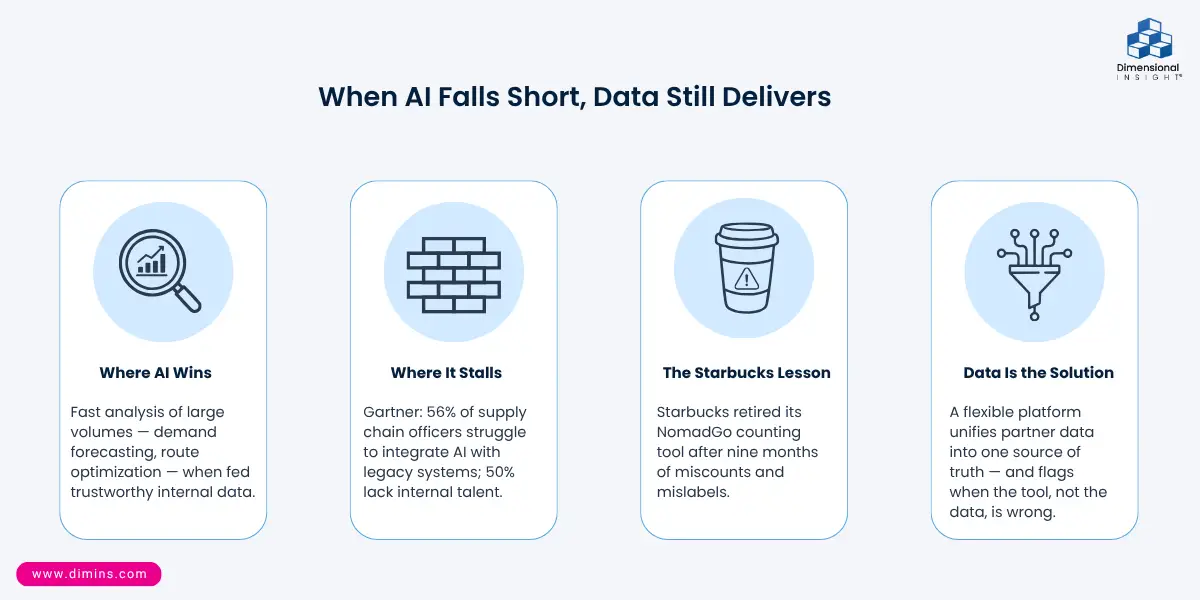
The most reliable data is often your own data. Knowing exactly what information is producing the results that AI is providing is helpful in knowing how accurate those results are. Companies can use this information for predictive analytics such as forecasting demand. Internal data can also help optimize delivery routes and streamline services.
Put simply, AI is best used in the supply chain in instances where large amounts of information need to be analyzed in a short amount of time. It produces results that would be difficult or impossible for humans to do on their own. But it doesn’t always work the way organizations hope.
What are the potential pitfalls of AI?
One of the major challenges in the supply chain industry is that organizations are finding it difficult to figure out how to use AI in the first place. A Gartner survey cites 56% of chief supply chain officers as saying that integrating AI with legacy systems and processes is a major challenge, and 50% say that they have limited internal expertise or talent to implement and manage AI. The most successful use cases of AI involve company-wide technological evolutions, including both the workforce and the technology they are using. It also means that sometimes you have to readjust when something is not working.
In late May, Starbucks announced that it was no longer using an AI inventory management system it had begun using just nine months earlier. The hope was that the AI tool would simplify inventory record-keeping and prevent stockouts. The reality, according to reports, was that the tool occasionally miscounted or mislabeled items.
Data is the solution
AI can’t replace a data-driven approach. It works best when it is a part of a comprehensive analytics plan. The more an organization looks at its areas of need and where AI could be most effective, the better off it will be in the way it uses the tool.
Successful AI implementation comes down to the data. A flexible analytics solution can bring together data from disparate sources to produce one single version of truth that can help an AI tool in the supply chain make sense of information that might be coming from different partners. It is important, though, that before that data is used an organization has a plan in place for ensuring that information coming in matches the standards of its own data. The more flexible the solution, the more opportunities there are to make adjustments, which is important when using an AI tool. As Starbucks found out, sometimes a tool doesn’t work out. Rather than putting the data hopes of the entire enterprise on one tool, it is important to be able to pivot and move on when necessary. The right analytics solution can make those adjustments with you as your organization reassesses its needs and grows.
It is important to have a system of checks in place to assess data. When AI produces results that make sense, those results can be used to make decisions that can improve the organization. If the data isn’t making sense, though, people working with the data need to be able to recognize why and where the gaps are so that they can make the needed adjustments that can keep the tool effective.
Just because AI isn’t working the way it is supposed to doesn’t mean you can’t still use data. The data is a part of the solution – it can help show you whether the tool itself is flawed, or if the information an AI tool is providing needs to be adjusted. The right analytics solution can help provide you with the data you need to make all these decisions, whether or not you are using artificial intelligence.

- Proper Data Governance Prevents Data Slop - October 8, 2026
- Tracking Shipping Price Changes with Analytics - October 1, 2026
- AI: The Good, The Bad (and Scary), and the Analytics - September 24, 2026