Technology has helped the utilities industry make great strides when it comes to performance. Drones are used by some crews to identify potential issues and help expedite repairs, bringing visibility to places that were not easily accessed in the past. There is also more transparency when it comes to billing. Advances in analytics allow utilities companies to control costs by closely tracking key performance indicators.
As it has in other industries, artificial intelligence has also provided opportunities for the utilities industry. Ernst & Young teamed up with Eversource to use AI to prevent power outages before they occur. Here’s how they’re using data to be proactive in possibly disruptive situations, and how your organization can use data in similar ways.
Integrating data
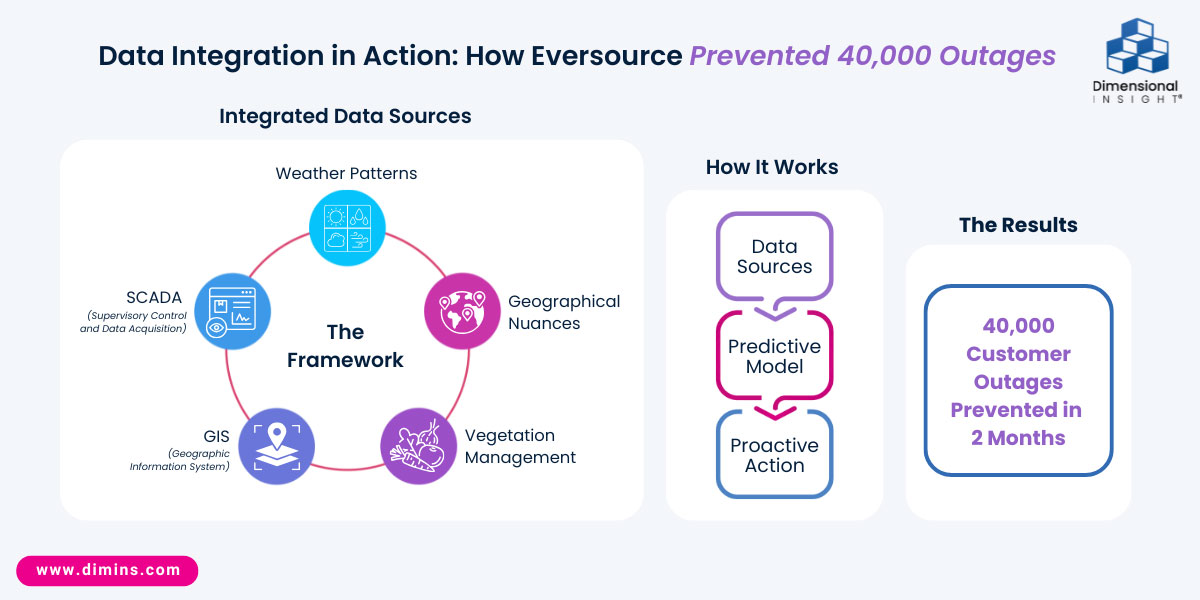
Ernst & Young and Eversource worked together earlier this year to develop a framework that can anticipate storms and allow them to take steps to mitigate power outages before they happen. In order to do this, they integrated several data sources that included weather patterns, geographical nuances, vegetation management insights, geographic information system (GIS), and supervisory control and data acquisition (SCADA).
The work minimizes unexpected outages, allowing the company to improve operational efficiency and enhance customer experience. The technology can also analyze historical outage data to predict the likelihood of sustained outages, and if there is a pattern of voltage dips, it will trigger inspections. Ernst & Young reports that in the framework’s first two months, Eversource was able to avoid 40,000 customer outages.
More pressure to perform
Utility companies are constantly working to manage their grids and ensure that customers are getting the service they demand. The main problem companies are dealing with when it comes to electricity is that America’s electric infrastructure is aging and it is being pushed to do more than it was originally designed to do. This is especially true with the ever-growing demands on the industry as more people turn to electricity versus other power sources.
The collaboration between Ernst & Young and Eversource is one example of how organizations are using technology to get creative in trying to solve the problems that the industry is facing. Outages affect customer satisfaction, in addition to disrupting day-to-day life. They also cost a lot of money to fix, and that combination does not make for an efficient business model. By using AI to address these problems before they happen, companies are better able to make good business decisions
What is the role of data?
None of this could happen without reliable data and analytics. Companies don’t necessarily need to employ AI to take advantage of their data, but they do need to be able to use their data wisely in order to make improvements. The model used by Ernst & Young and Eversource uses a diverse group of data sources. It is important that a business intelligence solution can integrate data from a variety of sources because often different data comes from different systems and it needs to be brought together to form one singular version of the truth.
Utilities companies have access to all kinds of data that can help them make better decisions. Some companies limit themselves to billing information at the customer level. While there is nothing wrong with using analytics in this way, it is just scratching the surface of the capabilities of data. By digging deeper, organizations can target the same kind of information that artificial intelligence can provide. While not all analytics might be as predictive as the AI Eversource is working on, companies can use the same data sources to bring real-time information to employees to address potential problems, like vegetation growth that may interfere with power lines or weather situations that have proven to be a problem in the past.
The more flexible a solution is, the more it can be customized to meet every company’s individual needs. Then, as things change, whether that is due to increased demand or the ever-modernizing energy grid, the solution can change with you to provide the information you need to keep making decisions that benefit both the customer and the organization’s bottom line.

- Tracking Shipping Price Changes with Analytics - October 1, 2026
- AI: The Good, The Bad (and Scary), and the Analytics - September 24, 2026
- Analytics Drives Creative Solutions to Utilities Industry Challenges - September 17, 2026