Whether or not you are someone who relies on artificial intelligence in your everyday life, it has become an unavoidable reality. It may be something you deliberately use to help develop a website or some other task that may have previously seemed out of reach, or it could be something you encounter unintentionally, calling a company on the phone and talking to AI rather than a real person.
For those who are skeptical of the technology, there is an underlying worry about fraud. What if bad actors are using AI to alter reality in a way that influences someone’s vote or misrepresents the truth? For every possible misuse of AI technology, though, there is the opposite possibility – that it can be used to help identify and combat those bad actors. Here are some of the ways AI can be used to help keep people safe, and the role data plays in all of it.
What kind of fraud risks are out there?
The New York Times recently reported that banks and investment firms have begun training their employees to identify and intervene when customers are targeted in a scam. According to the article, Americans over the age of 60 lose more than $28 billion annually to financial exploitation. Banks are increasing their role as the population ages and scams become more advanced, such as using AI-assisted voice cloning to impersonate a grandchild in need of emergency money.
The elderly are not the only target. Deloitte’s Center for Financial Services predicts that by 2027, generative AI could result in $40 billion in U.S. banking losses from fraud. But the same technology that is increasing the likelihood of fraud is well-positioned to help prevent those same issues.
How can AI help?
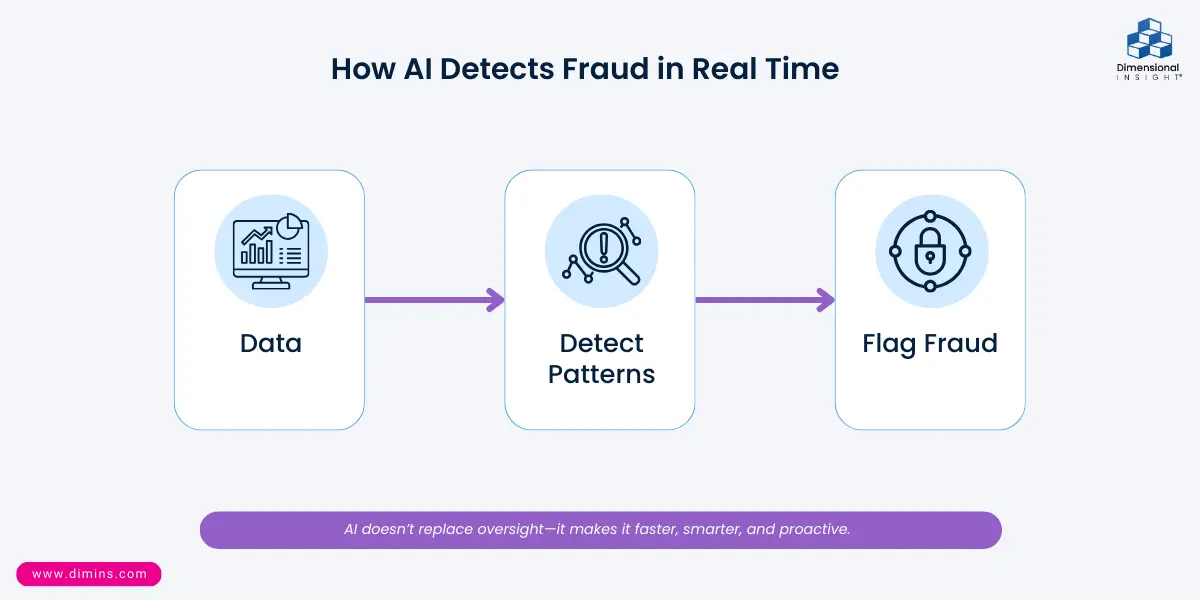
AI is capable of analyzing huge amounts of data, many times more than what a person can do. The systems can be trained on financial records to identify what constitutes a normal financial transaction versus those that appear to be fraudulent. AI can also be used to make predictions about what is likely to happen based on existing data.
As a result, AI can recognize patterns – or deviations from those patterns – that can help identify fraud attempts in real time. AI can also be used to recognize signatures or voice patterns that may be used to authorize transactions and in that way identify fraudulent human behaviors. At the very least AI can be used to flag unusual online transactions where a human employee may need to step in.
What role do business intelligence and data play?
The most important step in order for AI to work properly – whether it is for a bank or an organization in any other industry – is to have reliable data in the first place. The data AI is trained on is what it uses in order to identify the patterns that can help prevent fraud. For banks, this can come in the form of countless pieces of transactional data, but any organization collects vast amounts of data. The key is figuring out what data is most important for the goals you are looking to achieve, and then using the right business intelligence solution to bring that data together.
Often companies have different types of data coming from different systems. The best analytics solutions will bring all of that data together so it can provide the information that decision-makers can use to find efficiencies or improve the organization in other ways. In the case of bank fraud, it can provide the financial institutions with a single source of truth on which the AI models can be trained in order to identify the proper patterns and make the correct predictions.
AI took the national stage recently when President Trump ordered all federal agencies to stop using Anthropic, with the government instead using AI technology provided by OpenAI. The dispute shed light on a couple of ways the government uses AI. Not unlike its uses in other industries, the technology helps analysis move more quickly than if humans were doing the task, whether that is going through overseas communication intercepts or the CIA looking for patterns in intelligence reports. It also underscored the importance of an analytics solution you can trust and that can grow with your company as things change over time: just like with any business intelligence implementation, the change in AI software for the government is likely to take time and cause a disruption.


- Data Helps Supply Chain Leaders Make Pivotal Decisions - March 19, 2026
- AI’s Role in Preventing Fraud Depends Upon Trusted Data - March 12, 2026
- Census Data Helps Inform Decisions in Higher Education - March 5, 2026