
Healthcare organizations generate enormous amounts of data. Dashboards are easy to build. Reports are everywhere.
And yet, many teams still struggle to answer basic questions with confidence:
- Why don’t these numbers match?
- Which metric is correct?
- Why does every department seem to have its own version of the truth?
Often, the issue isn’t the data itself. It’s a misunderstanding of the difference between business intelligence and healthcare analytics—two terms that are frequently used interchangeably but are not the same.
Understanding that difference matters more in healthcare than in almost any other industry.
At a High Level: Analytics vs. Business Intelligence
At a general level, the distinction is straightforward:
- Business intelligence (BI) focuses on reporting and visualization—organizing data so people can see what happened.
- Analytics focuses on interpretation and decision support—helping people understand why something happened and what to do next.
In many industries, that difference is subtle.
In healthcare, it’s anything but.
A Simple Way to Think About It in Healthcare
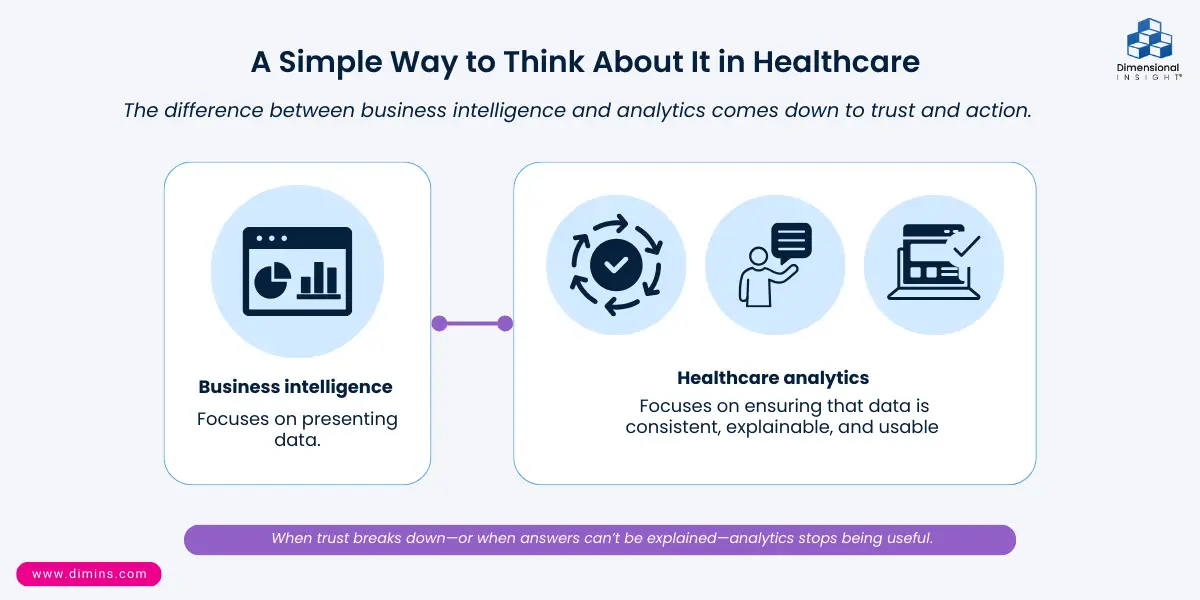
In healthcare, the difference between business intelligence and analytics comes down to trust and action.
Business intelligence focuses on presenting data.
Healthcare analytics focuses on ensuring that data is consistent, explainable, and usable for real decisions across finance, operations, and clinical leadership.
When trust breaks down—or when answers can’t be explained—analytics stops being useful, no matter how good the dashboards look.
Why the Difference Matters More in Healthcare
Healthcare analytics isn’t just about looking at charts. It supports decisions tied to:
- Financial performance and margins
- Quality measures and reimbursement
- Provider compensation and productivity
- Regulatory scrutiny and auditability
- Operational and clinical outcomes
In this environment, how metrics are defined, governed, reused, and explained matters just as much as how they are visualized.
That’s where general-purpose BI tools—such as Power BI and Tableau—often begin to show their limits in healthcare environments.
Business Intelligence vs. Healthcare Analytics: A Practical Comparison
| Business Intelligence | Healthcare Analytics | |
| Primary purpose | Reporting and dashboards | Decision support and action |
| Typical focus | What happened | Why it happened and what to do |
| Metric definitions | Often recreated per report | Governed, reusable, and consistent across teams |
| Data complexity | Mostly financial or operational | Clinical, financial, and operational combined |
| Trust requirements | Moderate | Extremely high |
| Typical users | Analysts and executives | Finance, operations, and clinical leaders |
| Risk of misinterpretation | Manageable | High if poorly designed |
This isn’t a criticism of BI. Business intelligence tools play an important role.
The challenge arises when BI is expected to carry the full weight of healthcare analytics.
Why General BI Tools Struggle in Healthcare
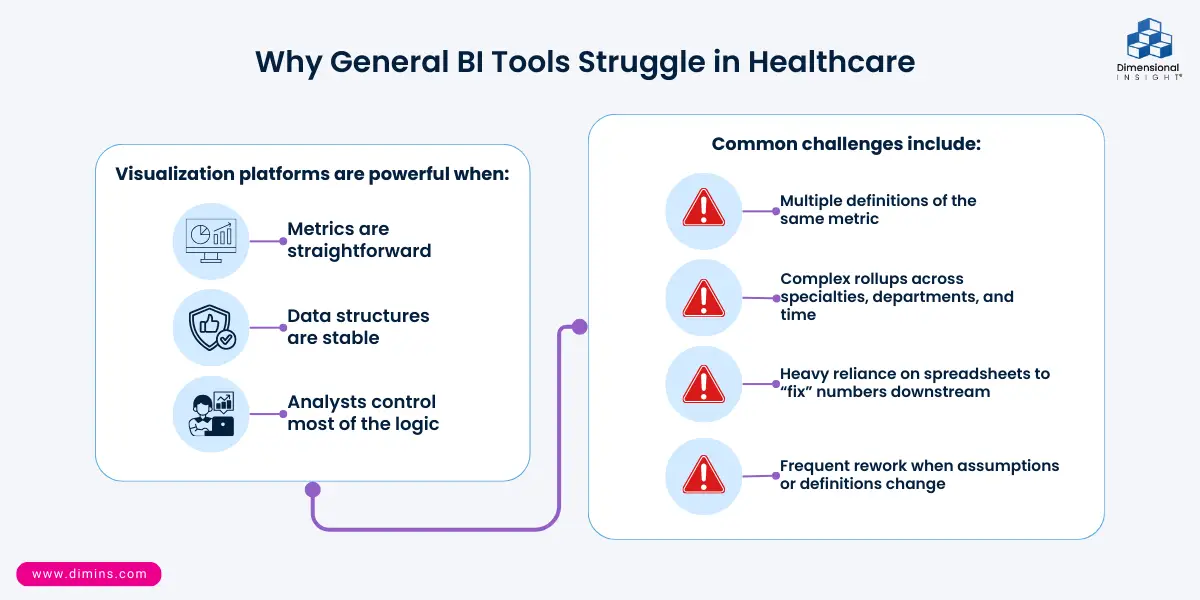
Visualization platforms are powerful when:
- Metrics are straightforward
- Data structures are stable
- Analysts control most of the logic
Healthcare rarely fits that model.
Common challenges include:
- Multiple definitions of the same metric (margin, LOS, productivity)
- Complex rollups across specialties, departments, and time
- Heavy reliance on spreadsheets to “fix” numbers downstream
- Frequent rework when assumptions or definitions change
The result is often dashboard sprawl: plenty of reports, but limited trust and uneven adoption outside of analytics teams.
What Healthcare Analytics Needs to Do Differently
Effective healthcare analytics accounts for realities that BI alone often overlooks.
- Metrics must be governed—not rebuilt: When each report defines key measures differently, confidence erodes quickly. Analytics needs shared definitions that can be reused and trusted across teams.
- Analytics must support real workflows: Healthcare teams don’t stop at dashboards. They ask follow-up questions, explore drivers, and adjust assumptions. Analytics should support that exploration without starting over each time.
- Explainability is non-negotiable: In healthcare, people don’t just want answers—they need to understand them. Analytics must make it easy to trace results back to source data and explain outcomes to leadership, clinicians, and auditors alike.
Why Fragmented Analytics Stacks Fall Short in Healthcare
In theory, separating business intelligence, analytics, and data platforms sounds reasonable.
In practice, healthcare organizations often experience the opposite:
- The same metrics defined multiple ways
- Hand-offs between teams to answer simple questions
- Spreadsheet workarounds to reconcile differences
- Declining trust in analytics over time
Healthcare teams don’t think in tools. They think in questions.
Analytics works best when data integration, metric governance, exploration, and explanation operate together—so answers remain consistent, defensible, and actionable regardless of who is asking.
Analytics Is Not the Same as AI (and That’s a Good Thing)
As interest in artificial intelligence (AI) grows, many healthcare organizations ask whether they need advanced AI or better analytics.
In most cases, analytics comes first.
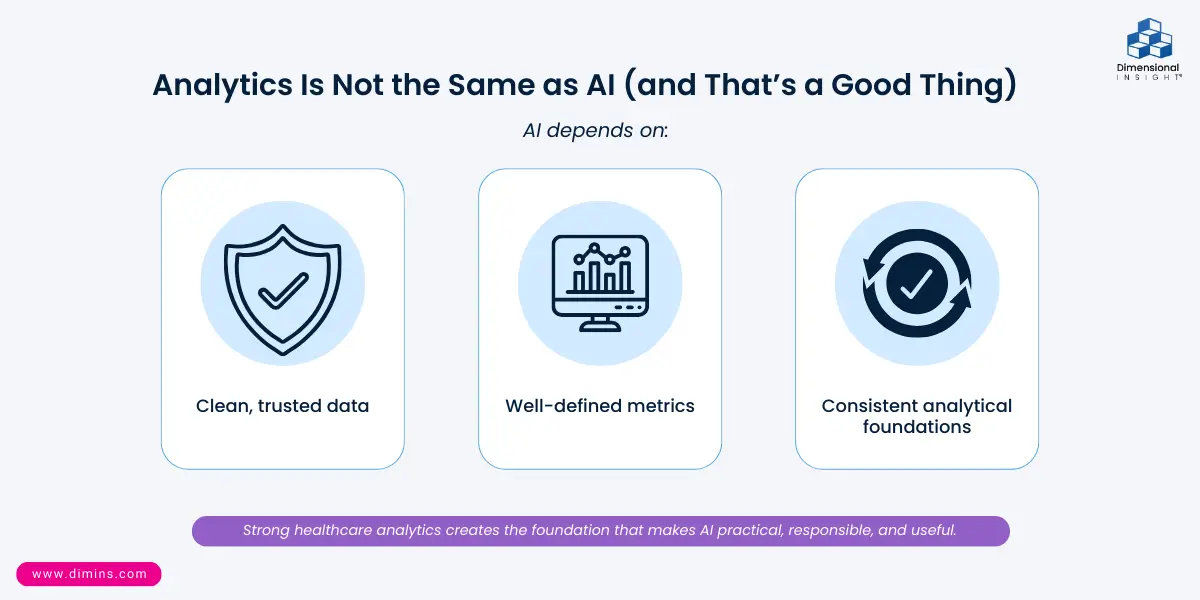
AI depends on:
- Clean, trusted data
- Well-defined metrics
- Consistent analytical foundations
Without those, AI amplifies confusion instead of reducing it. Strong healthcare analytics creates the foundation that makes AI practical, responsible, and useful.
Conclusion
Healthcare analytics isn’t about producing more dashboards.
It’s about giving people across finance, operations, and clinical leadership a shared, trusted understanding of performance—and the ability to explain and act on that understanding with confidence.
When analytics is designed for healthcare’s complexity, it becomes a foundation for better decisions, not just better reports.