Not too long ago, I decided to treat myself to lunch at Wendy’s. My daughter was about to head back to college, and we spent the morning together before hitting the drive-through. The plan was to grab a couple of burgers and bring back a frozen treat for her sisters, who would be getting home around the same time.
Much to my surprise, the voice at the drive-through was AI-automated. Somehow it anticipated the drink my daughter wanted with her meal, and when I ordered an iced tea with mine the voice responded with, “Anything else?” I thought it meant, “Do you want a different drink?” and I figured I would just forget the drink, so I responded, “No.” I quickly realized it had clocked my iced tea and was asking for more orders and I tried to correct my order to add the desserts. Too late. My turn was over. I had to go inside to make sure my other daughters would not be disappointed.
I shouldn’t have been all that surprised at the automation. The technology is increasingly present in everyday life, and it is likely to grow even more. Here’s how it might show up in your life, and the role data plays in it.
How is the restaurant industry using AI?
Artificial intelligence at large chains like Wendy’s is not all that unusual – there are a number of fast food restaurants that use some form of AI with customer orders. The technology is making its way into more small businesses as well, though. The president and CEO of the Massachusetts Restaurant Association says phone answering tools are probably the most widely adopted form of AI in the restaurant industry, especially by neighborhood pizza shops.
While most restaurants do the majority of their business through online ordering and delivery apps, missed phone calls can be a large source of lost revenue. In order for the smaller businesses to take advantage of every opportunity, they need to make sure they are taking every order that comes in. AI helps them do that, while ensuring efficiency in a number of areas, including staffing and costs.
AI is not going anywhere
The trend is not likely to slow down anytime soon. Everyone wants to get in on the AI boom, from industry leaders to politicians. In Massachusetts, Governor Maura Healey announced $100 million will go towards the state establishing an “AI Hub.” The Hub will work to support research, attract talent from the AI industry, and use the technology to help solve societal challenges. Healey wants to make Massachusetts a global leader in applied AI innovation. A number of Massachusetts technology companies have also joined together in a private-sector effort to host in-person events aimed at educating students, entrepreneurs, and other stakeholders about AI and growing its presence in the state.
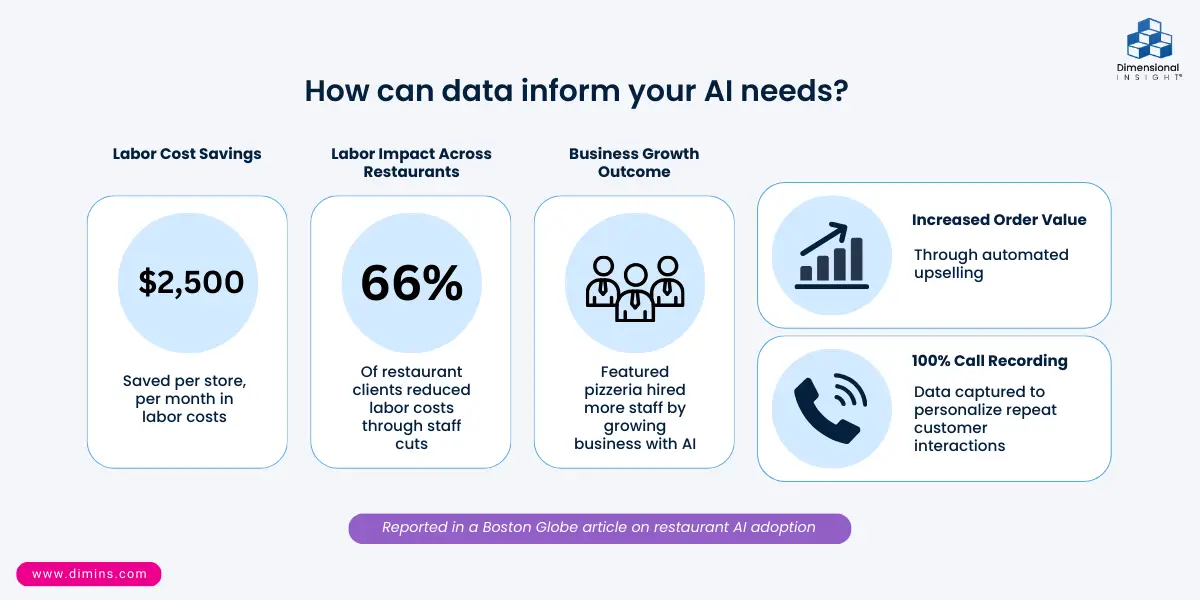
How can data inform your AI needs?
A Boston Globe article about a pizzeria using AI technology in Massachusetts and New Hampshire reports the AI company saves its customers about $2,500 per store per month in labor costs. While 66% of the AI’s restaurant clients reduce their labor costs through staff cuts, the pizzeria featured in the article says the technology has helped them increase business so much they have been able to hire more staff and use them in better ways due to the AI tool. The AI also increases order value with automated upselling, and all calls are recorded to gather data that restaurants can use to personalize interactions for repeat customers.
While saving money is top of mind for many organizations in the current economic climate, using AI to do so may or may not be the primary route. What is important for organizations is having the necessary data to make decisions about what is a good fit for them. The right analytics tool can help crunch the numbers to figure out what is the most efficient way to run your business. It can provide you with the data you need to make informed decisions instead of guessing or going along with whatever hot new technology seems to be working for someone else. A successful analytics platform is one that will partner with you to figure out your needs, whether that involves AI or not.
Analytics can help make predictions based on past performance. That’s how we are as people too. I will be better prepared to order through the AI at the Wendy’s drive-through the next time, and I’m also prepared for it to maybe recognize my car or my order and offer me an iced tea before I have a chance to say it. Whether that’s the right kind of approach for your business may not be clear to you based on your experiences, but with the right data and the right analytics solution you’re a step closer to making the types of decisions that will put your organization ahead.


- How Data Impacts the Automotive Supply Chain - February 18, 2026
- AI is Available to the Masses. What Does That Mean for Business Intelligence? - February 10, 2026
- How Data Helps Utilities Limit the Damage from Winter Storms - February 5, 2026