Every healthcare organization faces the same challenge: how to deliver better outcomes with limited time, staff, and resources. The answer increasingly lies in analytics — not just as a reporting tool, but as a foundation for more informed, efficient, and coordinated care.
From reducing readmissions to preventing infections to improving financial sustainability, healthcare organizations across the country are using analytics to turn complex data into action. Here’s how leading hospitals and health systems are doing it — and what others can learn from their success.
Turning Data into Actionable Insight
The most effective healthcare analytics programs start small but think big. They focus on trusted data, clear metrics, and a direct line of sight to clinical or operational outcomes. These organizations share three traits:
- Clarity: They know which metrics matter most and align teams around shared definitions.
- Accessibility: They make data easy to explore — no waiting on IT reports or data exports.
- Adaptability: They evolve as new challenges arise, from public health crises to shifting reimbursement models.
Each of the following real-world stories illustrates one of these strengths in action.
1. Driving Value-Based Care Success
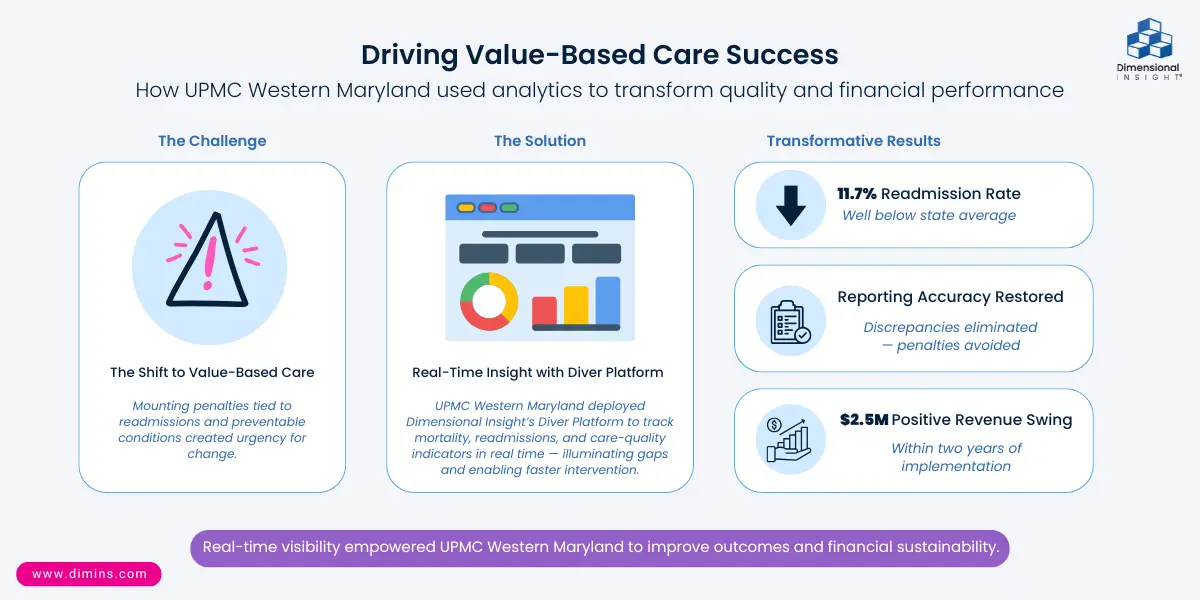
In UPMC – Western Maryland’s transition from volume-based to value-based reimbursement, analytics played a central role in improving both quality and financial performance.
Faced with mounting penalties tied to readmissions and preventable conditions, the organization used Dimensional Insight’s Diver Platform to track mortality, readmission rates, and care quality indicators in real time. Leaders could now see exactly where gaps existed — and intervene faster.
The results were transformative:
- A drop in readmissions to 11.7%, well below the state average
- Elimination of reporting discrepancies that previously led to costly penalties
- A $2.5 million positive revenue swing within two years
With better visibility into outcomes and performance, the organization moved from last place in state rankings for quality-based reimbursement to first.
Key takeaway: In value-based models, analytics doesn’t just measure success — it enables it.
2. Improving Patient Safety and Reducing Readmissions
Another healthcare organization, Munson Healthcare, focused its analytics on improving neonatal outcomes and safety. By examining newborn readmissions and correlating them with clinical variables, the hospital identified high-risk patterns that weren’t visible before.
Armed with these insights, clinicians redesigned care pathways and follow-up protocols. The results were measurable:
- 24% decrease in newborn readmissions
- 83% reduction in safety incidents related to discharge and follow-up care
These improvements didn’t come from adding new technology — they came from using data already in the system, but now presented in a way that made risk patterns unmistakably clear.
Key takeaway: Even small clinical teams can use analytics to uncover and address hidden drivers of patient risk.
3. Using Real-Time Dashboards to Improve Emergency Department Flow
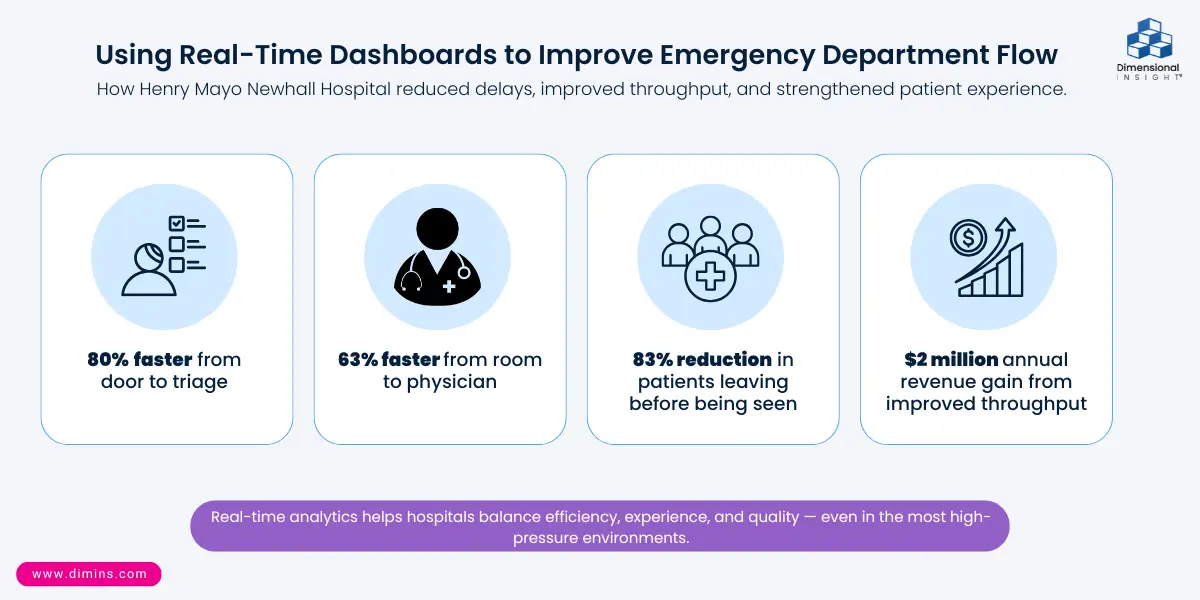
During a period of rapid growth, Henry Mayo Newhall Hospital’s emergency department was struggling with long wait times and patient drop-offs. The hospital turned to analytics to better understand patient flow from arrival through triage, room assignment, and discharge.
By integrating its EHR data into real-time dashboards, administrators and clinicians could pinpoint exactly where delays occurred — and fix them.
The impact was dramatic:
- 80% faster from door to triage
- 63% faster from room to physician
- 83% reduction in patients leaving before being seen
- $2 million annual revenue gain from improved throughput
What began as a technology project quickly became a culture change, where staff used data as a daily tool for improvement rather than an after-the-fact report.
Key takeaway: Real-time analytics helps hospitals balance efficiency, experience, and quality — even in the most high-pressure environments.
4. Using Clinical Analytics to Improve Treatment Decisions
A large regional health system faced a common challenge: ensuring consistent, evidence-based care among physicians across multiple hospitals.
Physician dashboards built with Dimensional Insight’s Diver Platform helped correlate treatment decisions — such as medication protocols or insulin regimens — with patient outcomes like glucose stability and length of stay.
The data revealed clear patterns: patients treated with newer evidence-based regimens achieved better control and shorter stays. Analytics also highlighted which clinicians might benefit from targeted education and gave leaders a data-driven way to support them.
Key takeaway: Analytics can bridge the gap between clinical best practice and everyday decision-making.
5. Advancing Public Health with Connected Data
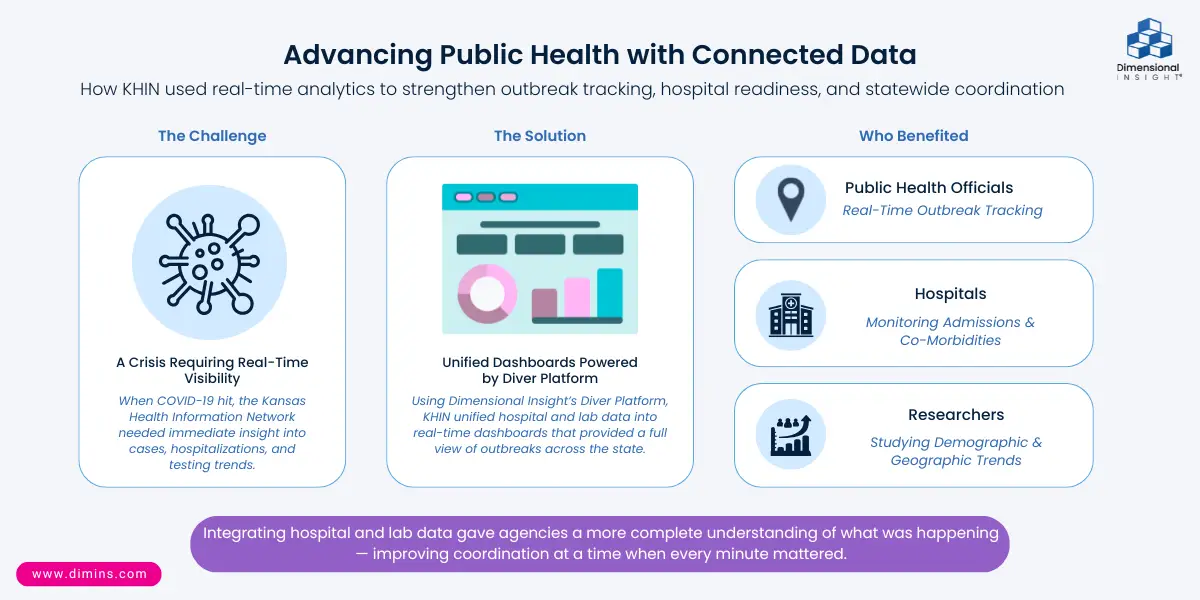
When COVID-19 struck, the Kansas Health Information Network (KHIN) needed to provide real-time visibility into cases, hospitalizations, and testing. By using Dimensional Insight’s Diver Platform, the organization created dashboards that allowed:
- Public health officials to trace outbreaks in real time
- Hospitals to monitor admissions and co-morbidities
- Researchers to study demographic and geographic trends
The ability to unify hospital and lab data across systems gave public health agencies a faster, more complete view of what was happening — saving valuable time and improving coordination during an unprecedented crisis.
Key takeaway: When data is connected and accessible, analytics becomes a public health asset, not just a reporting tool.
6. Unifying Financial, Operational, and Clinical Data
For one large physician organization, analytics served as the connective tissue between business performance and patient care.
By consolidating operational, clinical, and financial data into one platform, the organization gained visibility into everything from appointment volumes to reimbursement trends. Leaders could see how quality measures impacted payment, and financial staff saved 10 hours per week in manual reporting.
The result was a clearer understanding of where care quality and business health intersect — and a foundation for more sustainable, data-driven decision-making.
Key takeaway: The right analytics strategy aligns financial performance with clinical excellence.
The Common Thread: Trusted Data, Informed Action
Across all these stories, one theme stands out: trusted data leads to better decisions — and better outcomes. Whether a hospital is fighting infection rates, reducing wait times, or managing reimbursement risk, analytics provides the insight needed to act with confidence.
When healthcare organizations move beyond static reports to dynamic, governed data, they unlock the ability to measure what matters most: patient outcomes, operational efficiency, and long-term value.