
Every health system wants the best analytics platform. But when you ask what “best” really means, the answer isn’t as simple as a single vendor name or product feature list.
In healthcare, best is contextual. The right analytics platform depends on your organization’s goals, data maturity, infrastructure, and people. The real question isn’t which platform tops a list—it’s which one will deliver the most measurable value for your specific needs.
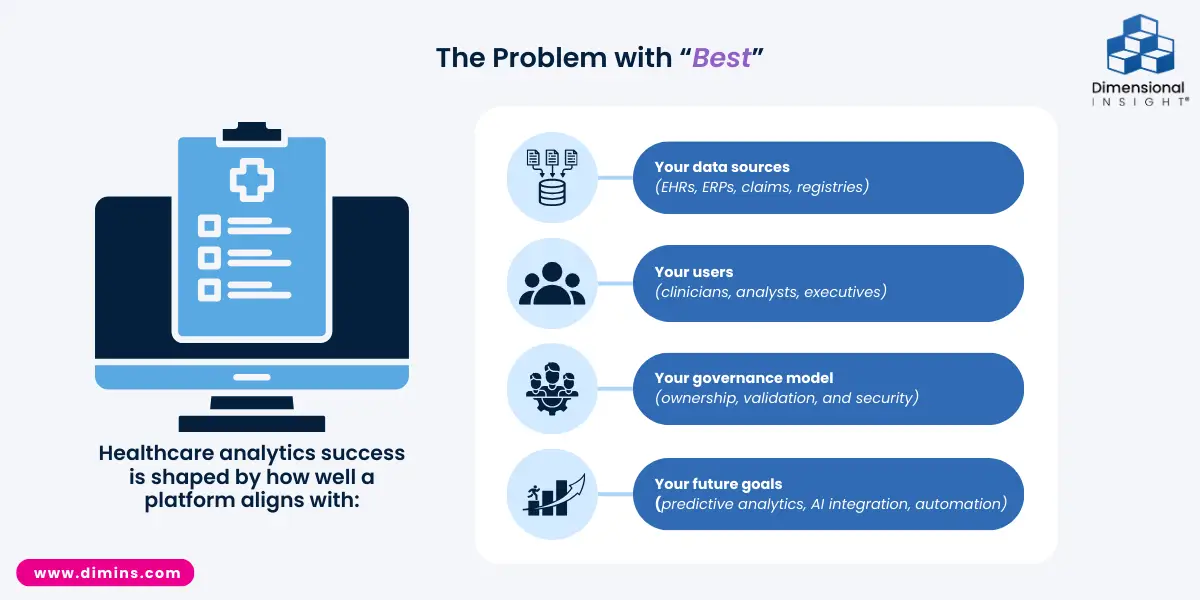
The Problem with “Best”
If you search “best healthcare analytics platform,” you’ll find vendor rankings, feature matrices, and customer reviews that don’t tell the whole story. One hospital’s top choice may be completely wrong for another.
Healthcare analytics success is shaped by how well a platform aligns with:
- Your data sources (EHRs, ERPs, claims, registries)
- Your users (clinicians, analysts, executives)
- Your governance model (ownership, validation, and security)
- Your future goals (predictive analytics, AI integration, automation)
Instead of chasing the “best,” focus on the best fit—the platform that helps your organization improve outcomes, efficiency, and confidence in data-driven decisions.
The Five Pillars of Evaluation
The following Five Pillars of Evaluation framework can help organizations cut through the noise and assess analytics platforms objectively.
| Pillar | What It Means | Why It Matters |
| Integration | Ability to connect data from EHR, ERP, and external sources into a single, reliable model. | Healthcare runs on complexity. Seamless integration prevents data silos and supports consistent metrics. |
| Governance | Built-in tools for ownership, data quality, and access control. | Trust in analytics starts with trust in data. Governance ensures accuracy and HIPAA compliance. |
| Usability | Interface and workflows that make analytics accessible to both technical and non-technical users. | If users can’t navigate the tool easily, adoption stalls—no matter how powerful the backend is. |
| Scalability | Performance and adaptability as your data volumes, users, and use cases grow. | Health systems evolve; your analytics infrastructure should grow with you, not against you. |
| Support & Partnership | Vendor’s experience, training, and long-term commitment to healthcare success. | True partnership extends beyond go-live—it’s about outcomes, not just software. |
Each pillar represents a measurable dimension. When evaluating solutions, involve a cross-functional team and score each pillar 1–5 based on your priorities. The result is a data-driven “fit profile” that replaces opinion with evidence.
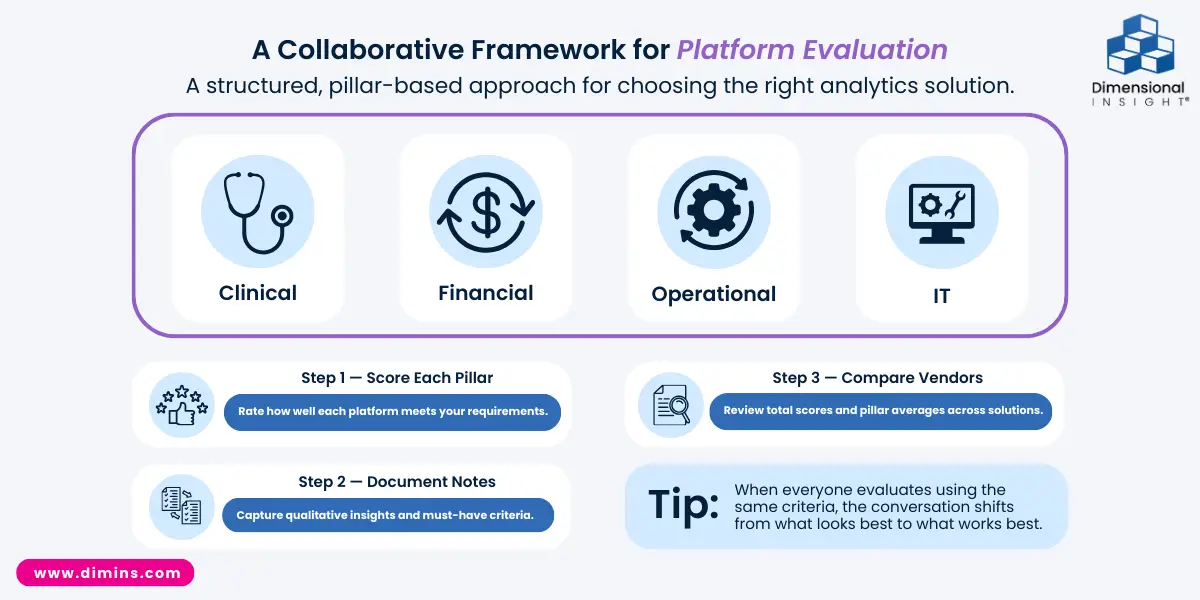
Applying the Framework in Practice
The best evaluations start with collaboration. Bring together representatives from clinical, financial, operational, and IT teams to discuss what success looks like for each pillar.
Then, for every platform you review:
- Score each pillar from 1 (needs major improvement) to 5 (fully meets requirements).
- Document qualitative notes and must-haves.
- Compare total and category averages across vendors.
This structured approach quickly reveals which solutions align best with your organization’s real-world workflows, not just their marketing claims.
Tip: When everyone evaluates with the same criteria, discussions shift from what looks best to what works best.
Beyond Features: What Consistency and Partnership Really Mean
Technology alone doesn’t drive outcomes. Culture, leadership, and partnership play just as big a role.
In fact, KLAS Research’s recent Consistent High Performers 2025 report found that vendors with the highest long-term satisfaction share key traits:
- They consistently exceed client expectations through proactive communication and strong customer success programs.
- They help clients measure ROI, not just in financial terms but through tangible clinical and operational outcomes.
- They maintain ongoing feedback loops, using user input to shape their product roadmaps.
- And most importantly, they build trust and loyalty—with 98% of organizations saying they would buy from these vendors again.
When evaluating analytics partners, look beyond product demos. Ask how each vendor measures success, listens to customer feedback, and demonstrates consistency over time. These are the signals of sustainable value.
Choosing with Confidence
Ultimately, the “best” healthcare analytics platform is the one that:
- Integrates your data seamlessly
- Embeds governance into every layer
- Is easy to use for every audience
- Scales as your needs evolve
- Comes with a vendor who understands healthcare as deeply as you do
Analytics platforms aren’t just about dashboards or KPIs—they’re about enabling better, faster, and more confident decisions that improve patient care and operational performance.
When you evaluate based on fit, consistency, and partnership, you’ll find the solution that’s truly “best” for your organization.