
As healthcare leaders plan for 2026, the technology landscape has reached a point of convergence. Artificial intelligence (AI) has matured, interoperability frameworks have evolved, and operational pressures have intensified. The question is no longer whether these technologies will matter—it’s how they will deliver consistent, measurable improvement across clinical, financial, and operational domains.
In 2026, healthcare organizations will focus less on experimentation and more on outcomes. The trends below reflect where investments are shifting, what leaders are prioritizing, and which capabilities are proving most impactful.

Trend 1: Clinical-Grade AI Becomes Standard, Not Special
Artificial intelligence moves from pilots to production in 2026. Organizations are embedding predictive and generative capabilities into clinical and operational workflows, but with higher expectations around transparency, model validation, and governance.
Across the industry, leaders are evaluating AI tools based on:
- Whether they reduce clinician burden
- Whether insights are explainable and trustworthy
- Whether they improve decision-making at the point of care
- How well they integrate into existing workflows
Use cases such as sepsis identification, readmission prediction, imaging prioritization, and care pathway recommendations are becoming more common. What differentiates organizations is not whether they deploy AI, but how responsibly and effectively they do so.
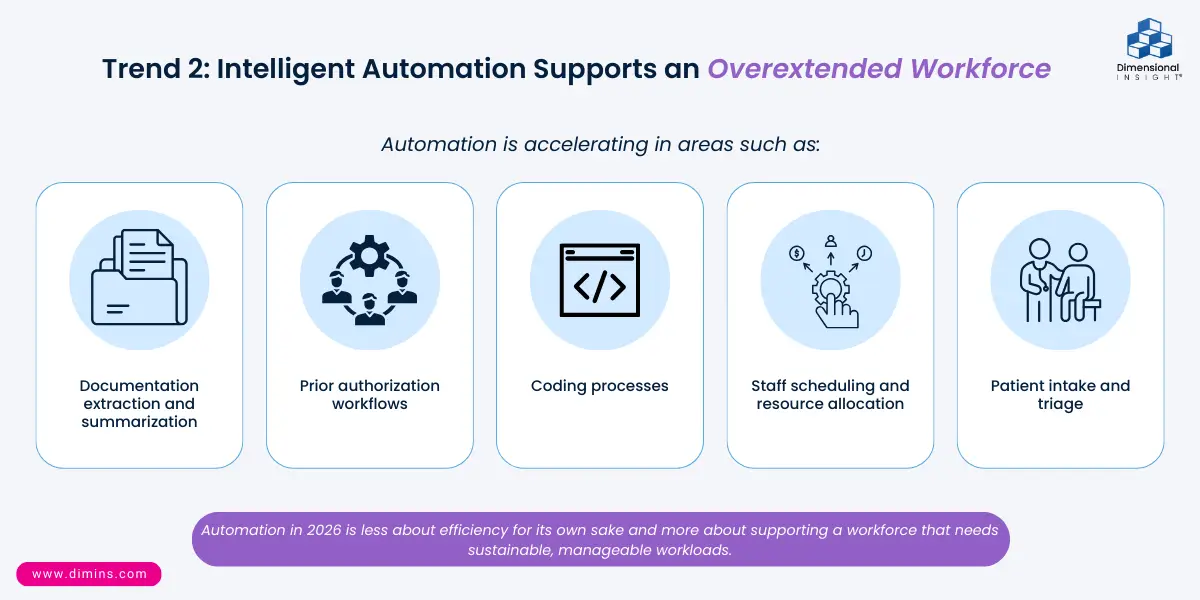
Trend 2: Intelligent Automation Supports an Overextended Workforce
Workforce strain continues to challenge every part of the healthcare ecosystem. Administrative burden remains one of the top drivers of burnout, and organizations are increasingly turning to automation to streamline manual processes.
Automation is accelerating in areas such as:
- Documentation extraction and summarization
- Prior authorization workflows
- Coding processes
- Staff scheduling and resource allocation
- Patient intake and triage
The focus is on removing repetitive tasks, reducing error rates, and enabling clinicians and staff to spend more time on high-value work. Automation in 2026 is less about efficiency for its own sake and more about supporting a workforce that needs sustainable, manageable workloads.
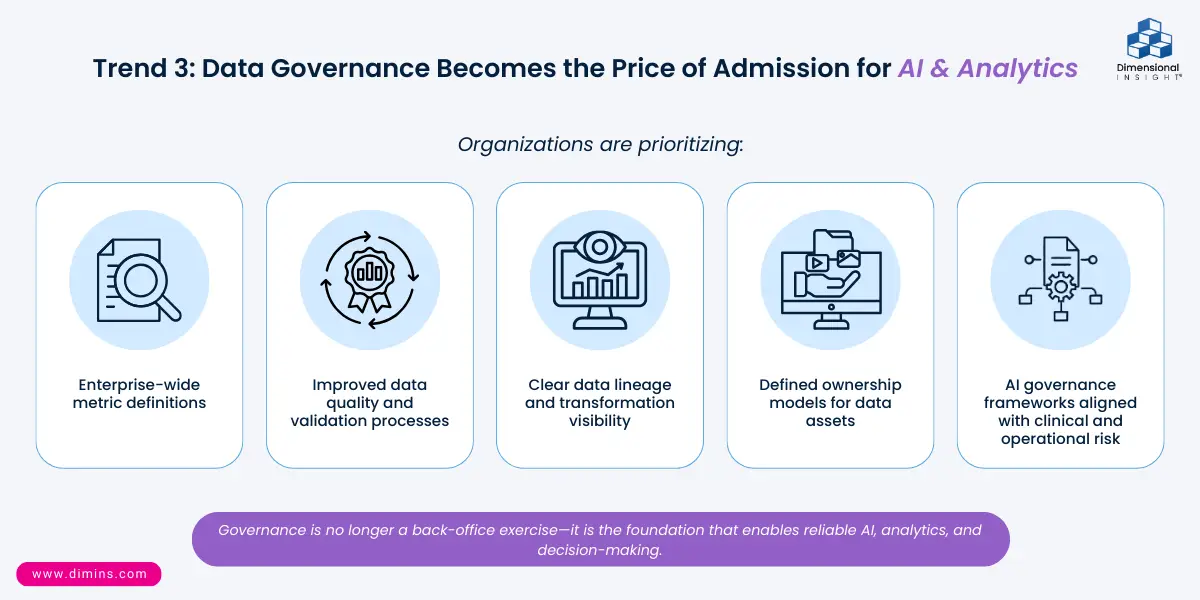
Trend 3: Data Governance Becomes the Price of Admission for AI and Analytics
AI adoption has heightened the industry’s awareness of something fundamental: without strong data governance, advanced analytics cannot scale safely or effectively.
Organizations are prioritizing:
- Enterprise-wide metric definitions
- Improved data quality and validation processes
- Clear data lineage and transformation visibility
- Defined ownership models for data assets
- AI governance frameworks aligned with clinical and operational risk
Health systems with established governance programs are able to adopt new technologies faster and with greater trust. They avoid internal discrepancies, reduce rework, and ensure their data is consistent across departments. Governance is no longer a back-office exercise—it is the foundation that enables reliable AI, analytics, and decision-making.
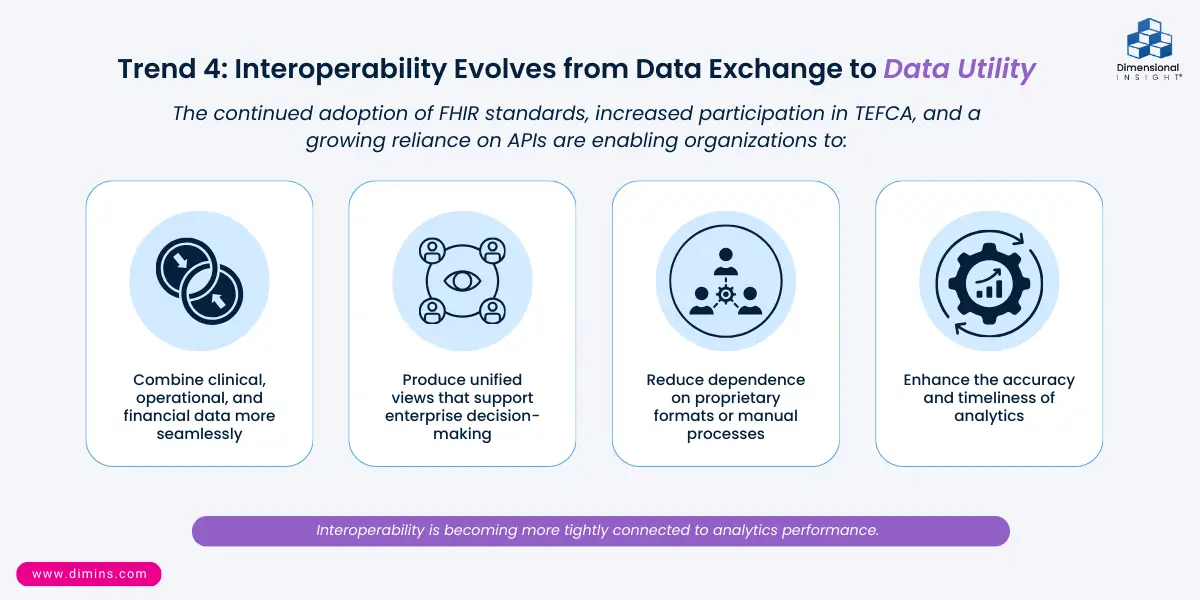
Trend 4: Interoperability Evolves from Data Exchange to Data Utility
Healthcare has made progress in moving data between systems. In 2026, the emphasis shifts to making that data useful.
The continued adoption of FHIR standards, increased participation in TEFCA, and a growing reliance on APIs are enabling organizations to:
- Combine clinical, operational, and financial data more seamlessly
- Produce unified views that support enterprise decision-making
- Reduce dependence on proprietary formats or manual processes
- Enhance the accuracy and timeliness of analytics
Interoperability is becoming more tightly connected to analytics performance. Data that moves freely—but also consistently and with context—is enabling more accurate forecasting, more proactive operational planning, and more coordinated care.
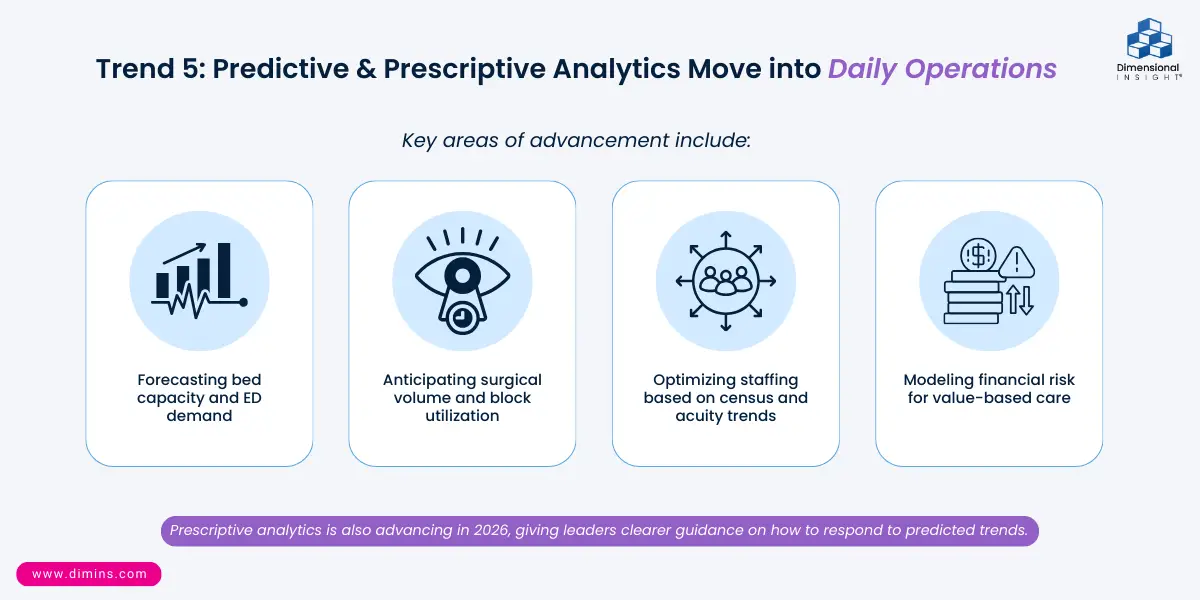
Trend 5: Predictive and Prescriptive Analytics Move into Daily Operations
Healthcare organizations continue to rely on dashboards for situational awareness, but many are now expanding into predictive and prescriptive analytics to better anticipate demand and allocate resources.
Key areas of advancement include:
- Forecasting bed capacity and ED demand
- Anticipating surgical volume and block utilization
- Optimizing staffing based on census and acuity trends
- Modeling financial risk for value-based care
Prescriptive analytics is also advancing in 2026, giving leaders clearer guidance on how to respond to predicted trends. This shift from retrospective reporting to forward-looking insight supports more proactive operational management across the enterprise.
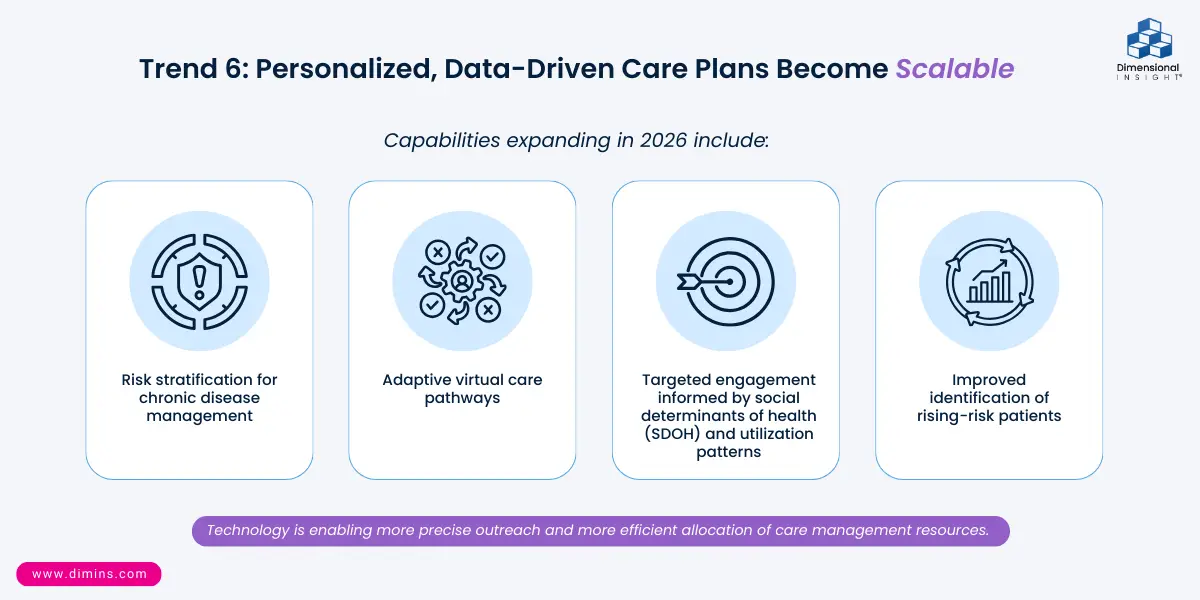
Trend 6: Personalized, Data-Driven Care Plans Become Scalable
Organizations are making progress toward individualized care models driven by integrated clinical, behavioral, and social data.
Capabilities expanding in 2026 include:
- Risk stratification for chronic disease management
- Adaptive virtual care pathways
- Targeted engagement informed by social determinants of health (SDOH) and utilization patterns
- Improved identification of rising-risk patients
Technology is enabling more precise outreach and more efficient allocation of care management resources. What previously required manual review or multiple disconnected systems is now supported by unified analytics platforms and automated insight.
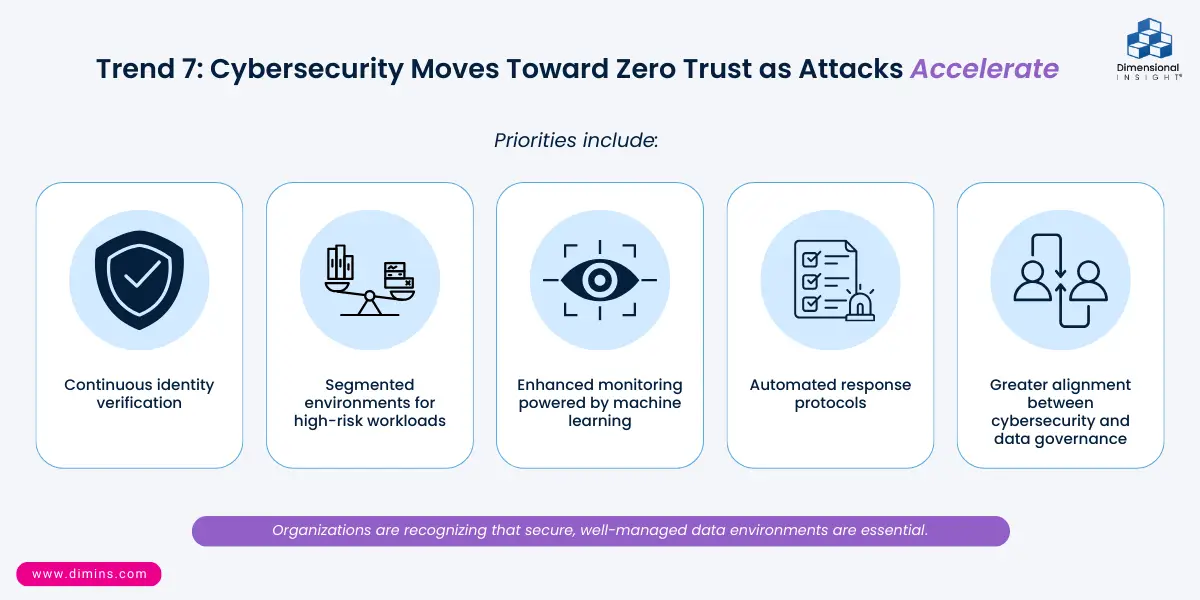
Trend 7: Cybersecurity Moves Toward Zero Trust as Attacks Accelerate
Cybersecurity threats continue to escalate in frequency and sophistication. As a result, healthcare organizations are adopting Zero Trust principles more broadly.
Priorities include:
- Continuous identity verification
- Segmented environments for high-risk workloads
- Enhanced monitoring powered by machine learning
- Automated response protocols
- Greater alignment between cybersecurity and data governance
Organizations are recognizing that secure, well-managed data environments are essential not only for compliance but for the trustworthy operation of analytics and AI systems.
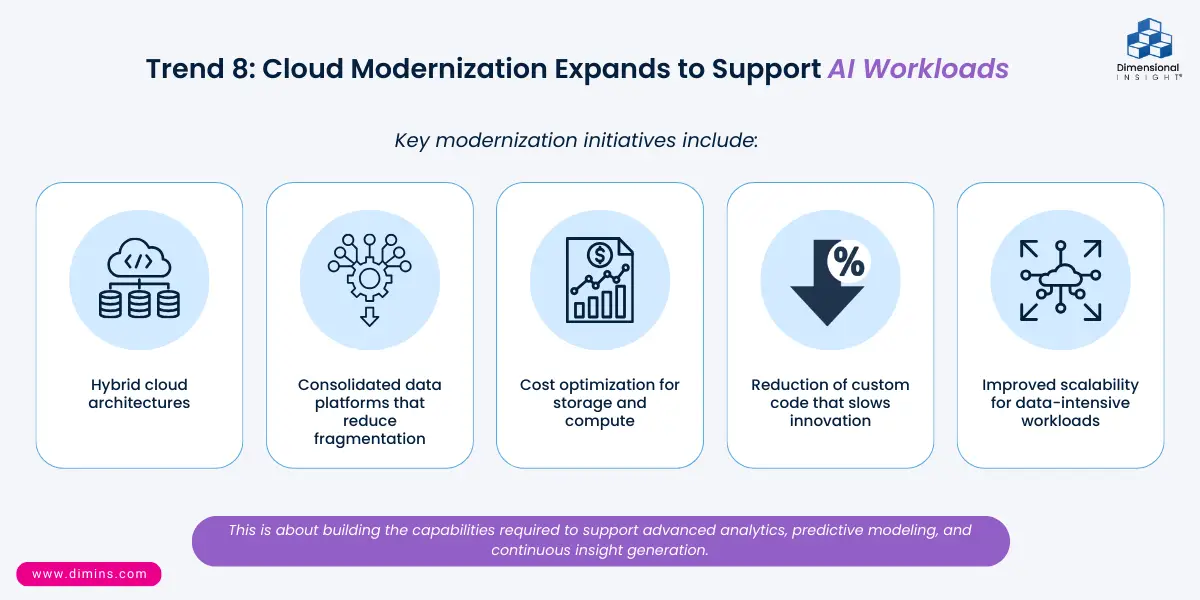
Trend 8: Cloud Modernization Expands to Support AI Workloads
Cloud strategies in healthcare are evolving from general migration efforts to targeted modernization aimed at supporting AI and real-time analytics.
Key modernization initiatives include:
- Hybrid cloud architectures
- Consolidated data platforms that reduce fragmentation
- Cost optimization for storage and compute
- Reduction of custom code that slows innovation
- Improved scalability for data-intensive workloads
This modernization is not about moving everything to the cloud. It is about building the capabilities required to support advanced analytics, predictive modeling, and continuous insight generation.
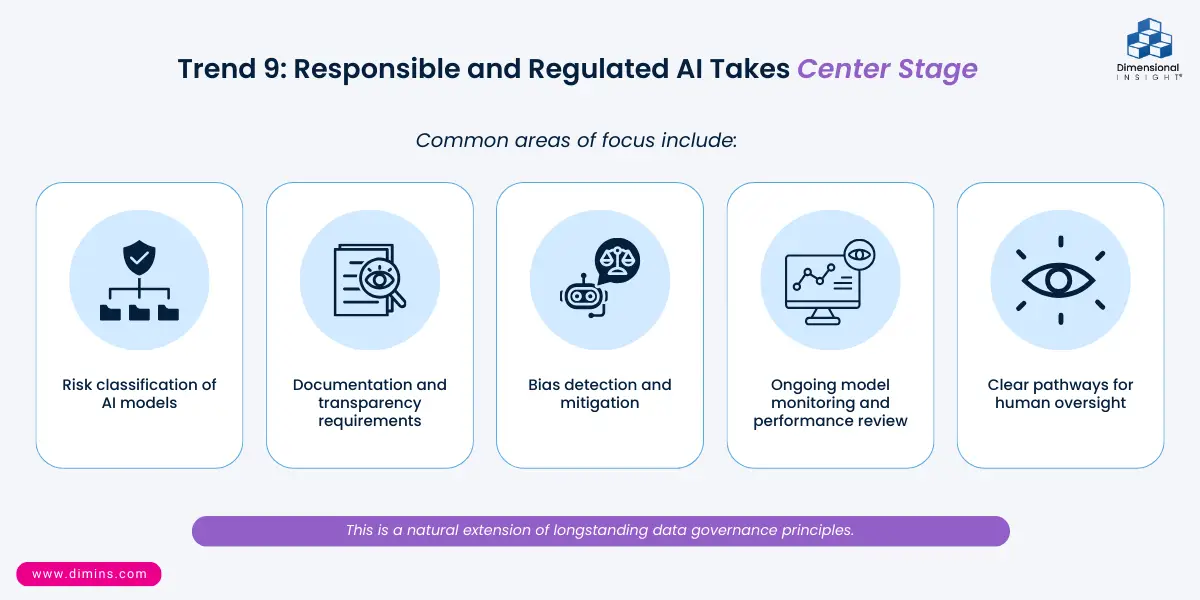
Trend 9: Responsible and Regulated AI Takes Center Stage
Regulatory frameworks around AI are gaining clarity, and healthcare organizations are proactively adapting. Responsible AI practices are becoming embedded into standard governance processes.
Common areas of focus include:
- Risk classification of AI models
- Documentation and transparency requirements
- Bias detection and mitigation
- Ongoing model monitoring and performance review
- Clear pathways for human oversight
Many organizations are centralizing AI oversight through internal governance committees or registries that track how models are used, what data they rely on, and whether they perform as expected. This is a natural extension of longstanding data governance principles.
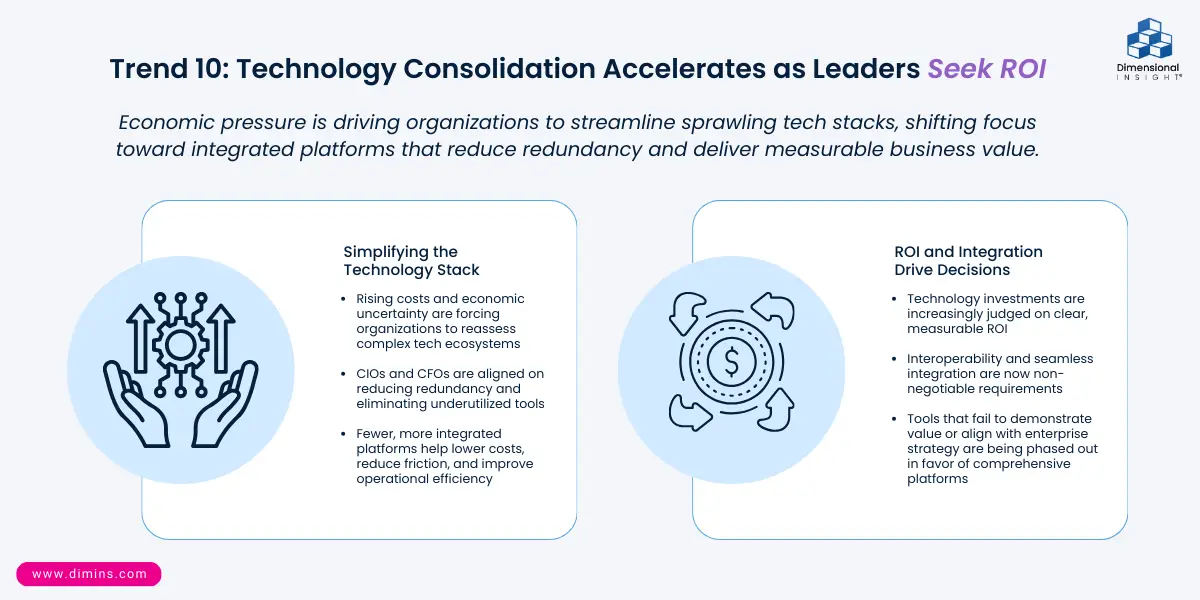
Trend 10: Technology Consolidation Accelerates as Leaders Seek ROI
Economic pressure is prompting organizations to simplify their technology environments. Leaders are prioritizing platforms that reduce redundancy, improve integration, and deliver clearer measurable value.
CIOs and CFOs are increasingly focused on reducing complexity, improving interoperability, and ensuring that each system contributes to a coherent enterprise strategy. Tools that cannot demonstrate value or integrate effectively are being phased out in favor of more comprehensive platforms.
What Forward-Looking Organizations Are Prioritizing for 2026
Organizations that are best positioned for success in 2026 tend to focus on three key capabilities:
- A strong, transparent data governance program
- A measured, outcome-focused approach to AI
- Operational efficiency through automation and forecasting
Rather than adopting technology for its own sake, they are concentrating on the capabilities that enhance clinical care, stabilize operations, and strengthen financial performance.
Conclusion: 2026 Is the Year Healthcare Turns AI Into Results
The past several years were about exploration. 2026 is about execution.
Healthcare organizations that pair modern analytics with responsible AI and strong data governance will be well-equipped to navigate uncertainty and drive meaningful improvement in the year ahead.
At Dimensional Insight, we remain focused on helping customers build the reliable data foundation that supports confident, consistent decision-making across the enterprise. The opportunities ahead are significant—and organizations with the right foundation are prepared to take advantage of them.


- 2026 Healthcare Technology Trends - January 6, 2026
- How to Build a Healthcare Data Governance Program That Actually Works - December 23, 2025
- What the 2025 Gartner Peer Insights Voice of the Customer Report Tells Us About Analytics and Customer Experience - December 16, 2025