
Energy demand is higher than ever, and in many places, grid capabilities need improvement in order to meet that demand. The increased demand comes from the rise of data centers that feed artificial intelligence, as well as more electric usage in vehicles and industrially, as eco-conscious companies change how they power their day-to-day activities.
While utilities organizations have seen this rise in usage coming for a while, and many have prepared for it, outdated facilities have made it harder on some places to meet the increased demand. Let’s take a look at why some places have work to do, and how analytics combined with artificial intelligence could be the key to success.
What potential problems exist?
A recent study out of New York illustrates the challenges many organizations in the utilities industry are facing. The New York Independent System Operator (NYISO) released its 2025-2034 Comprehensive Reliability Plan (CRP) in late November. It said New York is at an inflection point because of the aforementioned increased energy demand combined with the state’s aging generation fleet and the lack of new dispatchable generation resources being added to the system.
Though the report focuses on New York, the same can be said for many places with aging grids. This particular report examined lessons learned from the heatwave in June, and the need for a planning framework that better reflects present challenges of operating the grid while anticipating plausible future risks.
How can AI help?
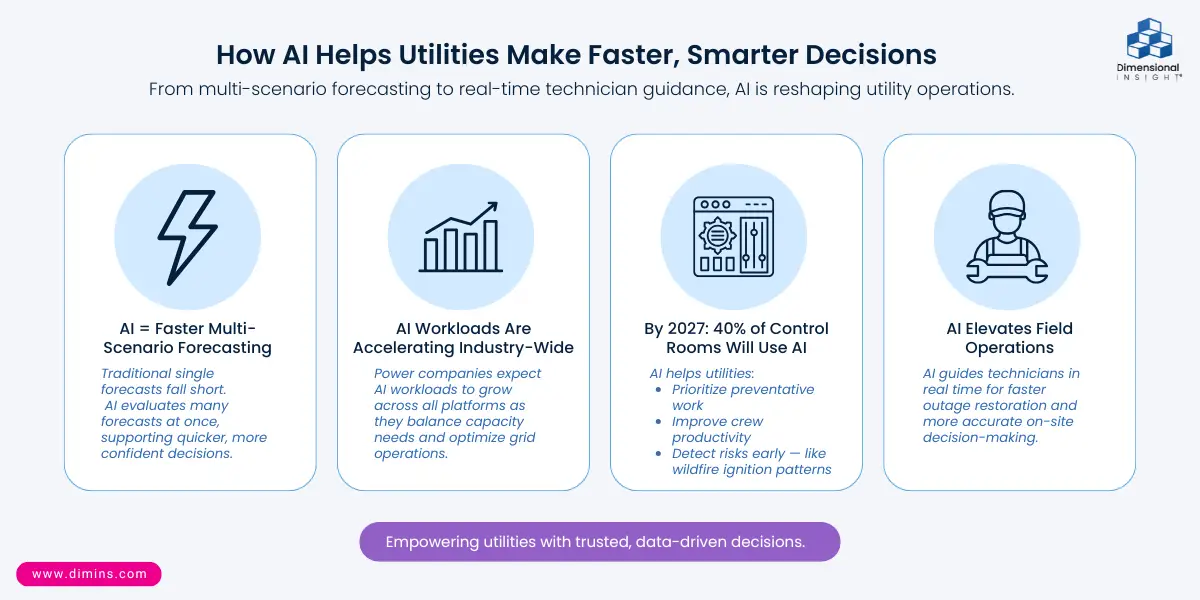
One way to address that problem is through AI. The CRP suggests that traditional planning methods built around a single forecast are no longer sufficient. AI presents the opportunity to consider a number of forecasts more quickly than ever before, helping utilities companies make better decisions at a time when quick decision-making is a necessity.
In its 2026 Power and Utilities Industry Outlook, Deloitte identifies the need to integrate analytics and AI to optimize efficiency as a top strategy for companies in the industry. According to the report, power company executives expect AI workloads to grow on all of their computing platforms over the next year, as they acknowledge they have to balance the need for increased capacity due to AI while using AI to optimize the grid.
The report predicts that by 2027, nearly 40% of utility control rooms will use AI, which can help utilities prioritize preventative work to reduce failures, while improving crew productivity. AI can also be used to guide technicians in real time, ensuring faster outage restoration, and it can help detect potential problems, like wildfires, proactively.
How do AI and analytics work together?
Deloitte stresses the need for human oversight of AI, referencing North American Electric Reliability Corporation guidance which emphasizes that AI should serve as a decision-support tool rather than an autonomous controller. And just like AI needs people for it to produce the best results, it needs reliable data in order to be most effective for organizations.
The right analytics solution can reliably pull data from disparate sources without sacrificing data quality. Everyone can be sure that they are looking at a single version of the truth, whether they are out in the field monitoring repairs or in an office working with customers, addressing compliance, or handling financial concerns. Data can range from what drones gather as they access areas that are hard for humans to reach, or it can be the countless bits of information about energy usage. Analytics can bring that type of information together to produce reports that area easy to understand and from which decisions can be made.
Just as important is the idea that a solution can adjust to the change in times. The technology needs to be able to address the challenges the utilities industry faces today, but it needs to be scalable so that organizations don’t have to start all over again from scratch when a new issue arises down the road.
The most pressing issue for most organizations in 2026 is having the right infrastructure in place to be able to meet everyone’s needs. In order to ensure that the industry is operating at peak efficiency, everyone needs to be using data. With the right data and analytics guiding the work that AI can do, the industry can set itself up for a successful new year while laying the groundwork for the important work the industry faces beyond 2026.


- AI Leads the Way for Utilities in 2026 - December 11, 2025
- Using Data to Identify Creative Wine and Spirits Gifts - December 2, 2025
- Making Supply Chain Decisions Using Better Data - November 26, 2025