Learn the key distinctions, pitfalls, and best practices for building trusted analytics environments.
At Dimensional Insight, we’ve long subscribed to the idea of “data as bodies of water.” Decades before the term “data lake” was invented, Diver users were already “diving through their sea of data.” The metaphor makes sense: data is fluid and amorphous. It flows in and out from many places, and a change in one area can create ripples everywhere.
Naturally, people need a place to store their data. Originally, that was the database. Databases are highly structured, meaning any data you put into them must fit a known form, or schema. Think of a database as a set of lists, each containing things and the key information about them. Sales records include a salesperson, a product, and units sold. Employee records include a name and a salary. You can’t put data into a database unless you know the important facts about it. We call this “schema-on-write.”
This works well for things like sales or inventory records, but it has limits. There’s a lot of valuable information out there — emails, manuals, even videos — that’s full of insight, but impossible to model perfectly in advance. Round-peg, square-hole.
A close cousin to the database is the data warehouse. While databases are usually optimized for adding data, data warehouses are optimized for using that data for analysis. They still share a fundamental limitation: the data must be structured before you can store it, so they can only handle certain types of information.
Enter the Data Lake
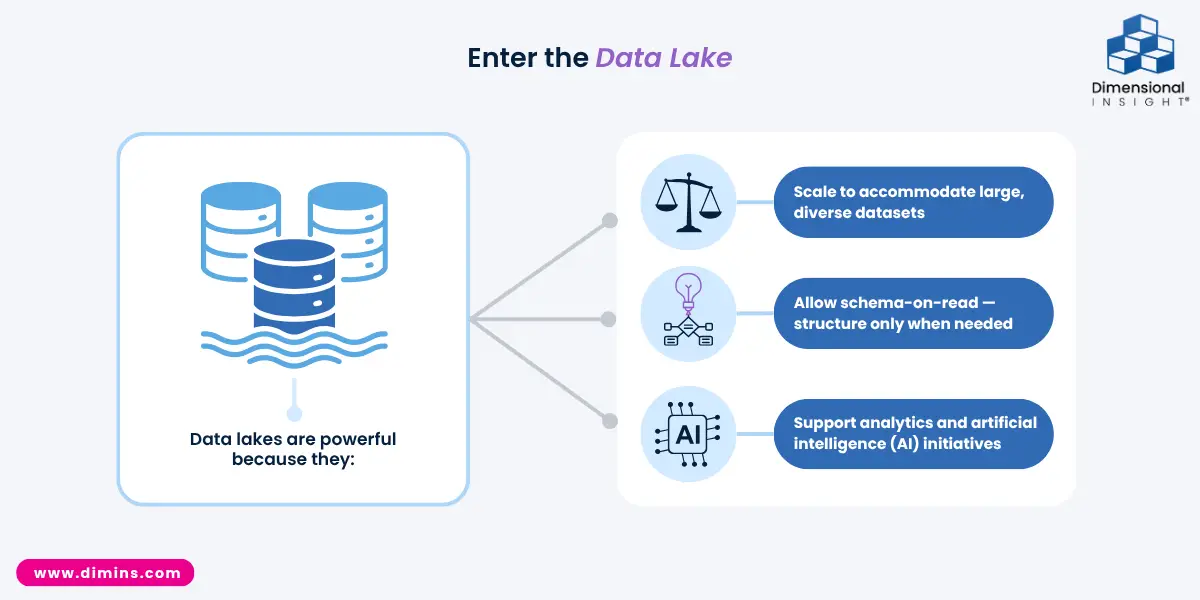
Then comes the data lake. Data lakes are large, centralized repositories for storing data in its natural form. They follow the philosophy of “put anything in, and figure out what you want to know when you pull it out” — also known as schema-on-read. Data lakes are large, diverse, and flexible. Want to search emails discussing TPS report cover sheets? Analyze videos containing dogs? No problem.
Data lakes are powerful because they:
- Scale to accommodate large, diverse datasets
- Allow schema-on-read — structure only when needed
- Support analytics and artificial intelligence (AI) initiatives
But that flexibility comes with risk. As we say in the industry: “Garbage in, garbage out.” Without the guardrails of a well-defined schema (and sometimes even with one), your data can get messy. Without a shared understanding of what the data should look like, a data lake can become a data swamp.

When Lakes Turn Into Swamps
A data swamp is what happens when your data loses clarity. Poor documentation, inconsistent naming, and lack of ownership all lead to data you can’t trust to mean what you think it means. Even something as simple as dates becomes ambiguous — is 03/06 March 6th or June 3rd?
Preventing swamps requires:
- Strong data governance
- Defined metadata and lineage
- Regular quality checks and curation
At Dimensional Insight, data governance is central to our approach. The Measure Factory ensures everyone agrees on the definition of each measure. Clear rules and definitions keep analytics meaningful, no matter where the data comes from.
What Is a Data Pond?
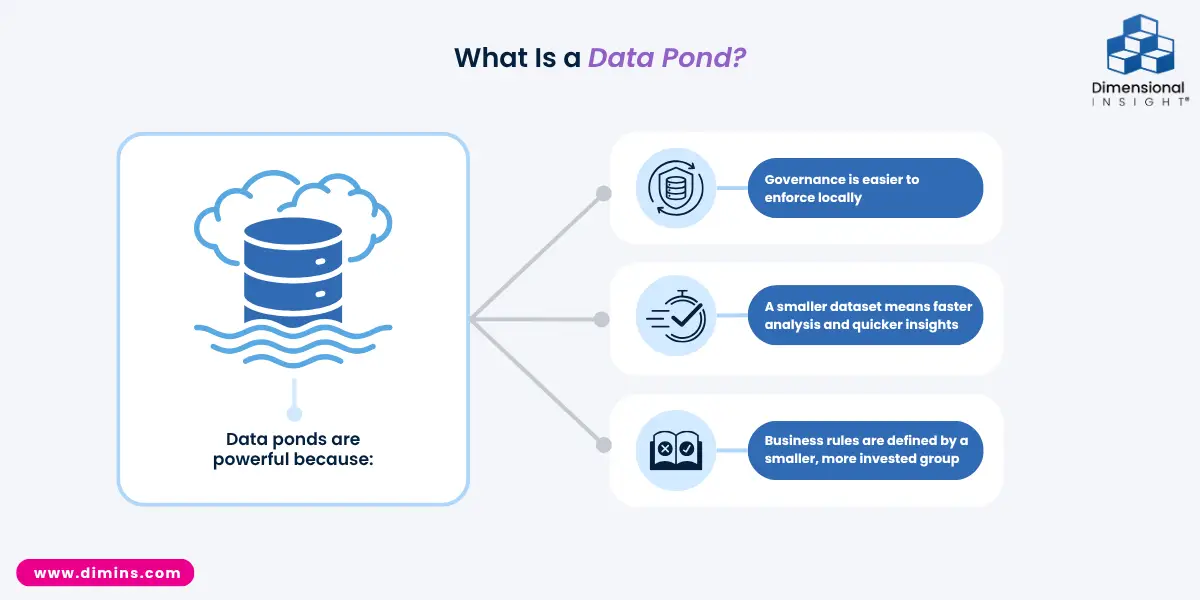
Another way to ensure clarity is to keep data focused. That’s where data ponds come in. A data pond is smaller and more targeted than a lake, typically belonging to a single department or business unit. It’s a curated subset of data relevant to a specific purpose.
For example, if a hospital’s data lake contains all enterprise information, an oncology department might maintain its own data pond for patient outcomes, treatment protocols, and trial participation. The pond is easier to manage, cleaner, and tailored for local insight.
Data ponds are powerful because:
- Governance is easier to enforce locally
- A smaller dataset means faster analysis and quicker insights
- Business rules are defined by a smaller, more invested group
Many organizations start with ponds before building a lake — a practical way to demonstrate value and establish governance on a smaller scale.
Data Pond vs. Data Lake: Key Differences
| Aspect | Data Pond | Data Lake |
| Scope | Departmental or project-specific | Enterprise-wide |
| Data Type | Mostly structured, curated | Structured + unstructured, raw |
| Governance | Local ownership | Centralized, with heavy metadata needs |
| Speed to Insight | Fast | Variable; depends on maturity |
| Cost & Complexity | Lower | Higher |
| Use Case Example | Oncology outcomes analysis | Cross-hospital population analytics |
A simple way to think about it:
Ponds are about precision.
Lakes are about possibility.
When to Choose a Data Pond vs. a Data Lake
Choose a Data Pond When:
- You’re starting small or focused on one function
- You need agility and departmental control
- Governance practices are still maturing
- You want rapid proof-of-concept analytics
Choose a Data Lake When:
- You have enterprise-wide data needs
- You support data science and AI initiatives
- Governance and metadata frameworks are mature
- You need a single source for cross-functional analytics
In reality, most organizations use both: ponds that feed a lake, or lakes that supply raw data to ponds that then curate it. The relationship is symbiotic.
Governance: The Foundation of Trusted Data
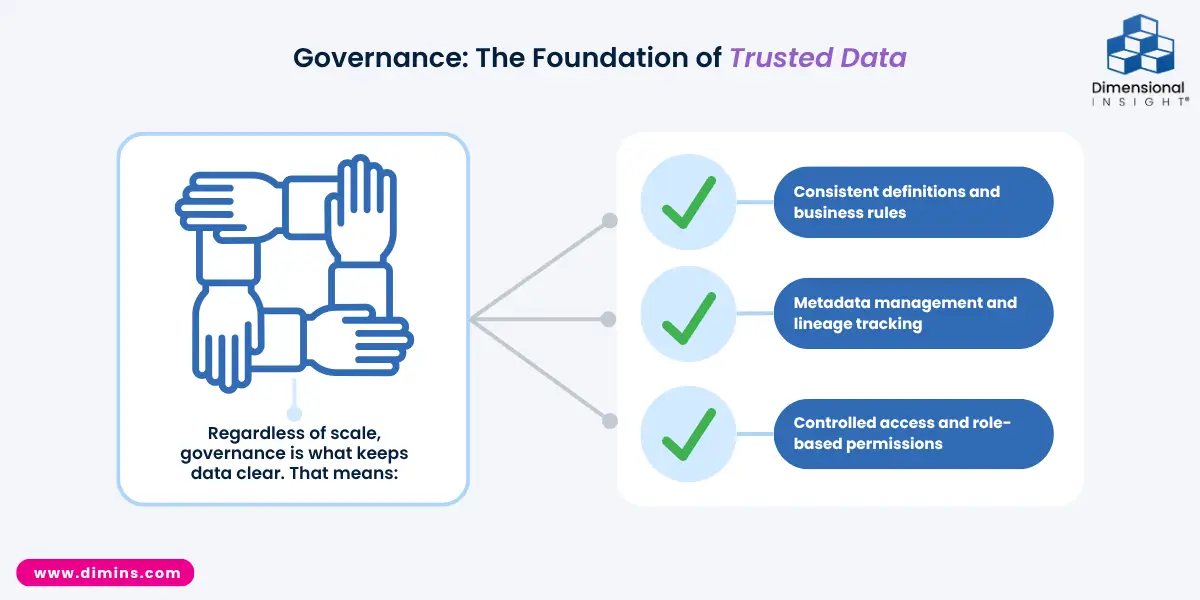
Regardless of scale, governance is what keeps data clear. That means:
- Consistent definitions and business rules
- Metadata management and lineage tracking
- Controlled access and role-based permissions
It’s the same philosophy that drives our work at Dimensional Insight: governed data builds trust — and trusted data drives better decisions. Without governance, even the most advanced technology can devolve into confusion. With it, even a modest data pond can deliver remarkable clarity.
Real-World Examples in Healthcare and Beyond
Here’s a healthcare example: a regional health system might begin by building data ponds for clinical areas — oncology, orthopedics, emergency department — each containing curated, validated data aligned with departmental goals. Over time, these ponds can connect into an enterprise data lake, enabling population-level analytics while preserving the governance lessons learned locally. This gradual approach reduces risk, builds data literacy, and creates a culture of ownership.
The same principle applies beyond healthcare: a winery might begin with a pond for sales and distributor data before unifying its environment to include marketing, production, and logistics.
Modern Approaches: Lakehouses, Meshes, and Fabrics
As technology evolves, new architectures attempt to bridge the gap between the structured reliability of data warehouses and the flexibility of data lakes.
Data Lakehouse
One such approach is the data lakehouse. Lakehouses take the volume and diversity of data lakes and add formal governance. They can store both structured and unstructured data, and can be taught to interpret unstructured content.
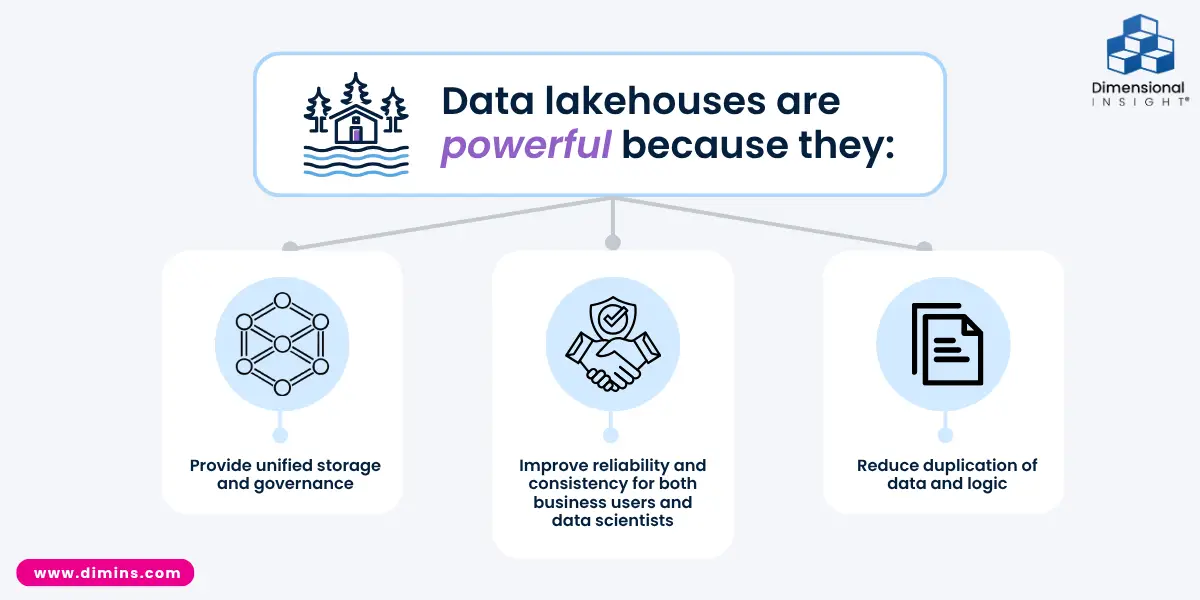
Data lakehouses are powerful because they:
- Provide unified storage and governance
- Improve reliability and consistency for both business users and data scientists
- Reduce duplication of data and logic
The trick to data lakehouses is that you still need governance. Without those, it’s data swamp all over again. Data lake solutions have technical mechanisms for governance, but without the institutional understanding you run the risk of having a fancier, but still murky, data swamp.
Data Mesh and Data Fabric
Other emerging approaches include data meshes and data fabrics. A data mesh treats data as a product, owned by domain teams. In many ways, departmental data ponds resemble early mesh concepts: localized control with shared standards. A data fabric focuses on metadata-driven integration and automation — the connective tissue between ponds, lakes, and warehouses.
These trends emphasize decentralization and governance as much as technology. The future isn’t about one perfect architecture — it’s about choosing the structure that supports agility and trust.
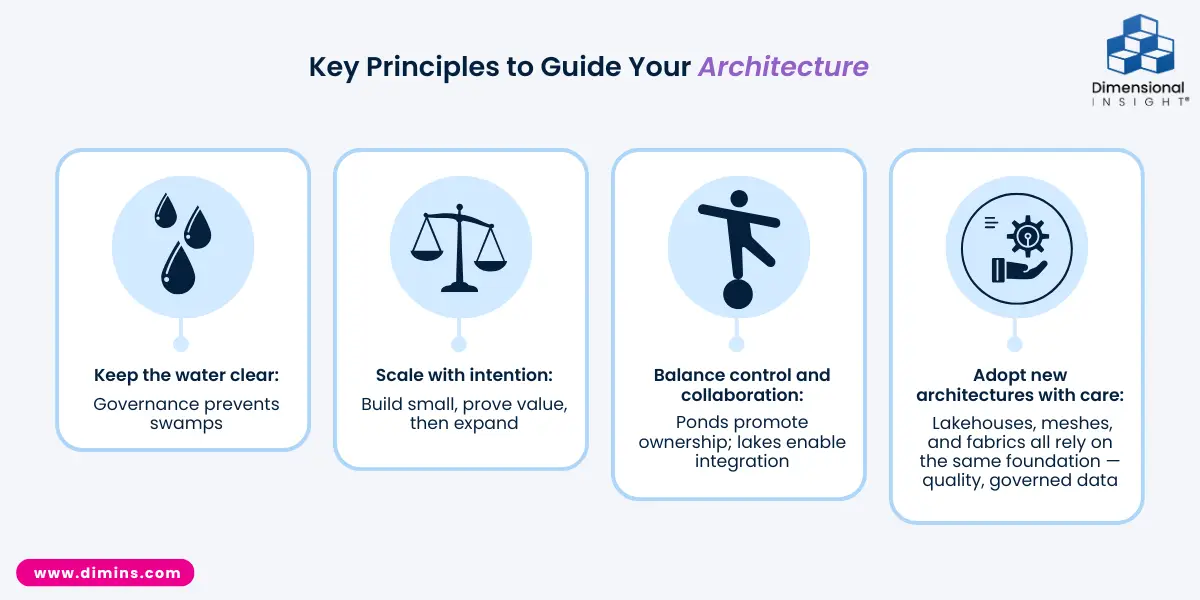
Key Principles to Guide Your Architecture
- Keep the water clear: Governance prevents swamps
- Scale with intention: Build small, prove value, then expand
- Balance control and collaboration: Ponds promote ownership; lakes enable integration
- Adopt new architectures with care: Lakehouses, meshes, and fabrics all rely on the same foundation — quality, governed data
Conclusion
In the end, your data environment should reflect your organization’s maturity, goals, and culture. Some teams thrive in small, manageable ponds. Others need the breadth and depth of a lake. The most successful organizations know how to connect both — keeping data clear, governed, and ready to support confident decisions.
At Dimensional Insight, we’ve seen firsthand how the right architecture empowers teams to move from confusion to clarity. Whether you’re defining your first data pond or expanding an enterprise lake, our team can help chart the best path forward.

- Data Ponds vs. Data Lakes: A Practical Overview - November 20, 2025