

How Analytics Can Help You Better Manage Your ICU. 3 Critical Areas in Which More Accessible Data Will Enable Meaningful Improvements
How Analytics Can Help You Better Manage Your ICU. 3 Critical Areas in Which More Accessible Data Will Enable Meaningful Improvements
Introduction
In the intensive care unit, every second counts. So does every piece of data.
Hospital ICUs are tasked with taking care of the most critically ill patients. That means that to improve patient care, providers must have access to vital information at their fingertips, and the departments themselves must be running at an optimal level.
However, managing ICUs also has its own unique set of challenges due to the acuity of patients, the types of resources needed (such as ventilators), and higher per-patient levels of staffing and necessary specializations.
An analytics platform can help hospitals and health systems better manage their ICU resources, resulting in streamlined operations, reduced costs, and improved patient outcomes.
In this white paper, we’ll examine three areas in which data can make a difference in the ICU, and take a look at how Dimensional Insight’s ICU Advisor uniquely addresses these areas.
Gaining Insight into Operations
It’s important for hospital administrators to understand how their ICU is performing at an operational level. That means getting a handle on key numbers such as current census, average length of stay, average number of ventilator days, throughput statistics, and more. Understanding these numbers will help a healthcare organization determine if it is most effectively using its resources and if there are opportunities for improvement.
Analytics platforms can help ICUs see these key numbers at a glance so they can get a pulse on the state of their department at any point in time. In addition, analytics can provide a view of trends over time. This insight enables administrators to assess things such as:
Are there seasonal fluctuations in our census?
What services (radiology, lab, pharmacy) are most commonly used within the ICU?
Is that utilization within normal ranges?
How many people are returning to the ICU? And is that number going up or
down over time?
What is the average number of ventilator days? And are we prepared if we see a surge in patients?
Understanding the Financial Picture of the ICU
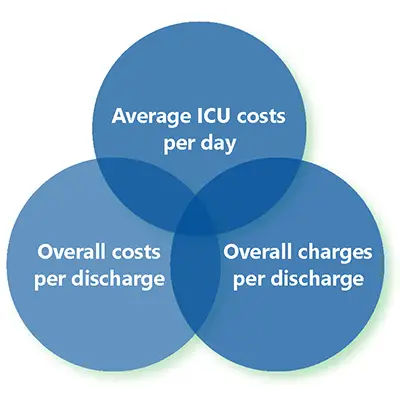
As with any other department in a hospital, administrators need to understand the ICU’s overall financial health and where there are are as for improvement. Key indicators to understand are:
Overall costs per discharge
Overall charges per discharge
Analytics helps hospitals and health systems visualize both overall numbers and trends over time. This enables more informed decisions, and when tied together with the operational data, helps a healthcare organization better understand its resource utilization and where it can make improvements without sacrificing quality or care.

Improving Patient Quality and Outcomes
While it’s of course important for a healthcare organization to understand its operations and finances, the ultimate goal is not only to improve the quality of patient care, but also to move the needle on patient outcomes — which is literally a matter of life or death in the ICU.
Utilization numbers can inform healthcare facilities on the efficiency of their operations, as well as informing providers on the necessity of services and whether they are impacting patient health.
Analytics can enable healthcare providers to view trends on clinical and quality measures, such as the number of central line-associated bloodstream infections (CLABSI), catheter-associated urinary tract infections (CAUTI), and sepsis, which are common infections a patient can contract in the hospital. Providers can view trends and then take steps to reduce numbers, informed by what the data is telling them.
About Dimensional Insight’s ICU Advisor
Dimensional Insight’s ICU Advisor is an analytics application that is uniquely qualified to address the three areas mentioned in this paper. Designed as a complement to Dimensional Insight’s Hospital Operations application, ICU Advisor enables healthcare providers to view and explore ICU-specific measures and KPIs.
The application is organized similarly to other Dimensional Insight applications, with a dashboard to view the most important metrics at a glance, information on what’s happened recently, and various KPIs organized into topics.
If there are metrics that users want to investigate further, they can dive into the details and explore freely down to as granular of a level as they’d like. Metrics included in the application are ICU-specific and are related to operations, finances, quality, and clinical, including KPIs such as:
ICU Discharges
ICU ALOS
CLABSI/CAUTI/Sepsis
Average ICU Charge/Day
Overall Costs Per Discharge
Overall Charges Per DischargeAverage Ventilator Days
patient outcomes.