

Cannabis Technology Landscape—Bridging the Gap with Analytics
Cannabis Technology Landscape—Bridging the Gap with Analytics
Despite only recently witnessing mainstream acceptance, the cannabis market has seen unprecedented growth—and alongside it, the emergence of a surplus of new industry-specific tools and software. As a result, the industry is beginning to look more and more like other established retail operations.
However, despite the abundance of newly available digital platforms, many businesses are still struggling to navigate their cannatech software stack and implement solutions that properly address their specific needs and long-term strategies. On top of this, incongruencies in legal status between different municipalities means a one-size-fits-all approach to market won’t cut it.
As with any modern industry, an optimized and coordinated technology stack is key for any cannabis cultivator, distributor, or retailer looking to realize their business’s potential. And at the epicenter of that stack is a fully integrated and comprehensive analytics platform capable of providing powerful data governance and detailed analysis.
Taking control—how analytics can optimize software investments
A poorly optimized software stack means businesses are:
A. Not fully capitalizing on the resources they have at their disposal
B. Missing out unrealized financial gains
C. Wasting spending on unnecessary expenditures
And most likely,
D. All of the above
The reality is, a company’s ROI depends on efficiency, and the only true pathway to an efficient tech ecosystem is through data-driven decision making.
Identifying software gaps and redundancy with data integration
Many of today’s existing platforms deliver a “jack of all trades, master of none” approach to cannabis technology, providing a wide variety of tools to reduce the burden and initial investment of business owners having to build and operate a sophisticated tech stack by themselves. On the surface, this is appealing for obvious reasons.
But as any experienced business executive knows, there is no single magical solution that will fix all their problems. With cannabis businesses growing at an unprecedented rate, decision-makers are looking more and more for options that retain their power of choice and allow them to tailor solutions to their own specific needs and goals—in other words, nobody wants to be constrained to a limited and inflexible closed ecosystem.
But that presents a new challenge: how exactly then do businesses determine what platforms they do and don’t need? Enter enterprise analytics.
Be aware of vendors who offer analytics, but aren’t analytic developers
With so many tech platforms available to choose from, cannabis business owners have to keep one important fact in mind: not all analytics vendors are built the same.
Nowadays, most vendors offer some form of embedded analytics within their applications as a courtesy to their clients. However, most of these embedded features are highly limited in scope and don’t provide a view of the big picture.
Generally speaking, the analytic and governance capabilities of cannabis software tools are built specifically around their own technical infrastructure. This means that although they may be useful in addressing their own reporting needs, they often have severely constricted uses when it comes to other important functions and data channels.
As a result, analysts are often forced to rely on manual input and integration, wasting valuable time and resources. Furthermore, the lack of a central platform to consolidate and standardize all of a business’s data raises serious questions about data trust and reliability.
The extensive variety of reporting demands within the cannabis industry means businesses need a platform that can address their needs across the entire organization. Platform-specific analytics simply lacks the infrastructure and support necessary to facilitate enterprise-wide operations. To truly capitalize on their entire tech stack, businesses have to implement a dedicated analytics solution capable of communicating and integrating data across multiple roles and functions.
The data feeds you should be measuring
Although only a few years old, the cannabis industry’s extraordinary growth has presented businesses with a wide variety of software tools to choose from. These include (but are not limited to):
- Seed-to-sale data tracking
- Integration and work-flow management
- Ecommerce solutions
- Financial services
- Point-of-sale data tracking
- Digital marketing
- Compliance
- Loyalty/rewards programs
- Marketplace
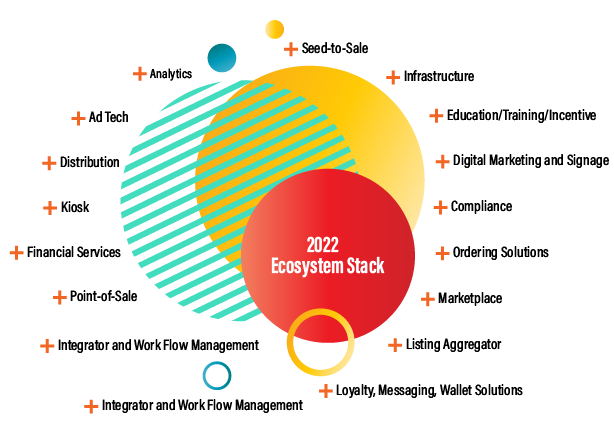
That’s a lot of tools, a lot of spending, and a lot of data. With all these tools and systems in place, businesses have to devote a significant portion of both time and money towards administrative functions necessary for keeping their data flowing. As previously mentioned, many of these systems unfortunately do not share the same data collection and export formats, leading to poor interoperability across the enterprise’s many roles and functions.
Using analytics to build a bridge between feeds
So the question is, with all these disconnected channels feeding us information from different tech infrastructures, how do we coordinate our data in a way that contributes towards enterprise-wide operations?
One of the primary advantages of any comprehensive analytics platform is its integration capabilities, allowing businesses to bring their data from multiple systems together into a single, unified view. This ensures that staff across different departments have access to the same library of consistent and real-time information, regardless of which tools they actually use within their individual roles. Additionally, this means that businesses aren’t limited to a specific ecosystem. With the right analytics platform at the core of their operations, cannabis businesses are able to hand-pick the right tools for their unique needs. For instance, salespeople can use data collected from inventory management systems to update their respective ecommerce platforms, and then follow-up with another program dedicated entirely to customer loyalty.
Without a solution in place to optimize and coordinate their various tools, businesses simply lack the framework to maximize their potential ROI.
Use cases for enterprise-wide analytics
While the benefits of integrating data across your business likely number in the thousands, some use cases are more relevant than others. The cannabis industry in particular faces a host of novel and difficult challenges due to its young age and highly regulated nature.
Using historical data to demonstrate success when entering new municipalities
When a cannabis business intends to enter a new municipality or expand its operations, the respective city/state usually requests information regarding how the company has performed in other districts. Some of the metrics these towns/cities are looking for include:
- Generated revenue
- Growth projections
- People employed
- Charitable investments
- Ratio of crime incidents prior to and after opening
- Public education

Without access to these measures, businesses can face a serious uphill battle in establishing new markets. This is where the benefits of an enterprise analytics platform really shine through.
By tracking data acquired from previous benchmarks, analytics solutions provide hard, concrete evidence of your business’s prior success. Each one of these measures demonstrates how new municipalities can expect your company to perform within their borders. Due to how young the industry is and its complicated legal status, it’s critical that cannabis businesses establish trust with potential new markets.
Comparing inventory management holding costs against projected/actual sales
Coordinating a business’s inventory with its sales has been one of the oldest challenges of any retail industry, and cannabis is no exception. Not having enough inventory to meet consumer demand can lead to lost revenue and potentially upset customers, while having excess of a poorly performing product can lead to wasted funds in holding costs, especially for perishables such as flower and edibles.
The business costs of inaccurate allocation predictions or the inability to anticipate or quickly adjust to market changes are incurred in the form of overstocks and shortages. Cannabis businesses can minimize these risks by employing data analytics to track the number of days of inventory and associated storage costs, resulting in significantly better inventory cost control.
Furthermore, data analytics can provide a business with insight into its operations across the entire supply chain and distribution market. This allows for better sales projections and enables businesses to accurately match supply with demand.
Cannabis analytics in the real-world
The challenge
Based in California, Petalfast is the first-of-its-kind full spectrum sales and marketing agency for the cannabis industry. It helps build cannabis brands through innovative consumer-led sales and marketing strategies.
However, like many organizations establishing themselves in the cannabis industry, Petalfast found there was not a lot of data usage among cannabis companies. It is challenging for brand-builders to use data to make decisions when distributors are sharing their data with unsophisticated technology. Delays in end-of-month reporting also presented challenges with understanding costs. In a nascent and quickly growing industry, Petalfast needed immediate access to data in order to drive its growth goals.
The solution
Petalfast worked with Dimensional Insight to implement enterprise-wide analytics within its organization and gain access to the data necessary to stay a step ahead of the competition. With Dimensional Insight’s CannaBI and Program Advisor applications, Petalfast is able to analyze data in a way that was previously unavailable to companies in the cannabis market.
This enables actions such as comparing performance by region, reflecting on individual salesperson productivity, and allowing executives to make decisions that will have dramatic results in real-time.
Results
With CannaBI, Petalfast can now look at a brand in real-time and see how the distribution is coming in, where the distribution is coming in, and where the brand is winning and losing. Using the built-in reporting features, managers at Petalfast are able to provide salespeople with a path to success.
Program Advisor allows Petalfast to track not only its own performance on goals, but also allows its suppliers to see that performance and allow payouts to happen on time.
“Doing a salesperson incentive, tracking that incentive, paying out that incentive, and then finally billing back the supplier for that payout—that chain is something that could not be done in cannabis until we were able to get Program Advisor on board,” says Jason Vegotsky, Petalfast’s co-founder and CEO.
The self-service aspect of the Dimensional Insight tools has also led to a more satisfied workforce at Petalfast. Salespeople are now able to see their own business in real time and how they’re performing, providing them with a dramatic uptick in sales, an uptick in culture, and an uptick in employee satisfaction.
You can read more about how Petalfast is using Dimensional Insight’s technology here.
In this white paper, we will talk about:
