
Business intelligence
Diver® Platform Architecture & Governance FAQ
This FAQ is for technical and data leaders who want to understand how Diver® Platform fits into their architecture, how it manages data and KPIs, and how it supports analytics and AI at scale.
For a business-level overview, see this page.
Business intelligence
Diver® Platform Architecture & Governance FAQ
This FAQ is for technical and data leaders who want to understand how Diver® Platform fits into their architecture, how it manages data and KPIs, and how it supports analytics and AI at scale.
For a business-level overview, see this page.
On this page
- What is Diver Platform?
- Where does Diver Platform sit in our architecture?
- How does Diver Platform handle data integration and data management?
- What is Spectre in Diver Platform?
- What is Measure Factory and how does it support KPI governance?
- How does Diver Platform help create a single source of truth for metrics?
- How does Diver Platform integrate with existing tools and BI environments?
- How does Diver Platform support AI and advanced analytics?
- What deployment options are available for Diver Platform?
- How does Diver Platform address security and compliance?
- Who typically uses Diver Platform?
- Who doesn’t need Diver Platform?
- We already have Power BI. Why would we also use Diver Platform?
Question 1
What is Diver Platform?
Diver Platform is Dimensional Insight’s end-to-end data and analytics platform. It combines data integration, data management, business rules and KPIs, and analytics/visualization in a single environment, so organizations can get to a trustworthy view of performance without stitching together multiple tools.
It’s widely used in complex, regulated industries such as healthcare and beverage alcohol, where leaders need governed, explainable numbers—not just more dashboards.
Question 2
Where does Diver Platform sit in our architecture?
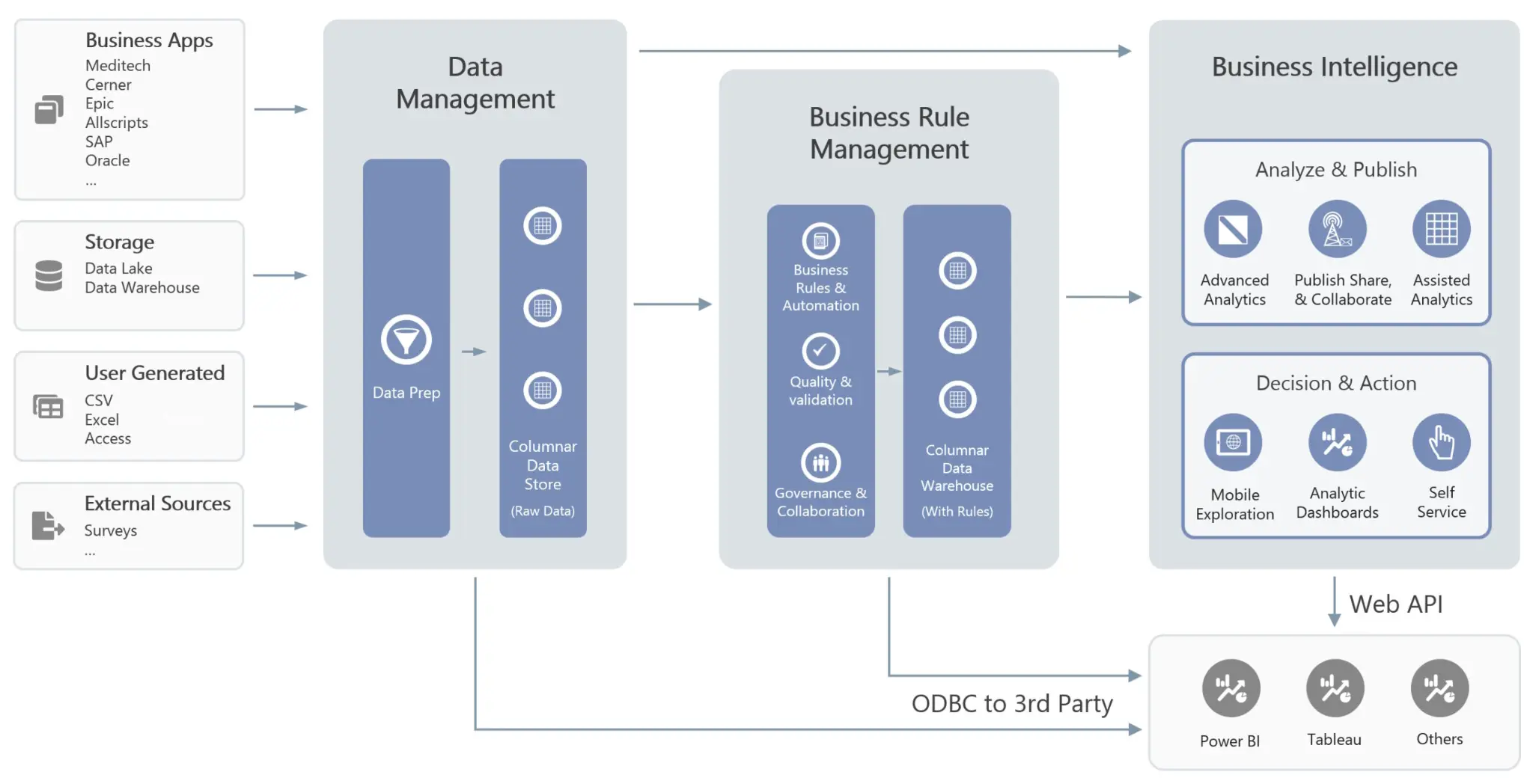
Diver Platform typically sits between your source systems and the analytics experiences your teams use day to day.
- Upstream, it connects to clinical, financial, operational, and external systems.
- In the middle, it standardizes and stores data in Spectre® columnar data sets and applies shared business rules and KPIs through Measure Factory®.
- Downstream, it serves governed content to DivePort®, ProDiver®, DiveTab®, industry Advisor applications, and—where appropriate—other BI tools connected via DI-ODBC.
In many environments, Diver becomes the data and KPI layer that everything else relies on: a single governed foundation that multiple tools can safely use.
Question 3
How does Diver Platform handle data integration and data management?
Data is standardized and stored in Spectre columnar data sets, then organized into reusable dimensions, hierarchies, and measures that can support many different dashboards, reports, and industry applications. The goal is not just “data loaded somewhere,” but a curated model that’s ready for KPIs, analytics, and AI use cases.
Question 4
What is Spectre in Diver Platform?
Spectre is Diver Platform’s high-performance data engine. It uses a columnar database design and in-memory processing to handle large, complex analytical workloads with fast response times.
By storing data in columns instead of rows and minimizing indexing overhead, Spectre can support substantial data volumes in a single structure while remaining efficient to maintain—important for enterprises that need speed and governance at the same time.
Question 5
What is Measure Factory and how does it support KPI governance?
Measure Factory is an optional Diver Platform module that acts as an automated business rules engine for key performance indicators (KPIs).
It provides a central place to:
- Define measures and their underlying rules
- Apply domain-specific logic consistently across data sources
- Track changes to definitions over time and document calculation logic
Because Measure Factory enforces those rules when data sets are built, organizations get a governed set of KPIs they can reuse across dashboards, reports, and applications—reducing debates about “whose numbers are right” and freeing teams to focus on what’s driving performance.
Question 6
How does Diver Platform help create a single source of truth for metrics?
Diver Platform supports a single source of truth by combining:
- Integrated data from across the enterprise and external partners
- Centralized KPI and rules management via Measure Factory, so definitions are specified once and reused
- Governed analytics experiences (DivePort, ProDiver, DiveTab, and industry Advisor applications) that all draw from that same governed layer
That combination means your CFO, operations leaders, and service line owners can all work from the same definitions, rather than maintaining separate spreadsheets and logic on the side.
Question 7
How does Diver Platform integrate with existing tools and BI environments?
Diver Platform can act both as a complete analytics environment and as a governed data source for other tools.
Using the DI-ODBC driver, Spectre data can be queried from ODBC-capable tools such as Excel and third-party BI platforms. That lets you keep a single, trusted KPI and data model in Diver, while still giving teams flexibility to explore that governed data through other visualization tools where appropriate.
Question 8
How does Diver Platform support AI and advanced analytics?
Diver Platform’s primary role in AI projects is to provide the governed data and KPI layer that AI and advanced analytics can rely on. Organizations use Diver to integrate and standardize data, define KPIs centrally, and create a single source of truth that AI models can safely build on.
On top of that foundation, Dimensional Insight offers optional, embedded AI capabilities inside specific applications—for example, forecasting and domain-specific chatbots within components such as Hospital Operations or Emergency Department Advisor. These AI features run in a contained, HIPAA-compliant environment without relying on public Internet access, so insights remain grounded in governed data and regulatory requirements.
Question 9
What deployment options are available for Diver Platform?
Organizations can choose the deployment approach that best fits their regulatory and operational requirements:
- On-premise / customer-hosted: Diver runs in your own environment (or with your hosting provider). Your team administers the stack while benefiting from the integrated platform.
- DI Cloud (Platform as a Service): Dimensional Insight provisions and manages the Diver infrastructure, while your team controls models, measures, and content.
- InterReport (Software as a Service): A fully managed option where Dimensional Insight handles data ingestion, ETL, content creation, and user support; you consume analytics as a service on top of Diver technology.
All options share the same core Diver Platform, so organizations can adjust their hosting strategy over time without changing tools.
Question 10
How does Diver Platform address security and compliance?
Diver Platform includes a security architecture that manages user authentication, role- and group-based access control, and logging.
In healthcare and other regulated settings, this supports compliance requirements by:
- Controlling what data different users and roles can see
- Enforcing row-level security where needed
- Providing an auditable trail of access and key configuration changes
Security is enforced at the platform level, so it applies consistently across DivePort, ProDiver, DiveTab, industry applications, and embedded AI features.
Question 11
Who typically uses Diver Platform?
Diver Platform is used by:
- C-suite and senior leaders who need a trusted, high-level view of performance across service lines, regions, or brands
- Operational leaders and clinicians (for example, hospital operations, ED leadership, supply chain managers, sales leaders) who need near-real-time visibility into their areas
- Analysts and IT teams who build and maintain models, KPIs, and content in Workbench®, ProDiver, and Measure Factory
Industries include healthcare, logistics, beverage alcohol, manufacturing, education, utilities, and other complex environments where decisions rely on accurate, governed data.
Question 12
Who doesn’t need Diver Platform?
- Multiple source systems to reconcile
- A need for governed KPIs across teams or locations
- Regulatory or audit requirements
- Growth, acquisitions, or expansions that make “one clean spreadsheet” unrealistic
Smaller organizations or teams with simpler setups may not need that level of complexity. If most of your questions can be answered from a handful of spreadsheets and you don’t need enterprise-wide governance, a lighter tool can be a better fit.
That’s where Navo comes in—a separate application designed to make spreadsheet life easier, without pivots, formulas, or extra stress. For teams that primarily live in Excel or CSV files and just want clearer views, comparisons, and trends, Navo can be a more natural starting point than a full platform like Diver. You can learn more at https://getnavo.app.
Question 13
We already have Power BI. Why would we also use Diver Platform?
Power BI is excellent at building dashboards and visual stories. Diver Platform is designed to be the governed data and KPI backbone those stories rely on.
Think of it this way:
- Power BI decides how things look. Diver Platform decides what they mean.
Power BI lets teams design rich, interactive reports. Diver Platform defines and applies the rules underneath—how margin is calculated, how readmissions are counted, how depletions are measured—so the numbers stay consistent across departments, sites, and service lines.
- Power BI starts with a blank canvas. Diver Platform starts with industry reality.
Diver Platform ships with industry-ready KPIs and applications (Hospital Operations, Emergency Department Advisor, Revenue Cycle, beverage alcohol analytics, and more). Instead of every team inventing their own metrics in separate Power BI models, Diver gives you a shared, governed starting point.
- Small teams, big complexity.
A small analytics team can use Diver Platform to support complex environments—multiple source systems, acquisitions, expansions, regulatory reporting—without stitching together a stack of separate tools and one-off models. Power BI on its own can handle simpler setups; as complexity grows, you need something to keep the whole picture coherent.
In practice, many organizations use both:
Diver Platform as the data and KPI platform that integrates sources, applies rules in Spectre®, and manages shared measures in Measure Factory®.
Power BI as an additional visualization option for certain audiences, connected to Diver data sets through the DI-ODBC driver so users get familiar visuals backed by a single, governed model.
Which combination you choose depends on your goals, complexity, and team structure. Some organizations are well served by Diver alone as their governed analytics platform. Others use Diver and Power BI together—Diver to make the numbers trustworthy, Power BI to present them in another way.