
Business Intelligence
Revenue Cycle Advisor™
Accelerate Collections. Reduce Write-Offs. Regain Financial Control.
Dimensional Insight’s Revenue Cycle Advisor™ gives hospitals the insight and control they need to manage billing and claims performance, reduce financial leakage, and drive sustainability. Built on a governed, enterprise-ready platform, the solution delivers 100+ pre-built KPIs and dashboards spanning charge capture, reimbursement, denials, and accounts receivable—empowering finance and revenue integrity teams with real-time visibility across the revenue lifecycle.
Business Intelligence
Revenue Cycle Advisor™
Accelerate Collections. Reduce Write-Offs. Regain Financial Control.
Dimensional Insight’s Revenue Cycle Advisor™ gives hospitals the insight and control they need to manage billing and claims performance, reduce financial leakage, and drive sustainability. Built on a governed, enterprise-ready platform, the solution delivers 100+ pre-built KPIs and dashboards spanning charge capture, reimbursement, denials, and accounts receivable—empowering finance and revenue integrity teams with real-time visibility across the revenue lifecycle.
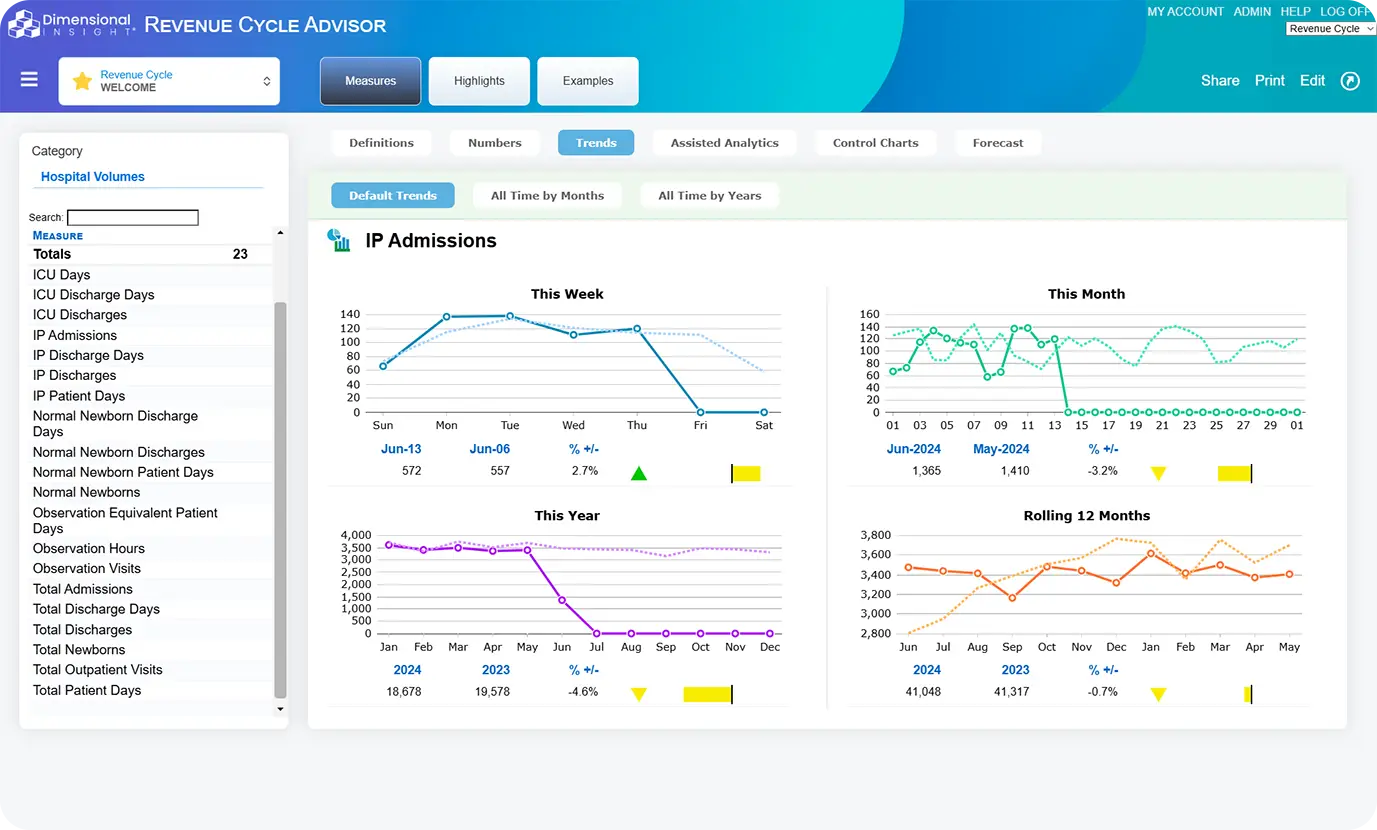
Clarity Across the Entire Revenue Cycle
Fragmented data stalls decision-making and creates blind spots in financial performance. Revenue Cycle Advisor unifies disparate sources into a centralized, governed view so hospital teams can:
Detect late, missing, or inconsistent charges by department or payer
Monitor denial rates by root cause, payer, or category
Analyze unbilled claims, aging ratios, and trial balances
Connect value-based revenue to cost, quality, and outcomes
Empower users with secure, self-service access to detailed, transaction-level data



















Unlock the Full Value of Your Revenue Data
With Revenue Cycle Advisor, you get a purpose-built analytics solution that integrates seamlessly with hospital billing, claims, and EHR systems. You can pinpoint patterns that affect collections, proactively manage denials, and uncover revenue leakage before it impacts margins.
Root-cause insight into denials and underpayments
Transparent reporting across the revenue lifecycle
Pre-configured dashboards to speed time-to-value
Role-based access for finance, compliance, and exec teams
Key Strategic Benefits
Accelerate collections
By identifying and resolving billing delays and underpayments
Reduce write-offs
By monitoring denial patterns and missing charges in real time
Gain full-cycle visibility
With 100+ KPIs across reimbursement, revenue integrity, and A/R
Empower decision-makers
With intuitive, self-service dashboards and drill-down analytics
Support value-based care
By connecting revenue data with clinical and outcomes measures
Shorten time-to-insight
With fast implementation and seamless integration into your workflows
What You Can Track and Manage (Selected Examples)
Below is a representative sample—not a comprehensive list.
Hospital Receivables
Bad Debt Balance
Unbilled % Total AR Balance
Uncoded Balance
AR Bal 0-30 D
AR Insurance Balance
Hospital Adjustments
Charity % Net Pat Svcs Rev
Contractual Adjustments
Gross Pat Svcs Rev
Late Charges Amount
Inpatient Charges
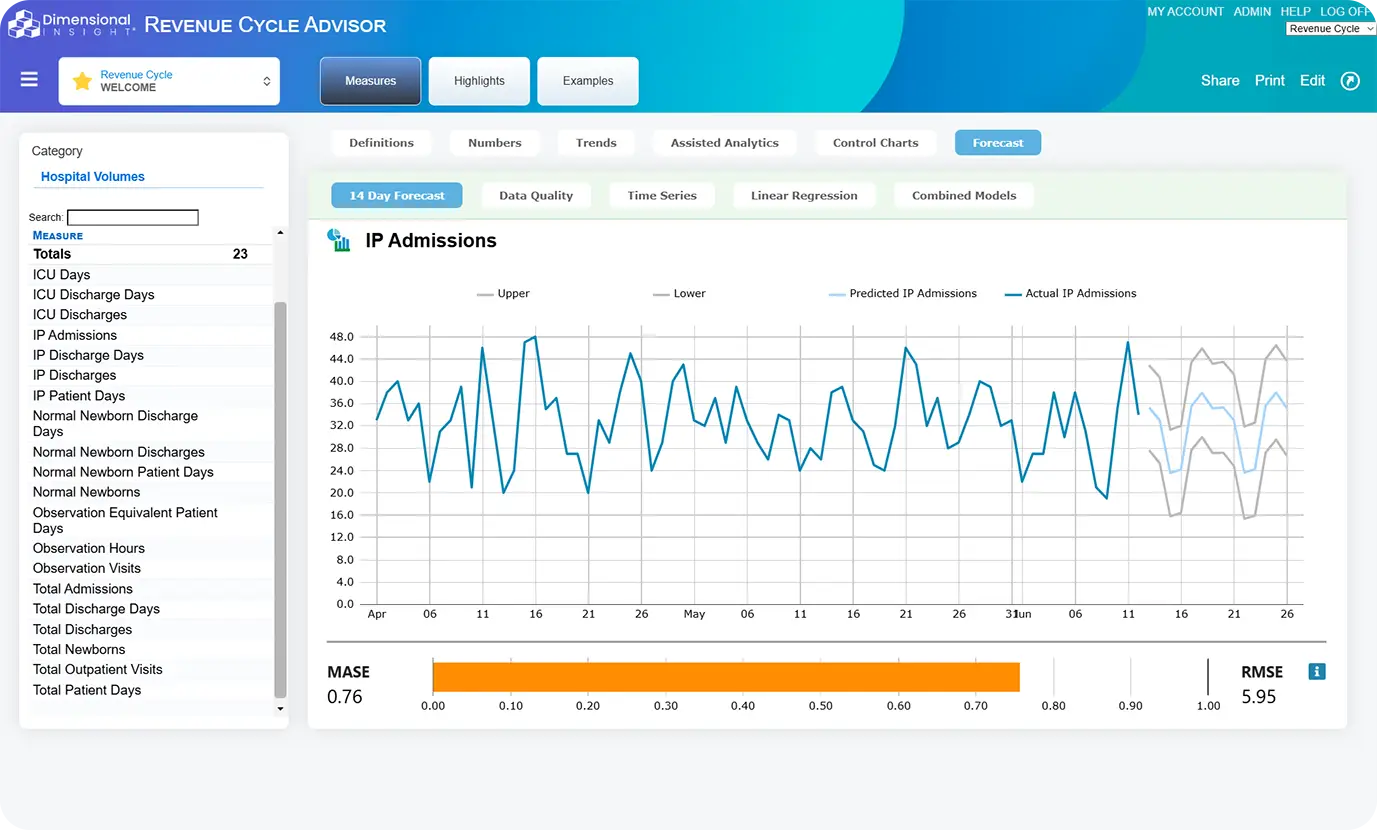
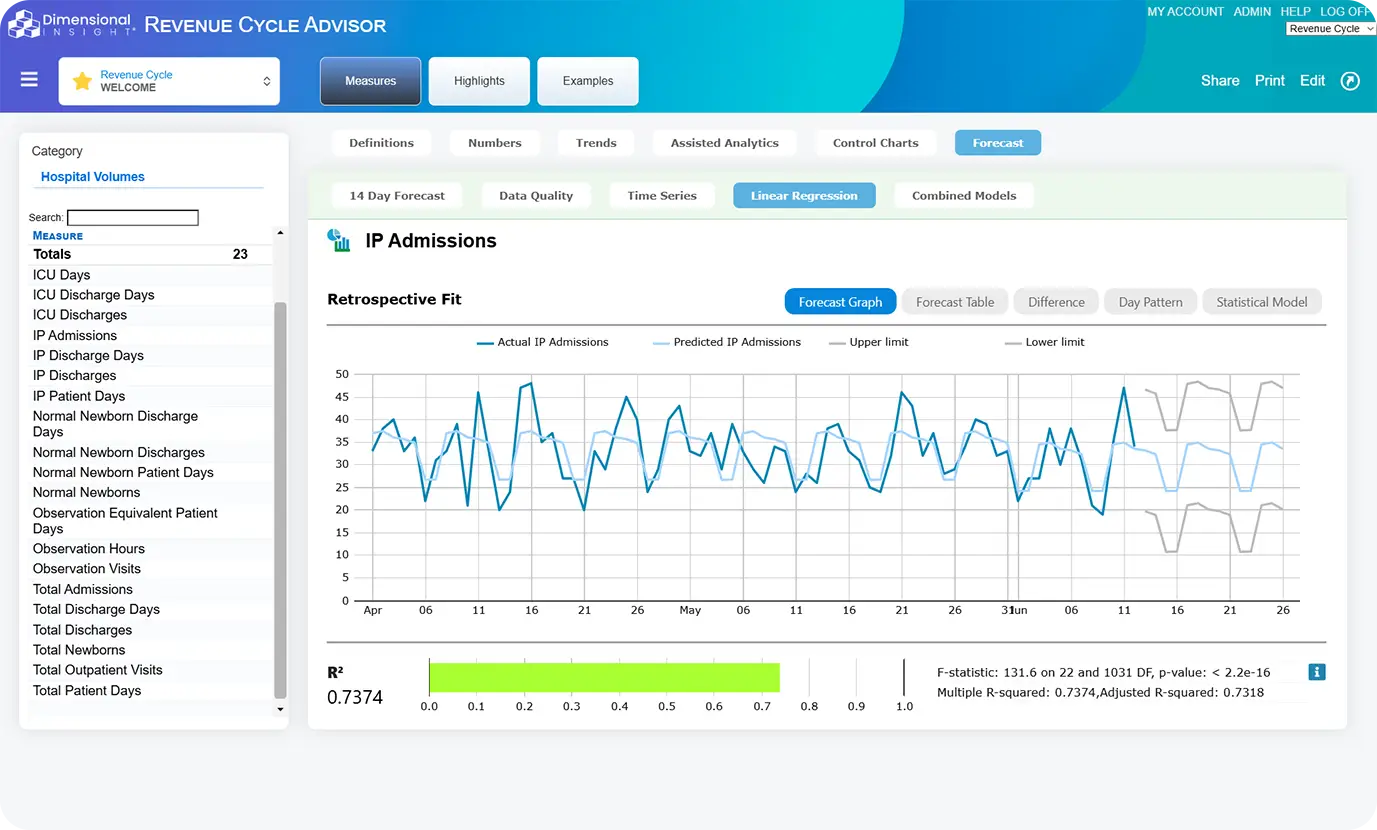
Hospital Volumes
Acute Admissions
ICU Discharge Days
Normal Newborn Discharges
Observation Hours
Total Patient Days
Frequently Asked Questions
Revenue Cycle Analytics — Answered
Common questions from CFOs, VPs of Revenue Cycle, billing leaders, and revenue integrity teams evaluating or implementing Revenue Cycle Advisor.
Revenue Cycle Advisor is Dimensional Insight's purpose-built analytics solution for hospital revenue cycle teams — CFOs, VPs of Revenue Cycle, billing managers, denial directors, and revenue integrity leaders. It runs on Diver Platform and ships with 100+ pre-built KPIs and dashboards spanning charge capture, reimbursement, denials, and accounts receivable. Where generic finance reporting shows aggregated numbers, Revenue Cycle Advisor connects them back to the encounter, the claim, and the payer — so teams can move from describing a number to investigating its root cause. It's designed for hospitals and health systems that need real-time visibility into revenue lifecycle performance, not just monthly retrospective reports.
Generic finance reporting was built for sales-and-margin businesses; healthcare revenue cycle is contract-driven, payer-specific, and entangled with clinical documentation. Revenue Cycle Advisor ties governed revenue cycle KPIs — denials, days in A/R, charge-capture lag, contractual variance — back to the encounter, the bill, and the general ledger, so finance leaders can investigate root cause rather than describe a number. Denial trends, charge lags, payer-mix shifts, and underpayments surface in real time, not weeks after month-end close. General ERP or BI tools can display revenue cycle numbers, but they leave the healthcare-specific KPI logic and payer complexity to your team to build.
Revenue Cycle Advisor ships with more than 100 pre-built KPIs covering the full revenue lifecycle. Charge capture and revenue integrity KPIs include late charges, missing charges, uncoded balances, and charge lag by department. Reimbursement KPIs include expected vs. actual reimbursement, contractual variance, and payer-specific underpayment detection. Denial KPIs include denial rate by category (eligibility, authorization, timely filing, coding), root-cause tracking, and denial write-off likelihood. Accounts receivable KPIs include AR aging buckets, days in A/R, unbilled AR, and payer-mix analysis. All KPIs are governed through Measure Factory, so definitions stay consistent across dashboards, reports, and downstream applications.
Denial prevention starts with three shifts — from reporting denials retrospectively, to organizing them by financial impact as they come in, to predicting them before they occur. Revenue Cycle Advisor supports all three. It categorizes denials by fully-adjudicated write-off likelihood (not raw volume), so teams focus on where the dollars are — typically eligibility, authorization, and timely filing. Governed KPIs feed pattern analysis across CPT codes, providers, and payers to surface non-obvious denial drivers. Predictive workflows can flag at-risk claims before submission and route them to the right team. Beacon Health System, an 11-hospital integrated delivery network on Cerner, uses this approach to prevent revenue loss before it occurs — moving from descriptive reporting to prescriptive action.
A well-designed timely-filing workflow puts risk in the hands of leaders every morning, with the underlying data one click away for billers. Revenue Cycle Advisor supports this with dashboards that score balances by proximity to timely-filing limits, sort by financial impact, and surface exceptions before revenue is lost. Billing managers review the leader summary and disperse prioritized accounts to their teams; billers see their assigned accounts with all supporting detail. The workflow replaces generic EHR work queues (which contain thousands of encounters with no prioritization) with a daily prioritized list of accounts that actually need attention. The result: prevention before write-off, not remediation after.
In most hospital EHR systems, revenue cycle activity happens at the balance level while expected reimbursement lives at the claim level. Revenue Cycle Advisor bridges this by bringing expected reimbursement to the balance level so it trickles down to all claims. Once claim-level payments can be compared to contracted expected reimbursement, two categories of variance become visible: underpayments (paid less than expected) and payer errors (paid what was expected but posted a denial that stopped the billing cycle). Both are recovered through Revenue Cycle Advisor's variance workflows. Accounts meeting variance thresholds can be passed to automation platforms for contractualization, continuing the billing cycle without manual intervention.
Yes. Revenue Cycle Advisor identifies the accounts; RPA bots execute the action in the source system. Diver Platform's Flow Scripts and plugins can pass qualifying accounts — underpayments, payer errors, contractual variances — to RPA platforms that then go into the EHR to contractualize accounts and push remaining responsibility to secondary or tertiary payers. The billing cycle keeps moving without manual clicks, and Revenue Cycle Advisor gives the team visibility into which payers are triggering these workflows most often. Beacon Health System runs this pattern in production, with Diver Platform handling the "what and why" and RPA bots handling the "how many times."
Prioritize by fully-adjudicated write-off likelihood, not by volume. Four denial categories consistently produce the highest write-off risk after full adjudication: eligibility, authorization, timely filing, and coding-related denials. Eligibility and authorization are typically the highest-value prevention targets because they can be caught pre-service, before the encounter generates a claim. Timely filing is high-value because the write-off is often 100%. Coding-related denials benefit from CPT-and-provider-and-payer pattern analysis. Revenue Cycle Advisor supports all four with pre-built KPIs and dashboards. Start where the write-off dollars are, not where the queue volume is — that's where the platform pays for itself fastest.
Revenue Cycle Advisor combines denial category, timely-filing proximity, authorization status, eligibility status, and dollar value into a composite priority score, then routes the top-priority accounts to the right person daily. This replaces the "which report do I work?" confusion when multiple managers send conflicting queues. Billers stop scanning thousands of encounters and start on the accounts with the highest financial impact. Measure Factory generates the score against governed measures; DivePort surfaces the daily prioritized list to each biller and their manager. The workflow is repeatable, auditable, and adjustable as denial patterns or payer behavior shifts.
Revenue Cycle Advisor connects to the major hospital EHR systems — Epic, Cerner (Oracle Health), MEDITECH, and others — pulling encounter, charge, claim, denial, and AR data into Diver Platform's governed foundation. From there, the same governed measures feed both Revenue Cycle Advisor dashboards and any downstream tools connected via the DI-ODBC driver. Because the platform sits between source systems and analytics experiences, teams get one consistent view of revenue cycle performance regardless of which EHR or ERP the data originally lived in. Deployment supports on-premise, DI Cloud, or InterReport SaaS — with HIPAA-aligned configurations across all three.
Learn more
Diver Platform Architecture & Governance FAQ
Technical detail on how Diver Platform fits into your architecture — Spectre engine, Measure Factory, deployment options, security, and Power BI integration. →
Healthcare Analytics FAQ
Broader context on how Dimensional Insight supports hospital operations, clinical outcomes, and financial performance across the Healthcare Library of Applications. →
Healthcare Analytics Overview
Explore the full Healthcare Library — Emergency Department Advisor, Hospital Operations Advisor, ICU Advisor, and more. →
See Revenue Cycle Advisor in Action
Explore dashboards that help you track billing performance, denial trends, and financial leakage—so you can improve margins and accelerate collections.